
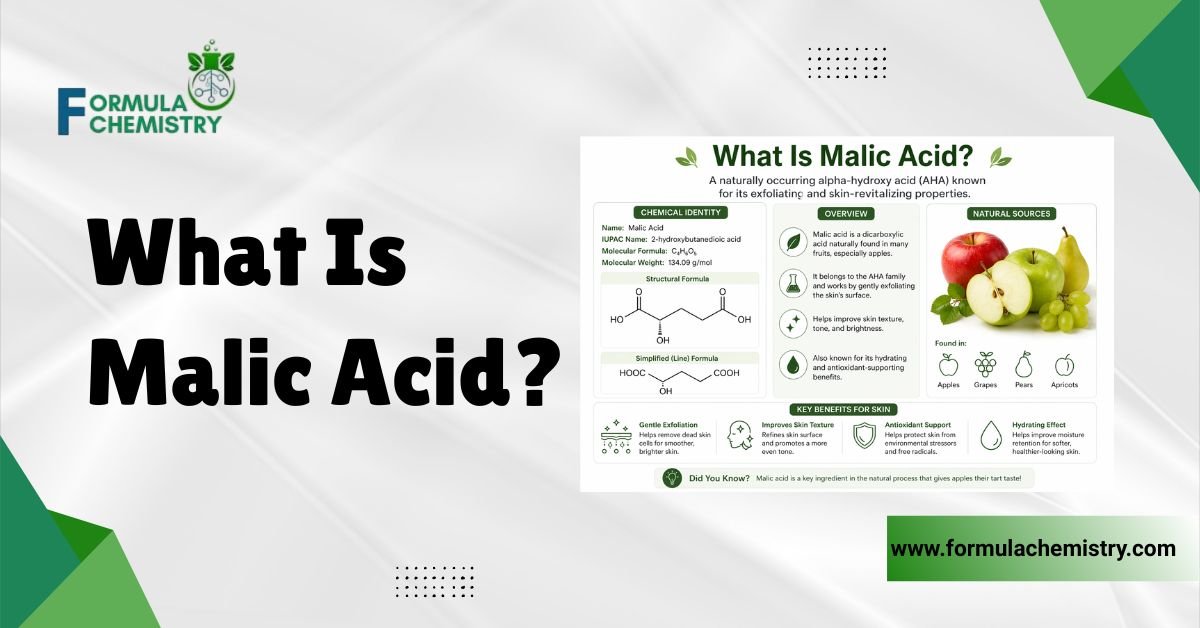
What Is Malic Acid and Why Do Formulators Keep Reaching for It?
Most formulators discover malic acid after a client complaint about glycolic being too harsh. That is usually the moment the penny drops. Malic acid is a naturally occurring alpha hydroxy acid found in apples, grapes, and stone fruits, and it sits in a formulation sweet spot that very few AHAs occupy: genuinely effective exfoliation with a significantly lower irritation ceiling than the acids dominating the market.
At Formula Chemistry, we see it misunderstood in two directions. Some formulators treat it as a weak, second-choice AHA. Others overload it into formulas without understanding its pH requirements. This guide covers what malic acid actually is, what it does in a formula, and how to use it correctly from day one.
What Is Malic Acid in Skincare?
Malic acid is a dicarboxylic alpha hydroxy acid derived primarily from apples and other fruits, used in cosmetic formulas as an exfoliant, pH adjuster, and mild humectant. It works by loosening the bonds between dead skin cells at the surface, encouraging natural shedding and improving the appearance of skin texture over time.
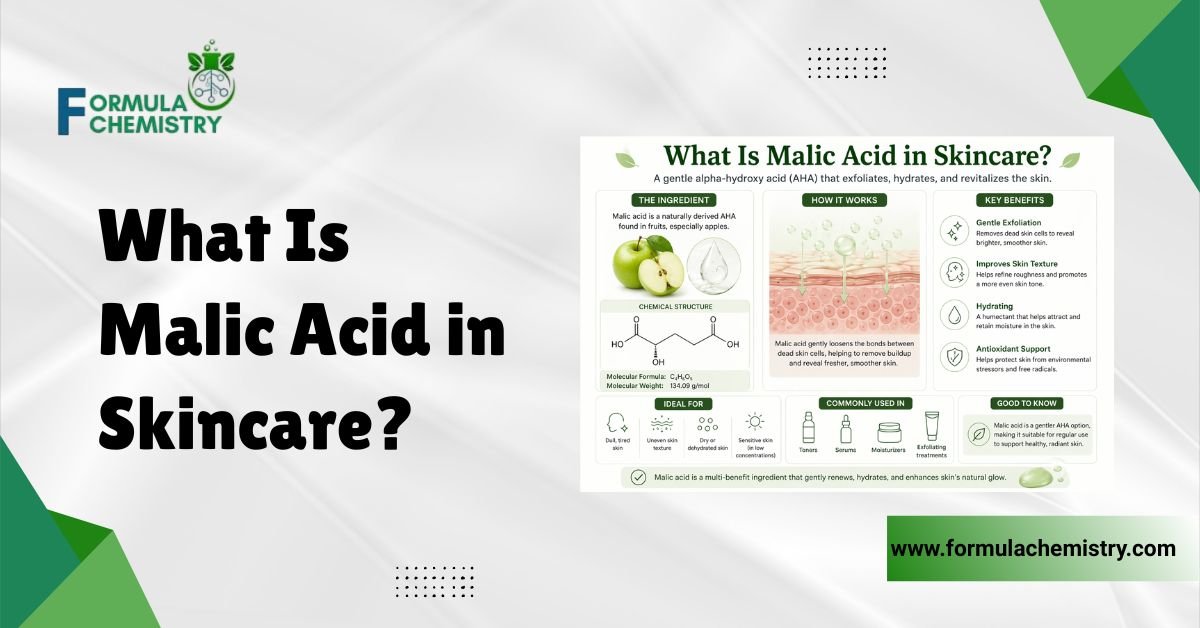
Its larger molecular size compared to glycolic acid makes it slower to penetrate and better tolerated in leave-on formats. Effective use requires a finished formula pH between 3.5 and 4.5.
What Is Malic Acid Made Of? Chemistry and Origin
Malic acid carries the INCI name Malic Acid and CAS number 6915-15-7. Its molecular formula is C4H6O5 with a molecular weight of 134.09 g/mol. It belongs to the dicarboxylic acid subclass of alpha hydroxy acids, meaning it carries two carboxyl groups on the same carbon chain rather than the single carboxyl group found in glycolic or lactic acid.
It occurs naturally in apples, cherries, tomatoes, and grapes, where it contributes to tartness and flavour. Commercially, malic acid used in cosmetic formulations is produced via chemical synthesis through hydration of maleic or fumaric acid, which yields a racemic mixture of L-malic and D-malic acid. The L-form is the naturally occurring isomer found in fruit.
This dicarboxylic structure is directly responsible for malic acid’s gentler penetration behaviour. Two carboxyl groups create a more polar, larger molecule that moves through the stratum corneum more slowly than monocarboxylic AHAs. For formulators, that means a reduced risk of over-exfoliation at equivalent concentrations.
What Is Malic Acid Used For in Cosmetic Formulas?
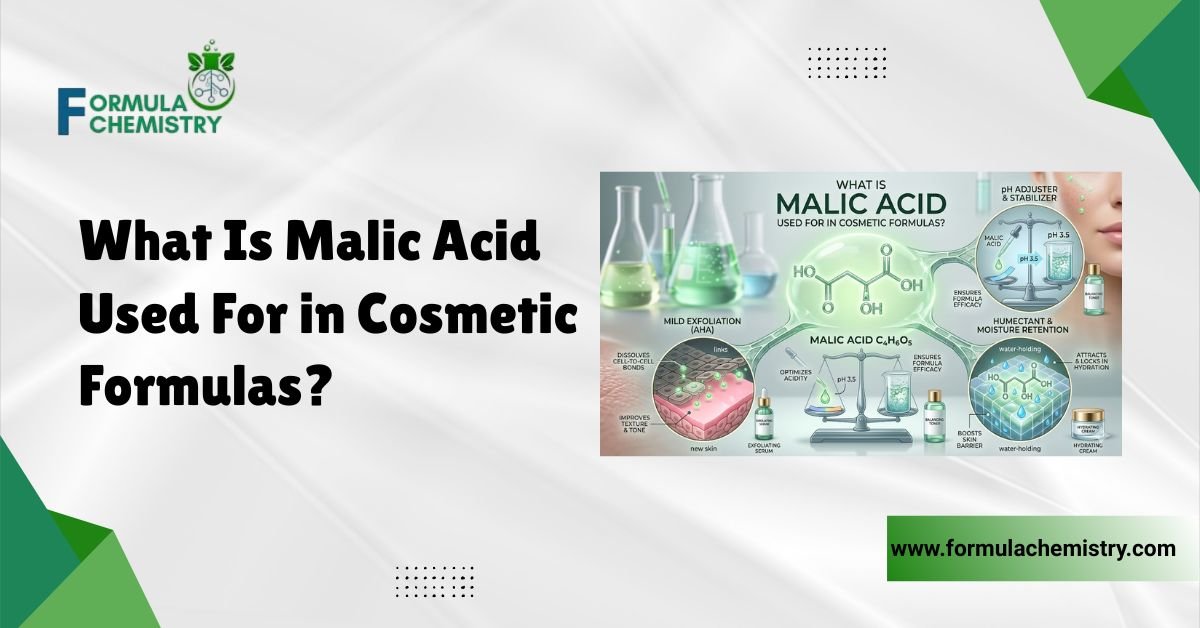
Malic acid serves three distinct functions in a cosmetic formula, and understanding all three prevents the common mistake of treating it as a single-purpose ingredient.
Malic Acid as an AHA Exfoliant
Its primary function is surface exfoliation. Malic acid disrupts corneodesmosomes, the structural protein complexes that bind corneocytes together in the outermost layer of the stratum corneum. When these bonds weaken, dead cells shed more evenly and completely, which can improve the appearance of skin texture, tone, and surface clarity over consistent use.
Effective exfoliant activity requires a formula pH between 3.5 and 4.5. Above pH 5.0, the acid is largely neutralised and exfoliant activity drops to negligible levels. This is the most common misapplication Formula Chemistry sees in submitted formulas: malic acid added at a reasonable percentage but formulated at a skin-friendly pH that renders it functionally inert.
Malic Acid as a pH Adjuster
At lower concentrations, typically below 1%, malic acid functions as a pH-adjusting acid in formulas where the goal is not exfoliation but gentle acidification. It is sometimes preferred over citric acid in this role because it contributes a slightly smoother sensory profile and is less likely to cause chelation side effects in formulas with metal-sensitive ingredients.
Malic Acid as a Humectant
Malic acid carries mild humectant properties. It is not a primary humectant in the way glycerin or sodium PCA are, but at working concentrations it contributes to water retention at the skin surface. This secondary humectancy is one reason malic acid skincare formulas often feel less drying than glycolic acid formulas at comparable pH levels.
Malic Acid Benefits for Skin: What the Chemistry Actually Supports
Formulators should be precise about what the chemistry supports and what remains in marketing territory. These are the malic acid benefits for skin that are grounded in its known mechanisms:
- Surface exfoliation through corneodesmosome disruption, leading to improved texture appearance with consistent use
- Mild humectancy contributing to surface water retention in the stratum corneum
- pH adjustment that supports the skin’s natural acid mantle environment in low-concentration applications
- Improved skin tone appearance over time as uneven pigmentation at the surface sheds more consistently
- Compatibility with a leave-on format at 2 to 4%, making it accessible for daily-use moisturisers and serums where stronger AHAs would require rinse-off application
Formulation Considerations for Malic Acid Skin Care Products
Ideal pH Range
Active exfoliation requires a finished formula pH of 3.5 to 4.5. For maximum AHA activity in a leave-on product, target 3.5 to 4.0. For rinse-off applications or formulas targeting sensitive skin, 4.0 to 4.5 is a more appropriate range. Above pH 5.0, malic acid is functionally inactive as an exfoliant regardless of concentration.
Solubility and Phase Addition
Malic acid is freely soluble in water and should always be added to the water phase or as a pre-dissolved aqueous solution in the cool-down phase. At concentrations above 5%, pre-dissolving in a small volume of warm water before adding to the batch prevents graininess and ensures even distribution throughout the formula.
Compatibility and Incompatibilities
Malic acid is compatible with most cosmetic emulsifiers, humectants, and film formers when the formula pH is correctly set. It is incompatible with ingredients that require a pH above 6.0 to remain stable, including certain preservatives like sodium benzoate in isolation.
Some botanical extracts, and protein-based film formers that denature at low pH. Niacinamide can be used alongside malic acid but requires careful pH monitoring as the combination can produce niacin conversion and cause flushing in some users.
Typical Usage Levels
- Leave-on exfoliant creams and serums: 2 to 4%
- Rinse-off treatments and masks: 4 to 8%
- pH adjustment applications: 0.1 to 0.5%
- Combined AHA blends with glycolic or lactic acid: 1 to 2% malic as supporting acid
Common Malic Acid Formulation Mistakes and How to Fix Them
- Formulating at pH 5.5 or above because it feels safer renders malic acid completely inactive as an exfoliant. The acid must sit below pH 4.5 to function. Recheck pH with a calibrated meter and adjust with lactic acid or sodium hydroxide solution as needed.
- Adding dry malic acid powder directly to a finished emulsion causes uneven distribution and localised pH spikes that destabilise the emulsion. Always pre-dissolve in distilled water before adding to the batch.
- Treating malic acid as interchangeable with glycolic acid at the same concentration ignores the difference in molecular weight and penetration rate. A malic acid serum at 4% behaves differently from a glycolic serum at 4% and should be assessed independently.
- Skipping preservative challenge testing because the low pH “feels protective” is a formulation error. Low pH reduces but does not eliminate microbial risk, particularly from moulds and yeasts that tolerate acidic environments.
- Using an emulsifier system not rated for low-pH stability in an AHA cream. Many common emulsifiers destabilise below pH 4.5. Always confirm pH tolerance with your supplier before finalising the formula architecture.
Suitability Guide for Malic Acid Skincare Formulas
Malic acid is well suited to normal, combination, dull, oily, and mildly congested skin types. Its slower penetration profile makes it one of the more accessible AHAs for skin that has shown sensitivity to glycolic acid in the past.
Formulators should approach with caution for clients with active rosacea, eczema, or post-procedure skin. The low pH required for activity is incompatible with a compromised or highly reactive skin barrier. Beginners to AHA formulation should start at 2% with a pH of 4.0 to 4.5 before moving to higher concentrations or lower pH values.
Always conduct a 48-hour patch test with any new formula before wider use.
FAQ’s about What Is Malic Acid and How Does It Work?
What is malic acid good for in a cosmetic formula?
Malic acid is most valuable as a leave-on AHA exfoliant in moisturisers, serums, and treatment creams where gentler exfoliation is the brief. It suits formulators building products for sensitive or AHA-naive skin types who need real acid activity without the irritation ceiling of glycolic acid.
At sub-exfoliant concentrations it also functions as a pH adjuster, making it a versatile supporting ingredient across product types.
Is malic acid bad for you or does it cause serious side effects?
Malic acid is not bad for you when used within cosmetically appropriate concentration and pH parameters. Malic acid side effects at working levels are generally limited to mild tingling or temporary surface redness during early use.
Which typically resolves within one to two weeks as skin acclimatises. Sustained irritation, visible peeling, or barrier disruption indicates the formula pH is too low or the concentration too high for that individual. Formulators should always include a usage advisory on leave-on AHA products.
What is malic acid in skincare versus other AHAs?
Malic acid sits between glycolic and mandelic acid on the gentleness scale within the AHA family. It is more effective than mandelic at equivalent concentrations but less aggressive than glycolic due to its larger molecular size and slower penetration rate.
Formula Chemistry positions it as the preferred AHA for leave-on daily-use formulas where long-term skin tolerance matters as much as immediate exfoliation performance.
How do you use malic acid on skin correctly as a formulator?
Use malic acid at 2 to 4% in leave-on formulas, pre-dissolved in water, and added at cool-down after emulsification is complete. Set the final pH to 3.5 to 4.0 using a calibrated pH meter.
Always complete preservative challenge testing before commercial release and include a sunscreen advisory on the finished label, as all AHA products increase photosensitivity regardless of concentration.
Key Takeaways for Formulators
- Malic acid is a dicarboxylic AHA with a molecular weight of 134.09 g/mol, making it slower to penetrate and better tolerated in leave-on formats than glycolic or lactic acid at equivalent concentrations.
- Active exfoliation requires a finished formula pH of 3.5 to 4.5. Above pH 5.0, malic acid is functionally inactive regardless of the percentage used.
- It serves three roles in a formula: AHA exfoliant, pH adjuster, and mild humectant. Understanding which role applies to your formula changes how you dose and position the ingredient.
- Malic acid side effects at working concentrations are mild and temporary in most users. Persistent irritation is a formulation problem, not an ingredient problem.
- Formula Chemistry recommends starting at 2% with a pH of 4.0 for first-time AHA formulators before increasing concentration or lowering pH toward 3.5.
- Build your next formula with malic acid as the sole AHA, run a proper accelerated stability test, and only then consider layering it with a second acid for enhanced activity.