
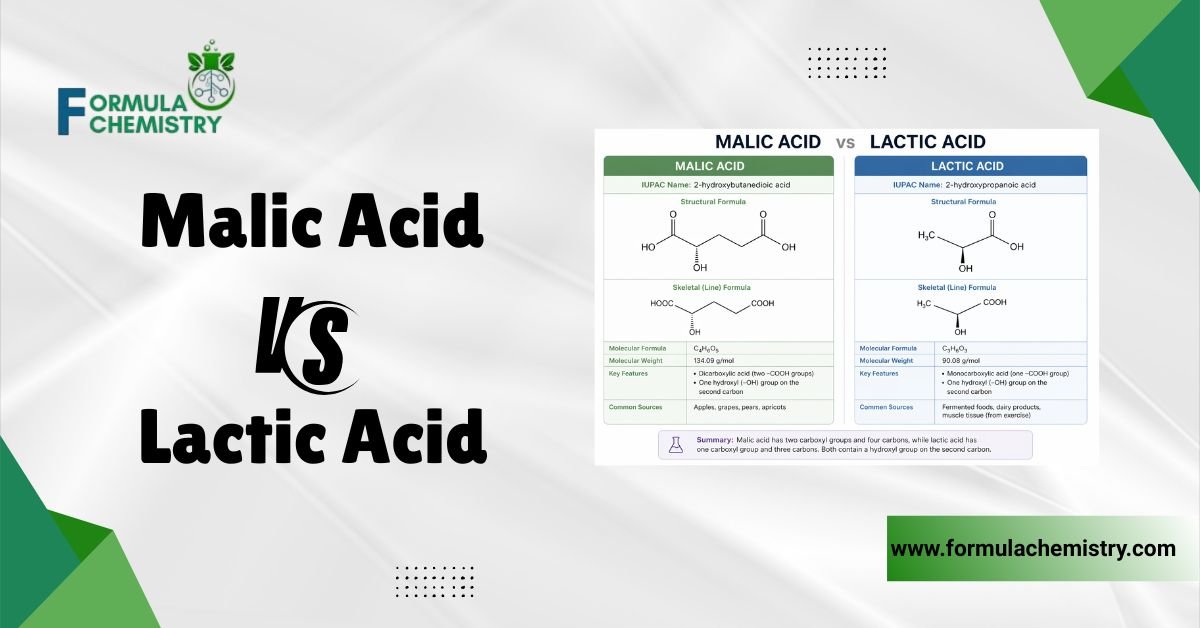
Malic Acid vs Lactic Acid: The Choice That Defines Your Entire Formula
Picking the wrong AHA for a formula is not a minor error. It affects pH architecture, emulsifier selection, preservation strategy, skin feel, and ultimately whether the product delivers on its claims.
The malic acid vs lactic acid decision comes up constantly in formulation work, and yet most guidance on the topic stays surface-level, comparing molecular weights without explaining what that actually means at the bench.
At Formula Chemistry, this is one of the most common questions we receive from brand owners and independent formulators alike. This guide gives you the full technical picture so you can make the right call for your specific formula brief, skin type target, and product format before you weigh a single ingredient.
Malic Acid vs Lactic Acid at a Glance
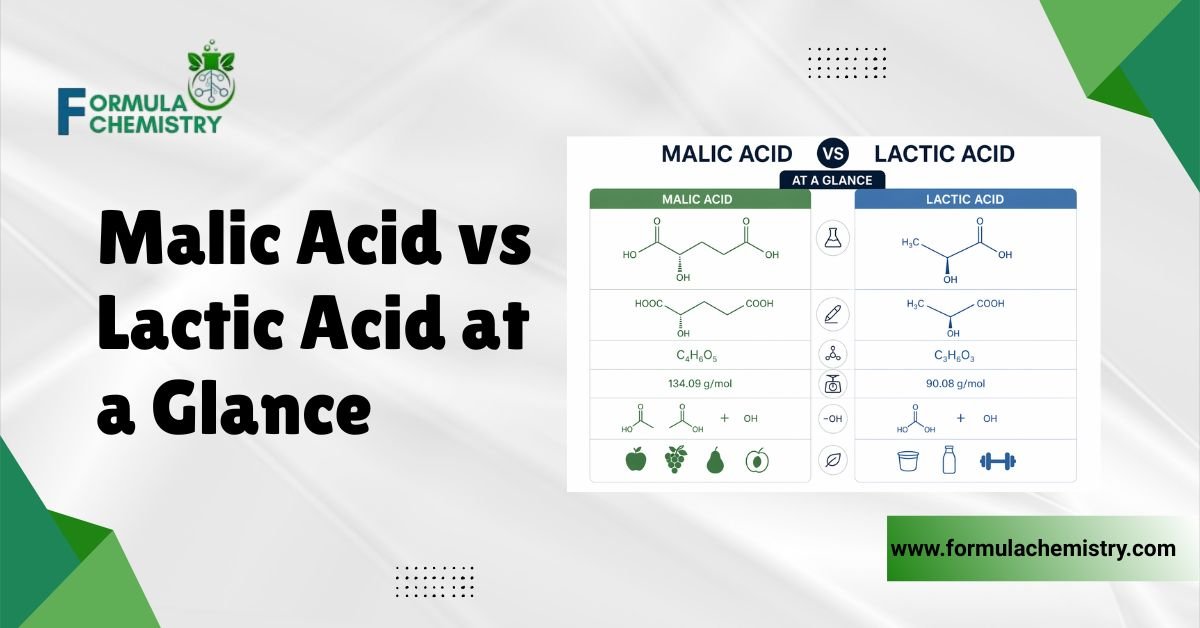
Malic acid and lactic acid are both alpha hydroxy acids used for surface exfoliation in cosmetic formulas, but they differ in molecular size, penetration rate, humectant activity, and tolerated concentration. Lactic acid is a monocarboxylic AHA with stronger humectant properties and faster skin penetration.
Malic acid is a dicarboxylic AHA with slower penetration and a lower irritation ceiling, making it better suited to leave-on daily-use formulas for sensitive or AHA-naive skin. Neither acid is universally superior. The right choice depends entirely on the formula brief.
Understanding the Two Acids: Chemistry First
Before comparing performance, the chemistry has to be clear. These are not interchangeable ingredients with minor differences. They belong to the same acid family but behave differently at the molecular level in ways that matter directly to formulation outcomes.
Lactic acid carries the INCI name Lactic Acid and CAS number 50-21-5. It is a monocarboxylic alpha hydroxy acid with a molecular formula of C3H6O3 and a molecular weight of 90.08 g/mol. It is produced commercially via fermentation of carbohydrates and occurs naturally in milk, fermented foods, and the skin’s own natural moisturising factor. The L-isomer is the skin-identical form and the one used in cosmetic formulation.
Malic acid carries the INCI name Malic Acid and CAS number 6915-15-7. It is a dicarboxylic alpha hydroxy acid with a molecular formula of C4H6O5 and a molecular weight of 134.09 g/mol. It occurs naturally in apples, grapes, and stone fruits. Commercially it is produced via hydration of maleic or fumaric acid, yielding a racemic mixture of L and D isomers.
The structural difference is the key formulation variable. Lactic acid carries one carboxyl group. Malic acid carries two. That second carboxyl group increases polarity, raises molecular weight, and slows the rate at which the molecule moves through the stratum corneum. Everything that follows in this comparison flows from that single chemical difference.
Penetration Rate and Exfoliation Intensity
Lactic acid at 90.08 g/mol penetrates the stratum corneum faster than malic acid at 134.09 g/mol. Faster penetration means more immediate exfoliant activity, which is an advantage in rinse-off formats and treatment products designed for experienced AHA users. It also means a higher risk of irritation in leave-on formulas, particularly on sensitised or reactive skin.
Malic acid’s slower penetration translates directly into a more controlled exfoliation response. The corneodesmosome disruption still occurs, dead cells still shed, and texture improvement still accumulates over consistent use. The difference is that the process happens more gradually with less surface reactivity in the short term.
For a leave-on daily moisturiser targeting normal to sensitive skin, malic acid’s penetration profile is the safer architectural choice. For a weekly treatment mask or a professional-use peel where intensity is the brief, lactic acid’s faster action is the more appropriate tool. Formula Chemistry consistently recommends matching penetration rate to product format rather than chasing the strongest available acid.
Humectant Activity: Where Lactic Acid Has a Clear Advantage
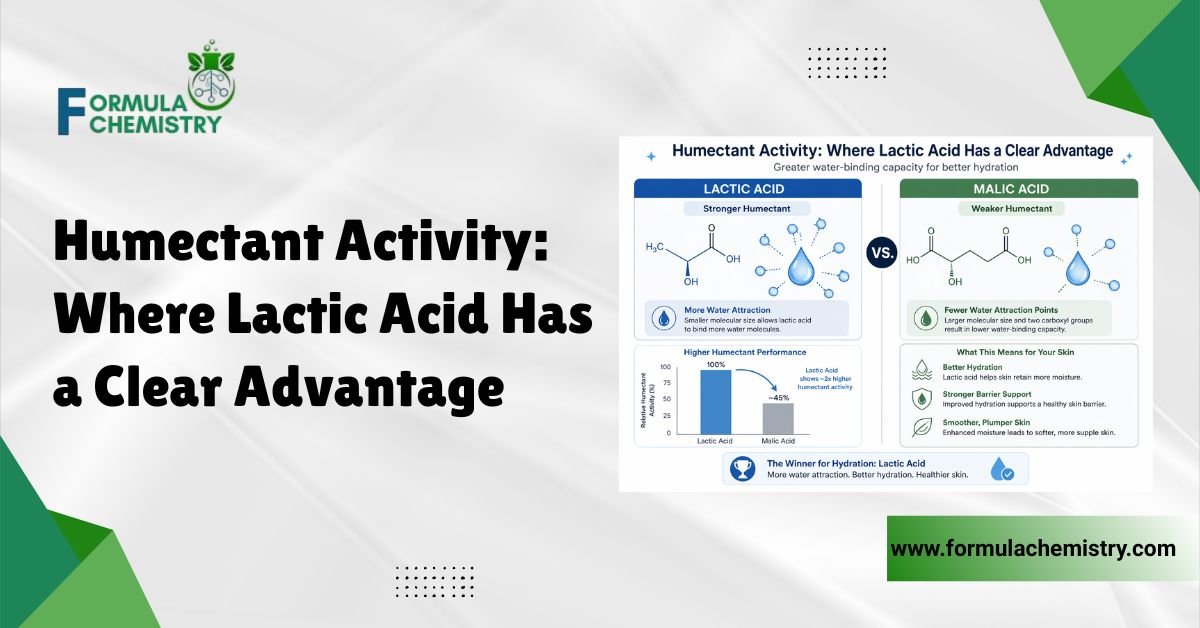
This is the area where lactic acid holds a genuine formulation edge. Lactic acid is a well-documented humectant as well as an exfoliant. It is structurally similar to components of the skin’s natural moisturising factor and draws water into the stratum corneum while simultaneously exfoliating the surface.
This dual function makes it particularly valuable in formulas targeting dry, dehydrated, or mature skin where barrier support and exfoliation are both required.
Malic acid has mild humectant properties but does not match lactic acid’s water-binding capacity. In a malic acid formula, the humectant gap is typically filled by glycerin, sodium PCA, or sodium hyaluronate added separately. In a lactic acid formula, the acid itself contributes meaningfully to the overall humectant system, which can simplify the formula architecture and reduce the total number of ingredients required.
If the skin type target is dry or dehydrated, lactic acid earns its place on both counts. If the target is oily, combination, or congested skin where heavy humectancy is not the priority, the humectant advantage of lactic acid is less decisive and malic acid becomes a more straightforward choice.
pH Requirements and Formula Architecture
Both acids require a finished formula pH below 4.5 for meaningful exfoliant activity. The practical working range for leave-on products is 3.5 to 4.0 for maximum activity and 4.0 to 4.5 for sensitive skin applications. Above pH 5.0, both acids are functionally inactive as exfoliants regardless of concentration used.
Where they differ is in how aggressively each acid drops the formula pH during production. Lactic acid, particularly in its 80 to 90% liquid concentrate form, is a potent acidifier and can push a formula pH down sharply if added without careful incremental dosing.
Malic acid in a 50% aqueous solution is easier to control during pH adjustment and gives the formulator more room to fine-tune before overshooting the target.
This makes malic acid a more forgiving ingredient for formulators earlier in their practice. Lactic acid demands more precision in the pH adjustment phase. At Formula Chemistry, we advise all new formulators to work with malic acid first when building their first AHA formula, then transition to lactic acid once pH adjustment discipline is established.
Typical Usage Levels by Product Format
Understanding where each acid operates within standard industry ranges prevents the two most common concentration errors: under-dosing for no effect and over-dosing past the safety threshold for leave-on products.
For lactic acid:
- Leave-on exfoliant serums and creams: 2 to 5%
- Rinse-off treatments and masks: 5 to 10%
- pH adjustment applications: 0.1 to 0.5%
For malic acid:
- Leave-on exfoliant serums and creams: 2 to 4%
- Rinse-off treatments and masks: 4 to 8%
- pH adjustment and supporting AHA in blends: 0.5 to 2%
Neither acid should exceed these ranges in a leave-on retail product without a qualified safety assessor reviewing the formula. The EU Cosmetics Regulation and FDA both flag high-concentration AHA leave-on products for additional safety scrutiny.
Skin Type Suitability: Matching the Acid to the Brief
Choosing between malic acid and lactic acid becomes straightforward once the target skin type is defined clearly.
Lactic acid suits dry, dehydrated, mature, and normal skin types where the combined exfoliant and humectant function earns its place. It is also appropriate for hyperpigmentation-focused formulas where the faster penetration rate supports more visible results in a shorter timeframe.
Malic acid suits sensitive, combination, oily, congested, and AHA-naive skin types where the priority is consistent gentle exfoliation without a high risk of surface reactivity. It is the better entry point for consumers new to acid skincare and for brand owners targeting a broad demographic without a specific skin concern focus.
Both acids are unsuitable for active rosacea, eczema flares, or post-procedure skin without dermatologist guidance. The low pH required for AHA activity is incompatible with a compromised skin barrier regardless of which acid is used.
Always conduct a 48-hour patch test with any new formula before wider use.
Common Mistakes When Choosing Between These Two AHAs
- Selecting lactic acid for a sensitive skin formula because it is “natural” ignores the fact that faster penetration increases irritation risk regardless of origin. Natural does not mean gentle at equivalent pH and concentration.
- Using malic acid at the same percentage as lactic acid without accounting for the difference in molecular weight and activity level. Malic acid at 4% and lactic acid at 4% are not equivalent in exfoliation intensity.
- Formulating either acid above pH 5.0 and expecting exfoliant results. pH is not a minor variable. It is the on-off switch for AHA activity in any formula.
- Skipping humectant support in a malic acid formula because the acid “has some humectancy.” Malic acid’s water-binding capacity is mild and insufficient on its own for a leave-on product. Always pair it with a dedicated humectant system.
- Combining both acids in a single formula without reducing individual concentrations. When blending malic and lactic acid, the total AHA load matters. Each acid contributes to cumulative exfoliation intensity and the combined pH effect.
FAQ about Malic Acid vs Lactic Acid for Cosmetic Formulation
Which is stronger, malic acid or lactic acid, at the same concentration?
Lactic acid is the stronger exfoliant at equivalent concentrations due to its smaller molecular size and faster penetration rate through the stratum corneum. At 3% in a leave-on formula, lactic acid will produce a more immediate surface response than malic acid at the same percentage and pH.
For experienced AHA users this is an advantage. For sensitive or AHA-naive skin it is a liability, which is why Formula Chemistry recommends malic acid as the default starting point for leave-on daily-use formulas.
Can you use malic acid and lactic acid together in one formula?
Yes, combining both acids is a legitimate formulation strategy used to broaden exfoliation activity across different penetration depths. When blending, reduce the individual percentages so the total AHA concentration stays within leave-on safety parameters.
A combination of 1.5% malic acid and 2% lactic acid at pH 3.8 is a reasonable starting point. Always recheck pH stability after adding both acids and conduct full challenge and stability testing on the finished blend before release.
Is lactic acid better than malic acid for anti-ageing formulas?
Lactic acid holds an advantage in anti-ageing formulas specifically because of its dual exfoliant and humectant function. Mature skin benefits from both surface renewal and increased water retention, and lactic acid delivers both in a single ingredient.
Malic acid can be used in anti-ageing formulas but typically requires a stronger supporting humectant system to compensate for its lower water-binding capacity. The choice depends on the overall formula architecture and the other ingredients already contributing to the hydration system.
What is the correct pH for both malic acid and lactic acid in a leave-on cream?
Both acids require a finished formula pH between 3.5 and 4.5 for active exfoliation in a leave-on product. For maximum activity, target 3.5 to 4.0. For sensitive skin applications, 4.0 to 4.5 provides a more comfortable margin.
Below pH 3.2, both acids cross into a safety zone that regulators in the EU and US flag for leave-on retail products. Always use a calibrated pH meter for measurement. pH strips do not provide sufficient precision for AHA formulation work.
Key Takeaways for Formulators
- Lactic acid penetrates faster and doubles as a humectant, making it the stronger choice for dry, mature, and hyperpigmentation-focused formulas where both exfoliation and hydration are the brief.
- Malic acid penetrates more slowly and carries a lower irritation ceiling, making it the more practical choice for sensitive, combination, and AHA-naive skin in leave-on daily-use products.
- Both acids require a finished formula pH of 3.5 to 4.5 for active exfoliation. pH is the controlling variable, not concentration alone.
- Combining both acids is viable but requires reducing individual percentages to keep the total AHA load within safe leave-on parameters. Always retest pH stability after blending.
- Formula Chemistry recommends malic acid as the starting AHA for new formulators building their first leave-on acid product, with lactic acid introduced once pH adjustment discipline and stability testing protocols are established.
- Define the skin type target and product format first. Every other decision in this comparison, including which acid to choose, follows from those two variables.