

Introduction
In the world of cosmetic science, an emulsion represents the most fundamental structure used to deliver active ingredients to the skin.
At its simplest, an emulsion is a stable mixture of two or more liquids that are normally immiscible specifically, oil and water. Because these two phases naturally repel each other, a third component known as an emulsifier is required to bridge the gap and create a homogenous texture.
FormulaChemistry recognizes that understanding the physics of emulsions is critical for both DIY formulators and consumers looking to decode ingredient labels.
Most moisturizers, lotions, and creams on the market are variations of this technology, designed to provide both hydration (water) and occlusion (oil) simultaneously.
Quick Facts
- What it is: A stable mixture of oil and water held together by surfactants called emulsifiers.
- Primary Function: To deliver both water-soluble and oil-soluble ingredients in a single, cosmetically elegant application.
- Who it’s for: Suitable for all skin types, depending on the specific oil-to-water ratio used.
- Typical Usage Range: Emulsions make up approximately 80% to 90% of all leave-on skincare products.
- pH/Stability: Most skincare emulsions are formulated within a pH of 4.5 to 5.5 to match the skin’s acid mantle.
- Compatibility: Highly compatible with various actives, provided the emulsifier is non-ionic or corresponds to the charge of the additives.
- Common Mistake: Forgetting that all water-containing emulsions require a strong, broad-spectrum preservative system.
- Safety Note: Always perform a patch test when trying new emulsions to rule out sensitivity to specific emulsifying waxes or oils.
The Chemistry of Oil and Water Binding
The main challenge in creating a skincare emulsion is overcoming surface tension. Oil and water do not mix because of the difference in their molecular structures; water is polar, while oil is non-polar.
To create a stable product, formulators at FormulaChemistry utilize emulsifiers molecules with a hydrophilic (water-loving) head and a lipophilic (oil-loving) tail.
When these ingredients are processed under high-shear mixing, the internal phase is broken into microscopic droplets. The emulsifier surrounds these droplets, preventing them from coalescing back into a separate layer. This creates a uniform consistency that allows for the even distribution of preservatives and
What is the difference between the different types of emulsions?
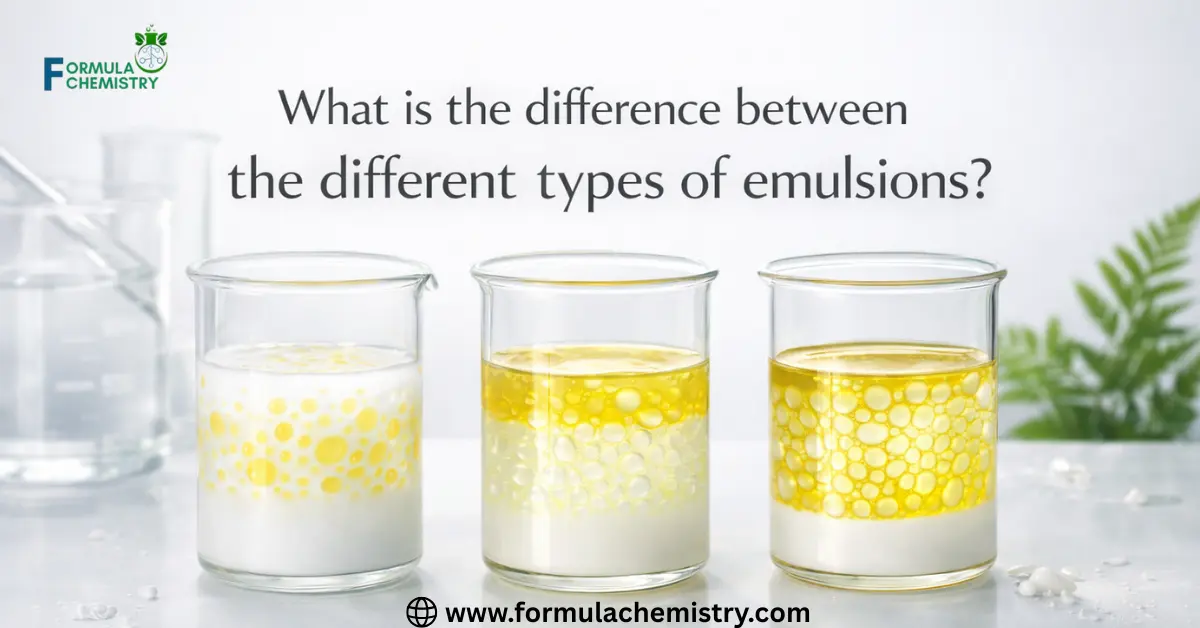
Emulsions are grouped based on which liquid is “hidden” inside the other. The two primary categories are Oil-in-Water (O/W) and Water-in-Oil (W/O).
The choice among these structures determines how a product feels on the skin, how quickly it absorbs, and which skin types it benefits most.
Oil-in-Water (O/W) vs. Water-in-Oil (W/O)
Most daily moisturizers are Oil-in-Water emulsions. In this structure, tiny oil droplets are suspended in a continuous water phase.
These products feel “light,” absorb quickly, and are easily washed off with water. They are the gold standard for hydrating serums and lotions intended for oily or combination skin.
Conversely, Water-in-Oil emulsions consist of water droplets suspended in a continuous oil phase. These are often referred to as “inverse emulsions.” They feel richer, heavier, and provide a major barrier on the skin’s surface. These are typically used for heavy night creams, and waterproof sunscreens.
| Emulsion Type | Continuous Phase | Skin Feel | Best For |
| O/W | Water | Lightweight, cooling | Oily, Acne-prone, Normal skin |
| W/O | Oil | Rich, occlusive, greasy | Very dry, Eczema-prone skin |
| Multiple (O/W/O) | Oil | Highly complex, slow release | Advanced clinical delivery |
Microemulsions and Nanoemulsions
In advanced cosmetic science, the size of the droplets matters. Standard emulsions have droplet sizes visible under a basic microscope. Microemulsions and nanoemulsions, however, feature much smaller droplets, frequently resulting in a translucent or clear appearance.
These systems are highly stable and are used to enhance the penetration of ingredients into the stratum corneum.
Because these smaller structures have a high surface area, they can sometimes cause increased irritation if they carry potent actives too deeply or too quickly for sensitive skin types. FormulaChemistry provides practical formulation education and safety-forward guidance to help users understand that “smaller” or “deeper” penetration is not always better for every skin condition.
How are emulsions formulated and stabilized?
The stability of an emulsion is the hallmark of a high-quality skincare product. If an emulsion is poorly formulated, it will undergo “creaming” (droplets rising to the top) or “breaking” (complete separation of oil and water).
Attaining long-term stability necessitates a balance of thermal energy, mechanical energy, and chemical selection.
The Role of Emulsifiers and Co-Emulsifiers
An emulsifier is the “glue” of the formulation. Common examples include Glyceryl Stearate, Cetearyl Alcohol (which also acts as a thickener), and Polysorbates.
Formulators often use a system of two or more emulsifiers to ensure stability across different temperatures. This is often calculated using the HLB (Hydrophilic-Lipophilic Balance) system, where oils are matched with emulsifiers of a similar value.
Usage ranges for primary emulsifiers typically fall between 3% and 6% of the total formula weight.
pH notes:
It is vital to ensure the emulsifier remains stable within the intended pH of the product; for example, some traditional soap-based emulsifiers fail in acidic environments (below pH 7), leading to product failure.
- Common Problems and Fixes:
- Problem: The emulsion feels “soapy” or turns white when rubbed in. Fix: Reduce the amount of high-melting-point waxes or add a small amount of dimethicone.
- Problem: Water is leaking out of the cream (syneresis). Fix: Increase the concentration of water-phase thickeners like Xanthan Gum.
- Problem: The product thins out in summer heat. Fix: Incorporate a co-emulsifier with a higher melting point to reinforce the internal structure.
Processing Methods and Equipment
Creating a stable emulsion usually requires heat. Both the water phase and the oil phase are typically heated to approximately 70°C to 75°C before being combined.
Once the phases are at the same temperature, they are joined under high-speed agitation. This mechanical energy breaks the internal phase into the small droplets required for a smooth texture.
As the mixture cools, the viscosity increases, and the emulsifiers “set” into a crystalline or gel network. Are key to preventing the formation of large wax crystals, which can make a cream feel grainy rather than smooth.
What are the benefits of using an emulsion?
Using a pre-mixed emulsion is generally superior to applying a pure oil and a water-based serum separately.
Emulsions allow for the delivery of “humectants” (which grab water), “emollients” (which soften skin), and “occlusives” (which seal in moisture) in one balanced step. This replicates the skin’s natural hydrolipidic film.
Hydration and Barrier Protection
The primary benefit of an emulsion is its ability to hydrate the skin while simultaneously preventing Transepidermal Water Loss (TEWL).
Without the oil phase, water applied to the skin would simply evaporate, often leaving the skin drier than before. Without the water phase, pure oils can feel heavy and may fail to address the underlying dehydration of the skin cells.
By uniting these phases, an emulsion provides an immediate smoothing effect.
Who should avoid specific heavy emulsions: Individuals with Grade 3 or 4 inflammatory acne should be cautious with high-oil-content W/O emulsions, as certain occlusive oils can be comedogenic or trap excess heat and bacteria against the skin.
Ingredient Delivery and Efficacy
Many of the most effective skincare ingredients are difficult to stabilize on their own. For example, is water-soluble and prone to oxidation, while Vitamin E is oil-soluble.
An emulsion allows these two antioxidants to work synergistically in the same bottle, protecting each other and the skin.
Furthermore, the texture of an emulsion can be “tuned” to improve user compliance. If a product feels good, a user is more likely to apply it daily, leading to better long-term results.
Formula Chemistry (spaced version) emphasizes that the “elegance” of a formula is not just for aesthetics; it is a functional component of how the product interacts with the skin’s surface.
FAQs about What is an emulsion in skincare?
Is an emulsion the same as a moisturizer?
In casual terms, yes. Technically, “emulsion” refers to the chemical structure (oil mixed with water), whereas “moisturizer” refers to the product’s function. Most moisturizers are emulsions.
Can I use an emulsion if I have oily skin?
Yes. Look for “Oil-in-Water” (O/W) emulsions or those labeled as “lotions” or “milks.” These provide necessary hydration without adding excessive oil to the skin’s surface.
Why did my DIY emulsion separate after two days?
Separation usually occurs due to insufficient emulsifier, lack of a water-phase stabilizer (like Xanthan Gum), or because the oil and water phases were not at the same temperature when mixed.
Do all emulsions need preservatives?
Yes. Any product containing water is a breeding ground for bacteria, mold, and yeast.
Key warnings: Never skip a broad-spectrum preservative in an emulsion, as microbial growth may not be visible to the naked eye.
How do I know if a product is an emulsion?
If the ingredient list contains both “Aqua” (Water) and an oil (like Caprylic/Capric Triglyceride or Simmondsia Chinensis Seed Oil), and they are not separated in the bottle, it is an emulsion.
Are emulsions safe for sensitive skin?
Generally, yes. However, the emulsifiers themselves can occasionally cause irritation. Those with reactive skin should avoid emulsions with high concentrations of fragrance or aggressive surfactants.
When should I apply an emulsion in my routine?
Standard emulsions (moisturizers) should be applied after water-based serums and before pure facial oils or sunscreens.
Is milk an emulsion?
Yes, milk is a natural biological emulsion consisting of butterfat globules suspended in a water-based fluid, stabilized by proteins like casein.
FormulaChemistry is committed to providing accurate, science-based information regarding cosmetic components.
As an editorial responsibility, we remind readers that while understanding ingredients is empowering, formulation should always give precedence to safety, preservation, and stability to protect the consumer’s skin health.