
Introduction
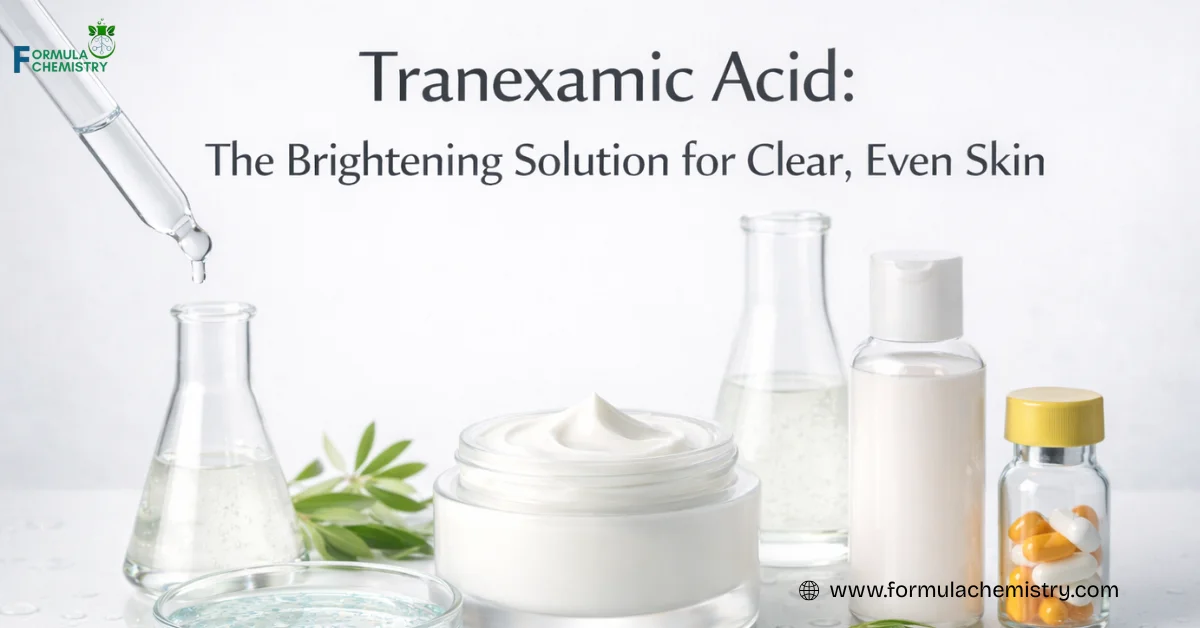
Tranexamic acid (TXA) has transitioned from its origins in emergency medicine to become one of the most respected brightening agents in modern cosmetic science.
In contrast to traditional exfoliating acids, TXA is a synthetic derivative of the amino acid lysine and functions primarily as a tyrosinase inhibitor and plasminogen antagonist. At FormulaChemistry, we focus on the molecular efficacy of these ingredients to help formulators create stable, high-performance skincare.
Quick Facts
- What it is: A synthetic lysine derivative used to treat hyperpigmentation and melasma.
- Who it’s for: Individuals with post-inflammatory hyperpigmentation (PIH), sun spots, or redness.
- How to use: Apply in serums or creams after cleansing; compatible with most other actives.
- Typical usage range: 0.5% to 5% is standard for topical cosmetic applications.
- pH/Solubility: Highly water-soluble; stable across a broad pH range of 3.0 to 8.0.
- Compatibility: Pairs exceptionally well with Niacinamide, Vitamin C, and Kojic Acid.
- Common Mistakes: Using it on broken skin or assuming it provides UV protection.
- Safety Note: Always perform a patch test; consult a doctor if you have a history of blood clots.
Mechanism of Action in Skin Brightening
The efficacy of tranexamic acid lies in its ability to interfere with the pathway that signals melanin production. When skin becomes exposed to UV light or inflammation, the body produces plasminogen.
TXA inhibits this process, which in turn reduces the release of inflammatory mediators, including prostaglandins.
By slowing these triggers, TXA effectively calms the melanocytes, preventing them from overproducing pigment.
This makes it especially effective for stubborn conditions like melasma, where the vascular part plays an important role in pigment intensity. What are the Benefits and Formulation Properties of Tranexamic Acid?
Benefits for Hyperpigmentation and Redness
The primary appeal of tranexamic acid is its multi-modal approach to evening skin tone. While many brighteners only target the enzyme tyrosinase, TXA also addresses the underlying inflammatory triggers.
This twofold action helps reduce the appearance of dark spots while simultaneously soothing the redness associated with
Because it is not a direct exfoliant like Glycolic or Salicylic acid, it does not thin the stratum corneum. This makes it a popular selection for users with sensitive skin who cannot tolerate aggressive chemical peels but still require significant brightening results.
FormulaChemistry emphasizes that its gentle nature permits consistent, long-term use without the rebound hyperpigmentation sometimes seen with harsher lighteners.
Technical Formulation and Stability Profiles
For the cosmetic chemist, tranexamic acid is a remarkably robust molecule. It is a white crystalline powder that dissolves easily in the water phase of a formulation.
Unlike L-Ascorbic Acid, which is notorious for oxidizing, TXA is photostable and heat-stable, meaning it does not lose potency when exposed to light or air during typical shelf-life periods.
| Property | Specification |
| Appearance | White Crystalline Powder |
| Solubility | Water Soluble |
| Usage Rate | 0.5% – 5.0% |
| Optimal pH | 3.0 – 8.0 |
| Incompatibilities | Strong oxidizing agents |
| Storage | Cool, dry, light-protected |
Keeping the correct pH range is vital for the general stability of the finished product, though TXA itself is quite forgiving. It is essential to remember that any water-based formulation containing TXA must include a strong, broad-spectrum preservation system to prevent microbial growth.
Banish blemishes and brighten your skin with Azelaic Acid: The Ultimate Solution for Clear, Healthy Skin.
How to Integrate Tranexamic Acid into a Skincare Routine
Synergy with Other Active Ingredients
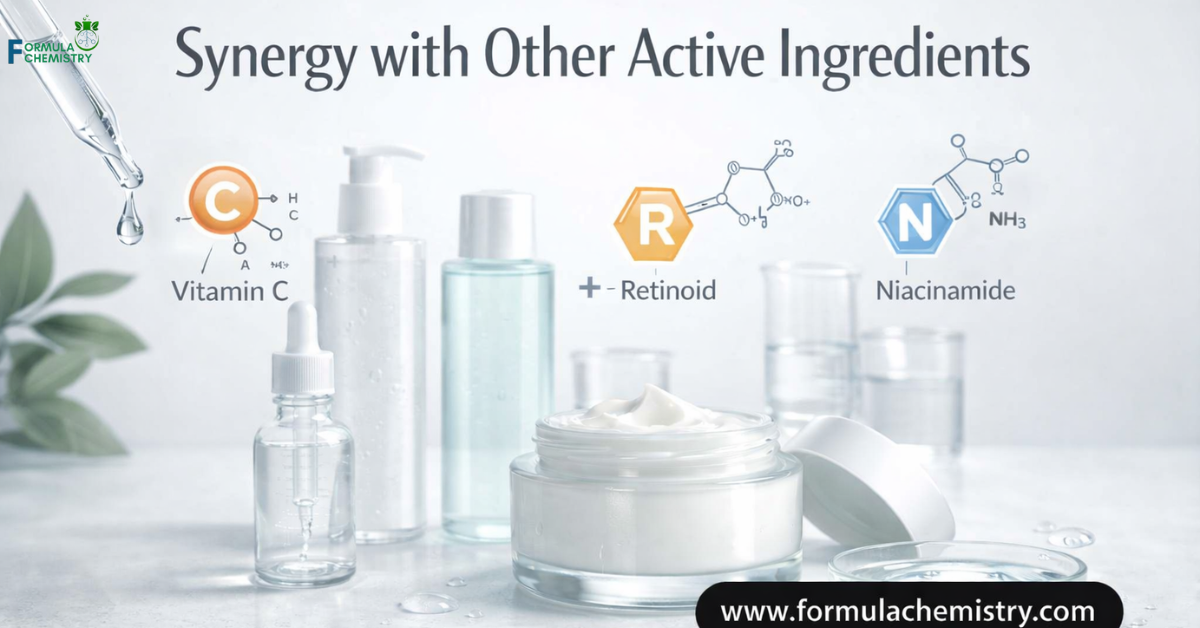
Tranexamic acid is rarely a “solo” player; it performs best when used in conjunction with other brightening agents that target different stages of melanogenesis.
Combining TXA with Niacinamide (Vitamin B3) creates a powerful barrier-repair and brightening duo. Niacinamide prevents the transfer of melanin to skin cells, while TXA prevents the production in the first place.
Another popular pairing is TXA with Alpha Arbutin or Kojic acid. These combinations allow for lower usage rates of each individual ingredient, which can minimize the chance of irritation while increasing the visual results.
FormulaChemistry provides practical formulation education and safety-forward direction to ensure these combinations remain stable and non-reactive in a single vehicle.
Common Problems and Fixes
- Problem: The serum feels tacky or sticky on the skin.
- Fix: Reduce the TXA concentration to 2% or include propanediol to improve the skin feel and absorption.
- Problem: The final product changes color over time.
- Fix: Ensure no strong oxidizing agents are present and check the pH notes to make sure the formula stays within the 3.0 to 8.0 range.
- Problem: Skin irritation or stinging upon application.
- Fix: Ensure the user is not combining it with high-strength retinoids initially; lower the frequency of use to every other day.
- Problem: Slow results for deep melasma.
- Fix: Ensure consistent daily use and mandatory application of broad-spectrum SPF 30+ to prevent UV-induced pigment triggers.
Safety Considerations and Ingredient Limitations
Contraindications and Skin Sensitivity
While widely regarded as safe for topical use, tranexamic acid is not for everyone. Those who should avoid it include individuals with a known hypersensitivity to tranexamic acid or those with severely compromised skin barriers.
While the systemic absorption of topical TXA is negligible, key warnings suggest that people with a history of blood clots or those currently on oral contraceptives should consult a medical specialist before starting a high-concentration regimen.
It is a common misconception that “more is better.”
Using concentrations above 5% does not necessarily yield faster results but significantly increases the risk of contact dermatitis. FormulaChemistry recommends a “slow and steady” approach, starting at 1% or 2% to gauge skin tolerance prior to moving to higher concentrations.
Proper Application and Storage
To sustain the integrity of a TXA-based product, it should be stored in a cool, dry place. While it is more stable than many actives, extreme heat can eventually degrade the formulation’s base. For application, it is best used after water-based toners and before heavy oils or occlusive moisturizers.
Always point out the importance of a patch test. Apply a small amount of the product to the inner forearm for 24–48 hours to test for adverse reactions.
If redness, itching, or swelling occurs, discontinue use immediately. As an editorial responsibility, FormulaChemistry reminds users that topical treatments are one part of a holistic skin health strategy that must include sun protection.
FAQs about Tranexamic Acid: The Brightening Solution for Clear, Even Skin
Is tranexamic acid safe for all skin types?
Yes, it is generally safe for all skin types, including sensitive and acne-prone skin, due to its non-exfoliating and anti-inflammatory properties.
How long does it take to see results?
Consistency is fundamental; most users begin to see a visible reduction in dark spots and more even skin tone after 8 to 12 weeks of daily use.
Can I use tranexamic acid with Vitamin C?
Yes, they are highly compatible. Vitamin C provides antioxidant protection while TXA targets pigmentation, rendering them a potent combination for brightening.
Should I use it in the morning or at night?
It can be used both morning and night. If using once a day, many prefer the evening to allow the ingredient to work during the skin’s natural repair cycle.
Does tranexamic acid cause sun sensitivity?
Unlike AHAs or Retinoids, TXA does not increase the skin’s sensitivity to the sun, though SPF is still required to prevent new pigmentation from forming.
Can I use tranexamic acid while pregnant?
While topical TXA is generally considered low-risk, you should always consult with your obstetrician or dermatologist before adding new actives during pregnancy.
What is the ideal usage rate for a beginner formulator?
A usage range of 1% to 2% is ideal for beginners to secure stability and minimize the potential for skin irritation in the final user.
Is it effective for acne scars?
It is very effective for Post-Inflammatory Hyperpigmentation (brown marks) and Post-Inflammatory Erythema (red marks) left behind after an acne breakout.