
Introduction
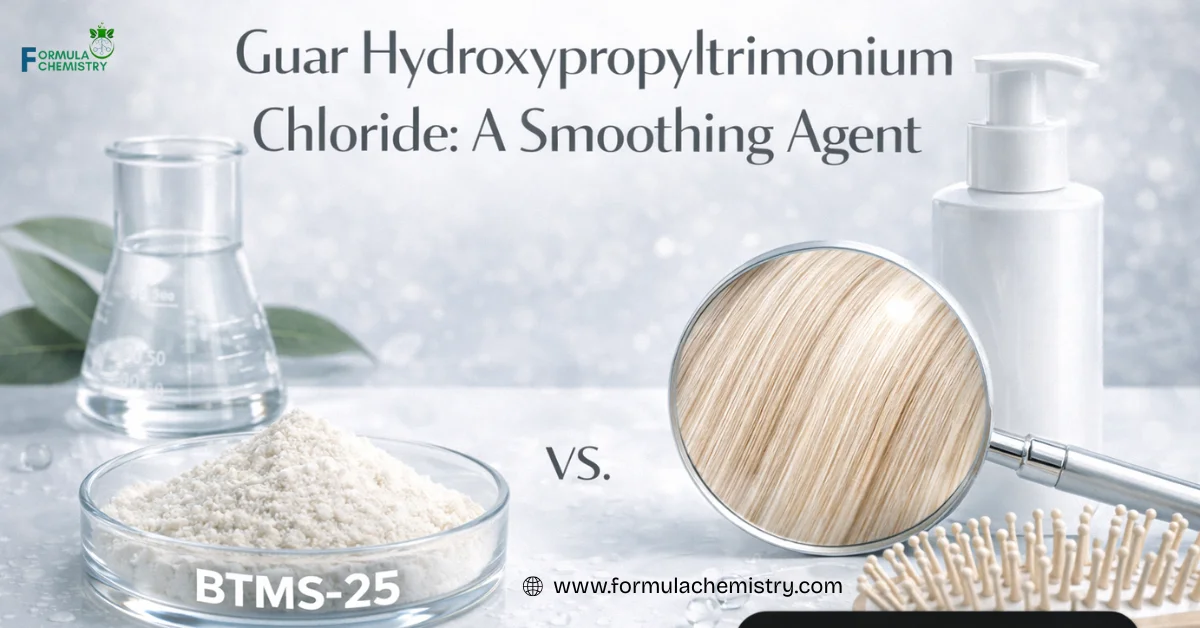
Guar Hydroxypropyltrimonium Chloride (often shortened to Cationic Guar or Guar HPTC) is a staple ingredient in the modern cosmetic chemist’s library. Derived from the endosperm of the guar bean (Cyamopsis tetragonoloba), this ingredient is chemically modified to hold a positive charge. This modification transforms standard guar gum from a simple thickener into a highly effective conditioning agent and deposition aid.
For formulators, Guar HPTC delivers a unique solution to the challenge of cleansing without stripping. Unlike standard thickeners, it possesses “substantivity,” meaning it adheres to skin and hair strands even after rinsing. This makes it invaluable in shampoos, body washes, and 2-in-1 formulations where a silky, smooth after-feel is required. It connects the gap between natural sourcing and synthetic performance, offering the best of both worlds for detangling and static control.
However, working with cationic polymers needs exact formulation techniques. Improper hydration can lead to “fish eyes” (undissolved clumps) or unstable products. Formula Chemistry provides practical formulation education and safety-forward direction to ensure you can utilize this powerful smoothing agent effectively and safely.
Quick Facts
- INCI Name: Guar Hydroxypropyltrimonium Chloride
- Function: Cationic Conditioner, Static Reducer, Deposition Aid, Thickener
- Charge: Cationic (Positive)
- Solubility: Water-soluble (requires specific hydration protocols)
- Typical Usage Rate: 0.1% – 0.5% (up to 1.0% for intensive treatments)
- Optimal pH: Stable across a wide range, but often requires acidic pH (< 5.0) to fully hydrate,depending on the grade.
- Compatibility: Compatible with anionic surfactants (rendering it ideal for shampoos) and nonionics.
- Safety Note: The powder is fine and can be an inhalation irritant; wear a mask when weighing.
- Key Benefit: provides “slip” and wet combability without weighing hair down significantly.
What Is Guar Hydroxypropyltrimonium Chloride?
At its core, Guar Hydroxypropyltrimonium Chloride is a quaternary ammonium derivative of guar gum. While standard guar gum is a nonionic polysaccharide used primarily for thickening food and cosmetics, Guar HPTC is reacted to include a cationic (positively charged) group. This chemical modification is what gives the ingredient its conditioning superpowers.
Hair fibers, especially those that are damaged or chemically treated, carry a net negative (anionic) charge. Because opposites attract, the positively charged Guar HPTC molecule magnetically adheres to the negatively charged hair shaft. This electrostatic attraction allows the polymer to form a thin, protective film over the cuticle. This film flattens the cuticle scales, resulting in smoother, shinier hair that is easier to comb when wet.
The Mechanism of Action
The “smoothing” effect of Guar HPTC is not only about coating the hair; it is about coacervation. In a shampoo system containing anionic surfactants (like Sodium Lauryl Sulfate or Sodium Cocoyl Isethionate), Guar HPTC forms a complex known as a coacervate upon dilution with water (during the rinse phase).
This coacervate separates from the surfactant solution and deposits onto the hair. It can also carry other beneficial ingredients, such as silicones or natural oils, depositing them onto the hair shaft alongside the polymer. This “deposition aid” mechanism is why Guar HPTC is found in almost every anti-dandruff shampoo (to deposit Zinc Pyrithione) and moisturizing body wash on the market.
Benefits Beyond Hair Care
While primarily marketed for hair, Guar Hydroxypropyltrimonium Chloride is surprisingly effective in skincare. In body washes and hand soaps, it lessens the harshness of surfactants. By depositing a microscopic, breathable film on the skin, it reduces Trans-Epidermal Water Loss (TEWL) during cleansing.
This leaves the skin feeling soft and conditioned rather than “squeaky” clean, which frequently indicates a compromised moisture barrier. It additionally contributes to the sensory profile of the foam, creating a creamier, denser lather that consumers associate with luxury products.
How to Formulate with Cationic Guar
Integrating Guar Hydroxypropyltrimonium Chloride into a formula requires more attention than simple mixing. The powder is highly hydrophilic and will swell instantly upon contact with water. If added too quickly or without proper dispersion, it will form stubborn lumps that are nearly impossible to smooth out later.
Most commercial grades of Guar HPTC are “self-hydrating” but require a pH trigger. The standard protocol involves dispersing the powder in room-temperature water under rapid agitation. At this stage, the solution may appear cloudy and thin. To “activate” or hydrate the polymer, the pH must be lowered, typically using a Citric Acid solution. Once the pH drops (usually below 5.0 or 4.0, depending on the supplier), the solution will become clear and viscous within minutes.
Usage Rates and Hair Types
The amount of Guar HPTC you use should be adjusted to the specific hair type or product goal. Using too much can lead to “buildup,” leaving hair feeling limp or greasy. Using too little will result in poor detangling.
Table: Recommended Usage Rates for Guar HPTC
| Hair / Skin Type | Recommended Usage | Formulation Goal |
| Fine / Thin Hair | 0.1% – 0.2% | Light conditioning, volume retention, static control. |
| Normal Hair | 0.2% – 0.4% | Balanced detangling, smooth feel, moderate slip. |
| Coarse / Damaged | 0.4% – 0.8% | Intense repair, heavy deposition, frizz reduction. |
| Body Wash | 0.1% – 0.3% | Skin softening, foam stabilization, irritation reduction. |
Compatibility with Surfactants
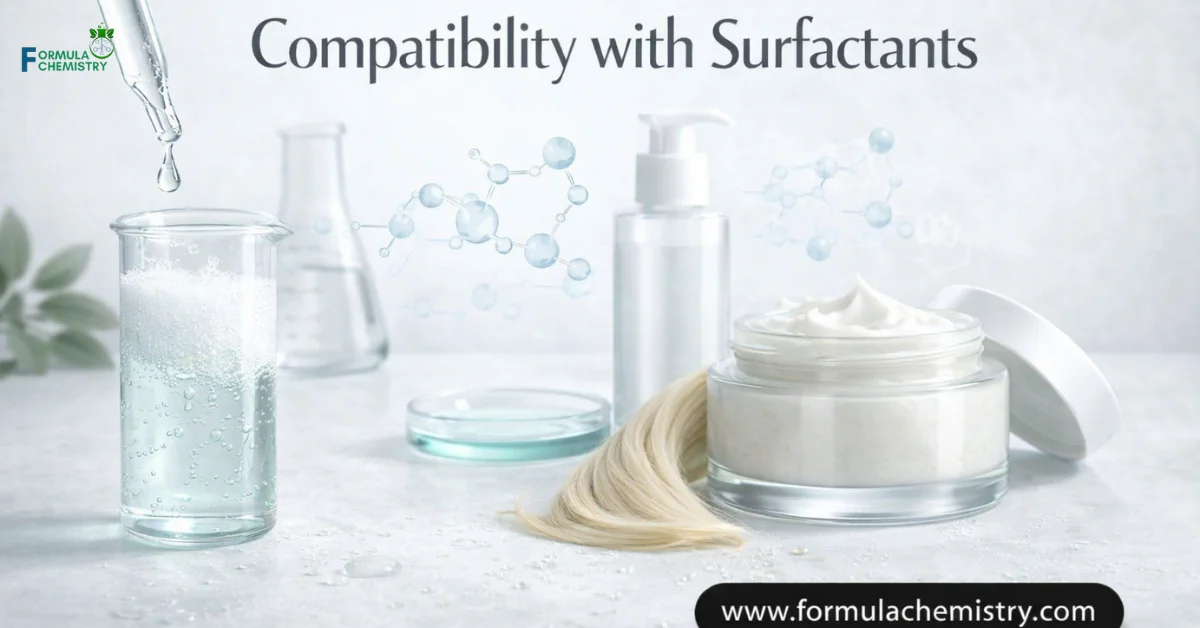
One of the specific advantages of Guar HPTC over other cationic conditioners (like Behentrimonium Chloride) lies in its compatibility with anionic surfactants. Most cationic ingredients will react with anionic surfactants to form an insoluble precipitate (scum). Guar HPTC, however, is a high-molecular-weight polymer that is compatible with anionics in the bottle.
This property allows formulators to create clear, 2-in-1 conditioning shampoos. However, the order of addition matters. It is generally best to fully hydrate the cationic guar in the water phase before adding any surfactants. If you add the powder directly to a surfactant blend, it may not hydrate fully, leading to haziness or lower viscosity yield.
TroubDiagnosing Commonulation Issues
Even with its popularity, Guar HPTC is notorious for causing production headaches. The most typical issue is the formation of “fish eyes” , small, gelatinous translucent lumps of unhydrated polymer. These occur when the outer layer of a powder particle hydrates too quickly, creating a gel barrier that prevents water from reaching the dry center.
To prevent this, you can create a slurry. Pre-mix the Guar HPTC with a non-water solvent, such as Glycerin or Propylene Glycol, before adding it to your main water phase. The solvent separates the particles, allowing them to disperse evenly before they begin to swell with water.
Common Problems and Fixes
- Problem: The shampoo is cloudy or hazy.
- Fix: Ensure the Guar HPTC was fully hydrated before adding surfactants. Check if the final pH is within the stable range. Some grades require a specific acidic pH to clarify.
- Problem: The product leaves a sticky residue on hair.
- Fix: The usage rate is likely too high (>0.5%). Reduce the percentage. Alternatively, the ratio of surfactant to polymer is unbalanced, causing excessive deposition.
- Problem: The viscosity is inconsistent (too thin).
- Fix: The polymer may not have been fully activated. Ensure you added enough acid (Citric or Lactic) to trigger the hydration. Also, high levels of salt (Sodium Chloride) can occasionally interfere with the viscosity build of certain guar grades.
Preventing Buildup and Over-Conditioning
Because Guar HPTC is designed to stick to hair, repeated use of high-concentration formulas can lead to buildup, making hair feel heavy and dull. This is particularly true for fine hair types.
To reduce this, formulators often pair Guar HPTC with amphoteric surfactants (like Cocamidopropyl Betaine), which help moderate the deposition. Additionally, guaranteeing the formula a strong burst cleansing system helps remove previous polymer layers during the wash. Warning consumers to rinse thoroughly is also an effective safety and performance tip. Always include a broad-spectrum preservative, as guar derivatives are polysaccharides and highly susceptible to bacterial growth.
FAQ’s about Guar Hydroxypropyltrimonium Chloride: A Smoothing Agent
Is Guar Hydroxypropyltrimonium Chloride a silicone?
No, it is not a silicone. It is a cationic polymer derived from guar gum. However it frequently serves a similar function to silicones by providing slip, smoothing the cuticle, and reducing static, making it a well-known popular silicone alternative in “silicone-free” products.
Is this ingredient natural?
It is considered naturally derived or semi-synthetic. The backbone is natural guar gum from the guar bean, but undergoes a synthetic process (quaternization) to become cationic. Therefore, it is generally not permitted in strict “100% organic”standards yet is allowed in many “clean beauty” frameworks.
Can Guar HPTC be used in leave-in products?
Yes, but with caution. Because it is substantive and can build up, usage rates in leave-in conditioners should be very low (0.1% – 0.3%). In rinse-off products, the excess is washed away, but in leave-ins, it remains on the hair, possibly causing stickiness if overdosed.
Why does my Guar HPTC clump when I add water?
This is due to the rapid hydration of the particle surface. To fix this, create a slurry with glycerin first, or add the powder to the vordey of rapidly agitating water before adjusting the pH. Do not add acid before the guar is fully dispersed.
Is Guar HPTC biodegradable?
Generally, yes. The guar backbone is a polysaccharide that is biodegradable. However, the rate of biodegradation can depend on the degree of substitution (how much it was modified). It is widely considered an eco-friendlier option compared to many synthetic polyquaterniums.
What is the difference between Guar Gum and Guar HPTC?
Guar Gum is nonionic and used strictly for thickening. It has no conditioning properties and rinses off easily. Guar HPTC is cationic, meaning it conditions, detangles, and sticks to hair. You cannot swap them 1-for-1 if you want conditioning benefits.
Does Guar HPTC irritate the eyes?
In its raw powder form, it can be a severe eye irritant. In finished formulations at standard usage rates (<1.0%), it is generally mild. However, always ensure the final product is pH-balanced and tested for ocular safety if intended for use near the eyes (like shampoos).
Can I use Guar HPTC in cold process formulations?
Yes. Most “self-hydrating” grades can be processed at room temperature. You do not need to heat the water to disperse it, although warm water can sometimes speed up the hydration process. This makes it energy-efficient for manufacturing.