
Introduction
Cocamidopropyl Betaine (often abbreviated as CAPB) is one of the most ubiquitous ingredients in modern personal care. Derived from coconut oil and dimethylaminopropylamine, this amphoteric surfactant functions as a cornerstone for gentle cleansing formulations.
It is highly valued for its ability to reduce the irritation potential of harsher detergents while improving the foam quality of shampoos, body washes, and facial cleansers. For cosmetic chemists, CAPB is far more than a cleaner; it is a functional problem-solver.
It builds viscosity, stabilizes foam, and acts as a conditioning agent in certain pH environments. Its versatility serves as a mainstay in everything from high-end paraben-free shampoos to affordable hand soaps.
Quick Facts
- INCI Name: Cocamidopropyl Betaine
- Function: Amphoteric Surfactant, Foam Booster, Viscosity Builder, Antistatic Agent
- Source: Derived from Coconut Oil (fatty acids) and synthetic amines.
- Charge: Zwitterionic (changes charge based on pH); typically cationic-like in acidic formulas.
- Typical Usage Rate: 2% – 10% as a secondary surfactant; up to 40% in specific concentrates.
- Active Matter: Usually sold as a 30% active solution (the rest is water and salt).
- Optimal pH Range: Stable across pH 4.0 – 8.0; conditioning properties peak below pH 6.0.
- Compatibility: Compatible with anionic, cationic, and nonionic surfactants.
- Safety Note: Generally mild, but choose low-impurity grades (low DMAPA) to avoid sensitization. Always preserve water-based formulas.
What is Amphoteric Chemistry and Why Does It Matter?
To understand Cocamidopropyl Betaine, you must comprehend its “amphoteric” nature. Unlike anionic surfactants (negatively charged, like SLS) that strip oils, or cationic surfactants (positively charged) that condition, amphoteric surfactants are zwitterionic.
This means they carry both a positive and a negative charge on the same molecule, letting them adapt to the pH of the formulation. In an acidic environment (pH < 7), Cocamidopropyl Betaine behaves more like a cationic surfactant.
This allows it to impart a soft, conditioned feel to the skin and hair, similar to a mild conditioner. In alkaline environments (pH > 7), it behaves more anionically, focusing on cleaning power.
The Role of Micelles in Cleansing
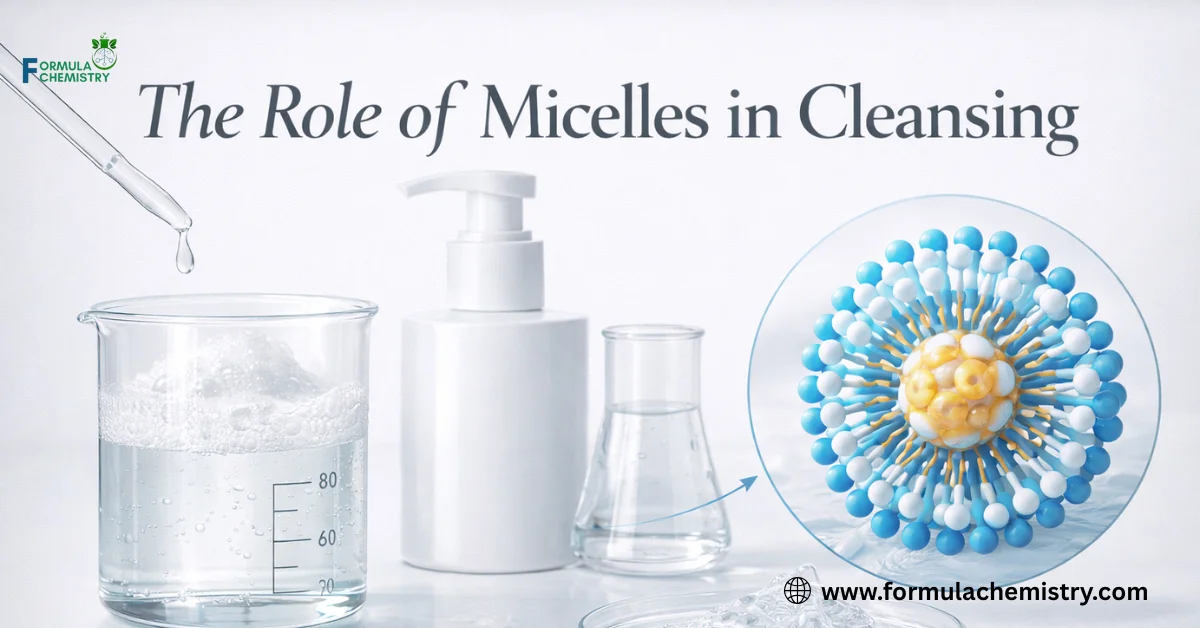
When mixed with water, surfactant molecules group together to form structures called micelles. The water-loving (hydrophilic) heads face outward, while the oil-loving (lipophilic) tails face inward, trapping dirt and oil.
Cocamidopropyl Betaine is unique because it helps pack these micelles more tightly when mixed with anionic surfactants. This tighter packing stabilizes the foam, creating tiny, dense bubbles rather than large, airy ones that burst quickly.
This “flash foam” and creamy lather are sensory indicators that consumers associate with high-quality, luxurious products. Without CAPB, many sulfate-free hair cleansers would feel flat and watery during application.
Formulating with Cocamidopropyl Betaine: Practical Guide
Cocamidopropyl Betaine is rarely used as the sole cleansing agent. It is almost always used as a secondary surfactant (co-surfactant) alongside a primary anionic surfactant like Sodium Cocoyl Isethionate (SCI) or Sodium Lauryl Sulfoacetate (SLSA). The usual ratio is often 3:1 or 4:1 (Primary Surfactant to CAPB). This ratio maximizes mildness while guaranteeing sufficient cleaning power.
One of its most valuable properties is its ability to build viscosity (thicken) formulations via the “salt curve.” When combined with anionic surfactants, adding Sodium Chloride (table salt) causes the micelles to elongate and tangle, thickening the liquid. CAPB improves this response, meaning you need less salt to achieve a honey-like texture compared to using an anionic surfactant alone.
Common Problems and Fixes
Despite its ease of use, formulators often encounter texture issues when working with betaines. Below are common challenges and how to resolve them.
- Problem: The shampoo turns into a solid jelly or “ringing gel.”
- Fix: You have passed the peak of the salt curve. Add a small amount of water or non-ionic surfactant to thin it back down. Reduce salt or CAPB concentration in the next batch.
- Problem: The formula is cloudy or hazy.
- Fix: Check your pH. Some grades of CAPB become hazy at very low pH (< 4.0). Alternatively, verify compatibility alongside your fragrance oil solubilizer.
- Problem: The foam is weak or collapses instantly.
- Fix: The ratio of oil/emollients to surfactant is too high. Increase the percentage of Cocamidopropyl Betaine to boost foam stability.
- Problem: Skin irritation despite using mild surfactants.
- Fix: Check the quality of your CAPB. Cheaper grades may contain high levels of free amines (DMAPA). Switch to a “low-impurity” or “sensitization-free” grade.
Safety, Purity, and Comparison
There is a common misconception that Cocamidopropyl Betaine is a frequent allergen. In reality, the allergic reactions attributed to CAPB are almost always caused by manufacturing impurities, specifically 3-dimethylaminopropylamine (DMAPA) and amidamine left over from the synthesis process. High-quality cosmetic grades experience rigorous purification to remove these byproducts.
When sourcing raw materials, look for suppliers who specify “low DMAPA” or “high purity.” For leave-on products (though rare for this ingredient), this is mandatory. For rinse-off products, it makes certain that even sensitive skin types, such as those with eczema or rosacea, can tolerate the product without redness or itching.
Comparative Table: CAPB vs. Alternatives
Selecting the right co-surfactant is critical for the final feel of the product. The table below compares Cocamidopropyl Betaine to other common options.
Table: Cocamidopropyl Betaine vs. Other Co-Surfactants
| Feature | Cocamidopropyl Betaine | Coco Betaine | Decyl Glucoside |
| Chemistry | Amphoteric | Amphoteric (Ionic) | Non-ionic |
| Mildness | High | Moderate to High | Very High |
| Foam Quality | Creamy, Dense | Flash Foam, Airy | Low, unstable foam |
| Thickening | Excellent (with salt) | Moderate | Poor (hard to thicken) |
| Cost | Low / Standard | Higher | Moderate |
| Best For | Shampoos, Body Wash | Acne wash, cleansers | Baby wash, sensitive skin |
Who Should Avoid High Concentrations?
While mild, chemically sensitive individuals should perform a patch test. Formulators creating products for certified “hypoallergenic” lines might opt for glucoside-based cleansers instead to eliminate the risk of amine sensitivity entirely. Furthermore, always ensure that any water-containing formula with CAPB is preserved with a broad-spectrum preservative, as the fatty acid component can serve as food for bacteria.
FAQ’s about Cocamidopropyl Betaine: A Mild Surfactant for Skin and Hair Care
Is Cocamidopropyl Betaine safe for babies?
Yes, it is widely used in baby shampoos and “tear-free” formulations. Its large molecular size prevents it from penetrating the skin, and its amphoteric nature reduces stinging in the eyes compared to sulfates. Always choose a high-purity grade for baby products.
Is Cocamidopropyl Betaine natural?
It is considered semi-synthetic or naturally derived. The hydrophobic tail comes from coconut oil (natural), but the hydrophilic head is synthetic. It is generally allowed in “natural” standards like COSMOS or Ecocert, provided the manufacturing process meets specific green chemistry criteria.
Can Cocamidopropyl Betaine replace sulfates?
Not directly 1:1. It is too mild to be the primary cleanser for heavy oils or product residue. It works best when paired with another mild surfactant, such as Sodium Cocoyl Isethionate or Lauryl Glucoside, to create an effective sulfate-free system.
Why is my Cocamidopropyl Betaine liquid separating?
If your raw material bottle has separated into layers, it may have been exposed to cold temperatures. Gently warm the bottle in a hot water bath (around 40°C) and shake well to homogenize it before use.
What is the pH of Cocamidopropyl Betaine?
The raw material usually has a pH between 4.5 and 6.0, depending on the supplier. In a finished formulation, it is stable across a wide range but performs best as a conditioner and thickener in slightly acidic formulas (pH 5.0 – 5.5).
Does Cocamidopropyl Betaine strip hair color?
No, it is one of the safest surfactants for color-treated hair. It does not lift the hair cuticle aggressively as sulfates do. In fact, its conditioning properties help smooth the cuticle and may extend the life of the hair color.
What is the difference between Cocamidopropyl Betaine and Coco Betaine?
Cocamidopropyl Betaine is a synthetic derivative with an amide group, making it milder and a better thickener. Coco Betaine is a simpler molecule; while more “natural” in structure, it can be slightly more irritating to the eyes and skin if not formulated carefully.
Can I use Cocamidopropyl Betaine in a leave-on product?
Technically, yes, but it is not recommended. Surfactants are designed to clean dirt and oil; leaving them on the skin can eventually disrupt the lipid barrier and cause dryness or irritation. It should be rinsed off.