

Introduction
Most emulsion failures trace back to one decision made before any mixing starts: choosing the wrong emulsion type or the wrong emulsifier to match it. A formulator who understands the difference between the two emulsion types rarely produces a batch that separates.
This emulsion formulation tutorial explains both systems from the inside out, so you can choose, build, and stabilise either one with confidence. An emulsion is a mixture of oil and water held together by an emulsifier, and it exists as either oil-in-water or water-in-oil depending on which liquid is dispersed in which.
You will learn how droplet structure defines an emulsion, how to choose an emulsifier by its HLB, how phase ratios and mixing shape the result, and why emulsions break. The tutorial closes with step-by-step methods for both an oil-in-water emulsion and a water-in-oil emulsion.
By the end, you will be able to identify any emulsion type, match it to the right emulsifier, and diagnose the most common stability problems before they ruin a batch.
What Is an Emulsion: Droplet Structure and Phases
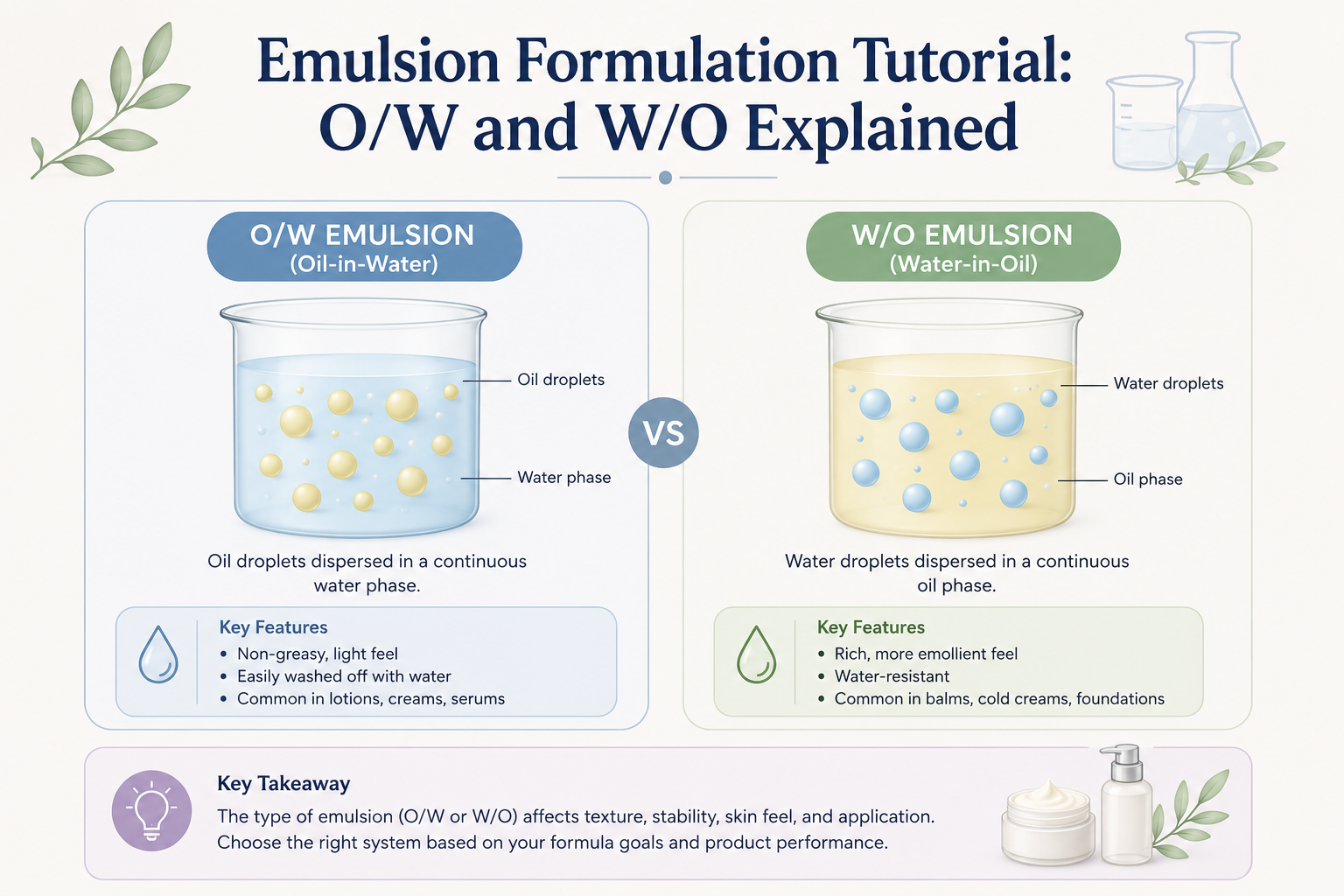
An emulsion is a system in which one liquid is dispersed as fine droplets throughout a second, immiscible liquid. Oil and water do not mix on their own, so an emulsifier sits at the boundary between them and holds the droplets in place.
Every emulsion has two phases defined by emulsion droplet structure. The dispersed phase, also called the internal phase, exists as suspended droplets, while the continuous phase, also called the external phase, is the liquid in which those droplets float.
Which liquid becomes the droplets decides the emulsion type. When oil forms droplets within water, the result is an oil-in-water emulsion, and when water forms droplets within oil, the result is a water-in-oil emulsion.
Droplet size matters as much as droplet type. Smaller, more uniform droplets resist separation far longer, which is why the mixing method used to create those droplets is central to a stable emulsion.
Typical cosmetic emulsions hold droplets between 0.1 and 50 micrometres across. Macroemulsions in this range look opaque and white, while far smaller droplets produce the translucent appearance of a microemulsion or nanoemulsion.
Oil-in-Water vs Water-in-Oil Emulsions
The two emulsion types behave so differently that choosing between them shapes every later decision. An oil-in-water emulsion suspends oil droplets in a continuous water phase, producing the light, fast-absorbing lotions and creams that dominate skincare.
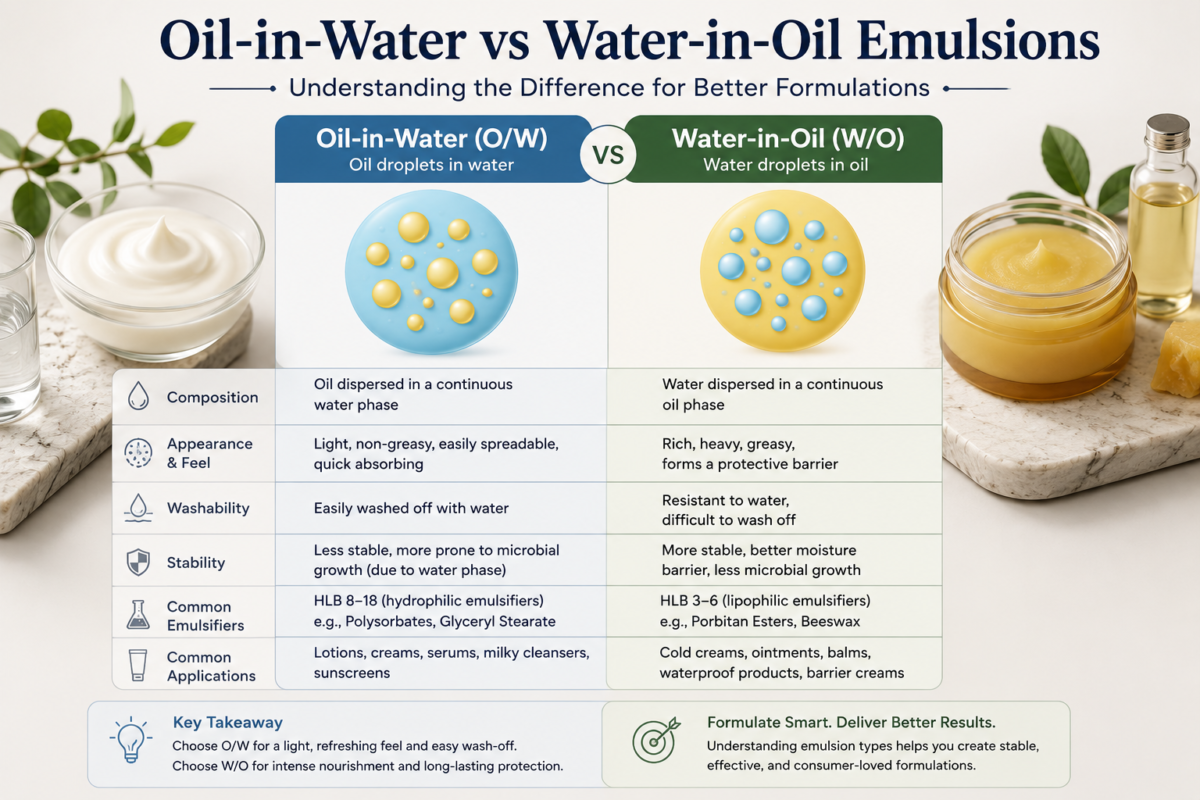
A water-in-oil emulsion does the reverse, suspending water droplets in a continuous oil phase. This structure gives a rich, occlusive feel that suits barrier creams, some sunscreens, and cold-climate products.
The continuous phase is what your skin contacts first, which is why an oil-in-water emulsion feels light and a water-in-oil emulsion feels greasy and protective. That single difference drives skin feel, rinse-off behaviour, and the type of emulsifier each one needs.
| Parameter | Oil-in-Water (O/W) | Water-in-Oil (W/O) |
| Continuous phase | Water | Oil |
| Dispersed phase | Oil | Water |
| Skin feel | Light, non-greasy | Rich, occlusive |
| Emulsifier HLB range | 8 to 18 | 4 to 6 |
| Typical products | Lotions, light creams | Barrier creams, some sunscreens |
| Electrical conductivity | High | Low |
| Dilutes in water | Yes | No |
| Main stability challenge | Creaming, microbial growth | Coalescence, harder to stabilise |
| Preservation demand | High | Lower but still required |
Identifying an Unknown Emulsion
You can determine an emulsion’s type with two simple bench tests. In the dilution test, a drop of the emulsion disperses readily in water if it is oil-in-water, and resists mixing if it is water-in-oil.
The conductivity test confirms the result. An oil-in-water emulsion conducts electricity because its continuous phase is water, while a water-in-oil emulsion barely conducts because oil surrounds every droplet.
Emulsion Formulation Tutorial: Emulsifiers, HLB, and Phase Ratios
The emulsifier is the ingredient that makes an emulsion possible, and selecting the right one is the heart of this emulsion formulation tutorial. An emulsifier is a molecule with a water-loving head and an oil-loving tail that anchors at the oil-water boundary and stabilises the droplets.
Emulsifiers are classified by HLB, the hydrophilic-lipophilic balance, a number from 0 to 20 that describes how water-loving or oil-loving a material is. The HLB system lets you match an emulsifier to the emulsion type you want to build.
An oil-in-water emulsion needs a water-loving emulsifier with an HLB of roughly 8 to 18. A water-in-oil emulsion needs an oil-loving emulsifier with an HLB of roughly 4 to 6, which is why the two systems rarely share the same emulsifier.
| Emulsion type | Required HLB | Example emulsifier (INCI) |
| Oil-in-water | 8 to 18 | Glyceryl Stearate (and) PEG-100 Stearate |
| Oil-in-water | 8 to 18 | Cetearyl Alcohol (and) Ceteareth-20 |
| Water-in-oil | 4 to 6 | Sorbitan Olivate |
| Water-in-oil | 4 to 6 | Polyglyceryl-3 Polyricinoleate |
Matching HLB to the Oil Phase
Each oil and butter has its own required HLB, the value at which it emulsifies most stably. A blend of oils carries a weighted-average required HLB, calculated from the proportion and required HLB of every oil in the phase.
The skill is to match your emulsifier system’s HLB to the oil phase’s required HLB. Blending a high-HLB and a low-HLB emulsifier lets you reach almost any value, which is how formulators stabilise complex oil blends.
A mismatch shows up as poor stability even when everything else looks correct. When an oil-in-water emulsion creams quickly despite good mixing, an HLB mismatch is a frequent and overlooked cause.
Emulsion Phase Ratios
Emulsion phase ratios describe how much dispersed phase sits within the continuous phase. The ratio influences both the emulsion type and the final viscosity, since a higher internal phase generally produces a thicker product.
Most oil-in-water lotions carry an oil phase of 10% to 25%, with the rest as water phase and additives. Pushing the internal phase too high can force the emulsion to invert, flipping an oil-in-water system into a water-in-oil one without warning.
The emulsifier load scales with the internal phase. More dispersed droplets create more surface area to coat, so a higher oil phase needs a higher emulsifier level to stay stable.
Emulsion Mixing Techniques and Homogenization
Mixing is not a finishing step in emulsion work; it is what creates the droplets in the first place. Emulsion mixing techniques apply mechanical energy to break the dispersed phase into fine droplets that the emulsifier can then stabilise.
Simple stirring produces large droplets and a coarse, short-lived emulsion. High shear mixing emulsion methods use a rotor-stator homogeniser that forces the mixture through a narrow gap at high speed, shearing the droplets into far smaller and more uniform.
Emulsion homogenization is the step that gives a professional lotion its smooth texture and long stability. Homogenising for one to three minutes after combining the phases typically produces droplets fine enough to resist creaming for months.
Temperature and order of addition support the mixing. Both phases are usually heated to around 75°C and held there before combining, which keeps waxes molten and lets the emulsifier work while shear does its job.
Emulsion Stability Factors and Breaking
Emulsions are thermodynamically unstable, which means they always tend to separate given enough time. Emulsion stability factors are the tools a formulator uses to slow that separation to the point where the product lasts its intended shelf life.
The main factors are droplet size, emulsifier quality, continuous-phase viscosity, and the density difference between the phases. Smaller droplets, a strong interfacial film, a thicker continuous phase, and a small density gap all extend stability.
Emulsion breaking happens through several distinct mechanisms, and recognising which one is occurring tells you how to fix it. The table below summarises the common failure modes.
| Failure mode | What happens | Common cause | Prevention |
| Creaming | Droplets rise or settle, reversible | Density gap, large droplets | Smaller droplets, thicker continuous phase |
| Flocculation | Droplets clump, reversible | Weak droplet repulsion | Adequate emulsifier, electrolyte control |
| Coalescence | Droplets merge, irreversible | Weak interfacial film | Strong emulsifier and co-emulsifier |
| Phase inversion | Emulsion flips type | Wrong ratio or temperature | Correct phase ratio, controlled heat |
| Ostwald ripening | Large droplets grow at the expense of small ones | Solubility differences | Match phase solubilities |
Creaming and flocculation are reversible, so a gentle stir can restore the product. Coalescence and a full break are permanent, which means the emulsion must be reformulated rather than rescued.
Three practical levers improve stability in almost any emulsion. A co-emulsifier such as Cetearyl Alcohol reinforces the interfacial film, a gum or fatty thickener raises the continuous-phase viscosity, and a chelator such as Disodium EDTA protects the system from metal-driven destabilisation.
Gum thickeners earn their place in oil-in-water work. Raising the viscosity of the water phase slows the droplets from rising, which directly reduces creaming across the product’s life.
How to Make an Oil-in-Water Emulsion Step by Step
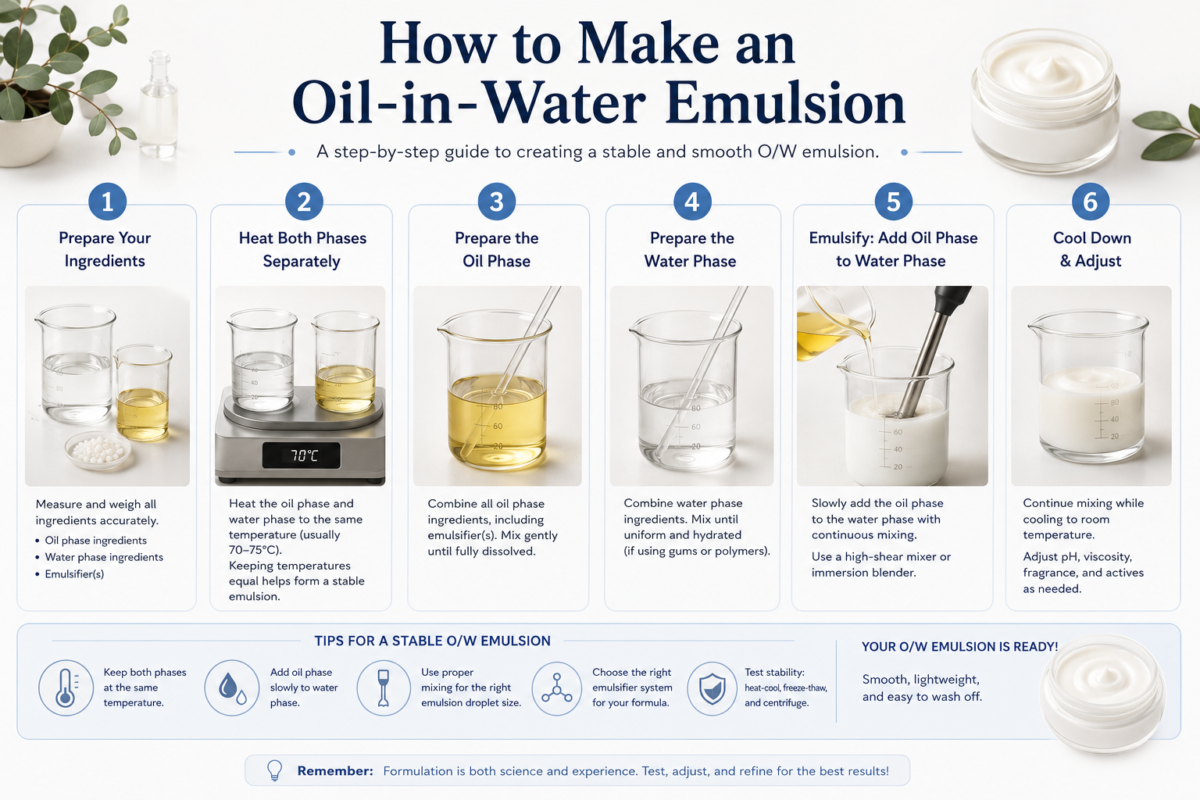
This is a compact method showing how to make an oil-in-water emulsion step by step, using a simple, stable starting structure. The example uses a complete emulsifier, so a single material handles the stabilising work.
| Phase | INCI Name | Percentage |
| A (water) | Aqua | 76.00% |
| A (water) | Glycerin | 3.00% |
| B (oil) | Glyceryl Stearate (and) PEG-100 Stearate | 5.00% |
| B (oil) | Cetearyl Alcohol | 3.00% |
| B (oil) | Caprylic/Capric Triglyceride | 9.00% |
| C (cool-down) | Phenoxyethanol (and) Ethylhexylglycerin | 1.00% |
| D (adjust) | Citric Acid solution | qs to pH 5.0 |
Heat the water phase and the oil phase separately to 75°C. Hold both at temperature until the oil phase is fully molten and the water phase is clear.
Pour the oil phase into the water phase while both sit at 75°C, then homogenise for one to three minutes until the emulsion turns uniform and opaque. Switch to gentle stirring and cool the batch, adding the preservative below 40°C and adjusting the pH to roughly 5.0 with citric acid solution.
Water-in-Oil Emulsion Formulation Guide
A water-in-oil emulsion formulation guide differs from the oil-in-water method in three important ways. The emulsifier is oil-loving with a low HLB. The water phase is usually added to the oil phase, and the system needs extra help to stay stable.
Add the water phase slowly into the heated oil phase while mixing, rather than the reverse. This order keeps oil as the continuous phase and prevents the system from forming an oil-in-water emulsion by mistake.
Electrolytes stabilise a water-in-oil emulsion in a way they never do for oil-in-water. Adding 0.5% to 2% of a salt such as magnesium sulfate to the water phase strengthens the system and reduces the risk of the internal droplets coalescing.
Water-in-oil emulsions are less forgiving than their counterparts. They demand careful temperature control, slow water addition, and a well-matched low-HLB emulsifier, which is why they suit a formulator who has already mastered oil-in-water work.
Common Emulsion Formulation Mistakes
These are the errors that derail emulsion work most often. Each one names the mistake, explains why it happens, and gives the exact fix.
- Mismatching the emulsifier to the emulsion type. Beginners pick an emulsifier by name rather than HLB, then wonder why the emulsion never forms. Match the HLB to the type: 8 to 18 for oil-in-water, 4 to 6 for water-in-oil.
- Combining phases at different temperatures. A hot oil phase poured into a cold water phase shocks the emulsifier and breaks the emulsion. Bring both phases to the same temperature, around 75°C, before combining them.
- Relying on stirring instead of shear. Gentle stirring leaves droplets large and the emulsion coarse and unstable. Use a rotor-stator homogeniser to shear the droplets small enough to resist creaming.
- Pushing the internal phase too high. Overloading the dispersed phase forces the emulsion to invert or break. Keep the oil phase within a sensible range and raise the emulsifier load as the internal phase grows.
- Skipping the preservative in the water phase. Any emulsion with a water phase supports microbial growth, including water-in-oil systems. Include a broad-spectrum preservative at full strength in every emulsion that contains water.
- Adding salt to an oil-in-water emulsion to thicken it. Electrolytes that stabilise water-in-oil systems can destabilise oil-in-water ones instead. Thicken an oil-in-water emulsion with a fatty alcohol or gum, and reserve electrolytes for water-in-oil work.
- Declaring an emulsion finished without stability testing. A lotion that looks perfect on day one can cream or break within weeks. Run room-temperature, warm, and freeze-thaw checks before trusting any emulsion.
Suitability Guide
The two emulsion types suit different needs, and matching the type to the use is part of formulating well. An oil-in-water emulsion suits most everyday skincare, while a water-in-oil emulsion suits richer, more protective products.
Oil-in-water emulsions work for normal, combination, and lightly dry skin, where a light, fast-absorbing finish is preferred. Their water-led feel makes them comfortable for facial lotions and daily body creams.
Water-in-oil emulsions suit very dry skin and protective applications that benefit from an occlusive layer. Their oil-led structure resists wash-off, which is useful for barrier creams and cold-weather products.
On experience level, an oil-in-water emulsion is the right starting point for a beginner, since it forms easily and forgives small errors. A water-in-oil emulsion is an intermediate project that rewards the control learned on oil-in-water systems first. The Formula Chemistry approach is to master one type fully before moving to the other.
Always conduct a 48-hour patch test with any new formula before wider use.
Frequently Asked Questions
What is an emulsion in cosmetics?
An emulsion is a stable mixture of oil and water held together by an emulsifier. One liquid is dispersed as fine droplets throughout the other, creating lotions, creams, and many other products. Without an emulsifier, the two liquids would simply separate.
What is the difference between O/W and W/O?
In an oil-in-water emulsion, oil droplets are dispersed in a continuous water phase, giving a light, non-greasy feel. In a water-in-oil emulsion, water droplets are dispersed in a continuous oil phase, giving a rich, occlusive feel. The continuous phase determines the skin feel and the emulsifier needed.
How do I know if my emulsion is O/W or W/O?
Use the dilution test by adding a drop to water, since an oil-in-water emulsion disperses readily while a water-in-oil one resists. A conductivity test confirms it, because oil-in-water conducts electricity and water-in-oil does not. Both tests take seconds at the bench.
What HLB do I need for an O/W emulsion?
An oil-in-water emulsion needs a water-loving emulsifier with an HLB of roughly 8 to 18. The exact value depends on the oils in your formula, since each oil has a required HLB. Matching the emulsifier HLB to the oil phase improves stability.
Why did my emulsion separate?
Emulsions separate through creaming, flocculation, coalescence, or phase inversion, each with a different cause. Common reasons include large droplets from weak mixing, a mismatched emulsifier, or combining phases at different temperatures. Identifying the failure mode tells you which fix to apply.
Do I need a homogeniser for emulsions?
A homogeniser is not strictly required, but it produces far smaller droplets and a much more stable emulsion than stirring. For reliable lotions and creams, a rotor-stator homogeniser is the single most useful piece of equipment. Hand stirring alone tends to give coarse, short-lived results.
What phase ratio works for a lotion?
A typical oil-in-water lotion uses an oil phase of about 10% to 25%, with the balance as water phase and additives. A higher oil phase gives a thicker, richer product and needs more emulsifier. Pushing the oil phase too high risks inverting the emulsion.
Can an emulsion change type while mixing?
Yes, an emulsion can invert from one type to the other during processing. Phase inversion is triggered by an excessive internal phase, the wrong temperature, or over-mixing. Controlling the phase ratio and temperature keeps the emulsion in its intended type.
Key Takeaways
You now have the framework to choose, build, and troubleshoot either emulsion type. These are the points worth carrying into every emulsion you make.
- An emulsion is oil and water held together by an emulsifier, existing as oil-in-water or water-in-oil depending on which phase is dispersed.
- The continuous phase sets the skin feel, and the emulsion type dictates the emulsifier HLB: 8 to 18 for oil-in-water, 4 to 6 for water-in-oil.
- Droplet size from high shear mixing and homogenization is central to stability, since smaller droplets resist separation longer.
- Emulsions break through creaming, flocculation, coalescence, phase inversion, and Ostwald ripening, and the mechanism tells you the fix.
- Every emulsion containing water needs a full-strength preservative, and every batch needs stability testing before it is trusted.
Choose your emulsion type first, match the emulsifier HLB to it, then build a small test batch and run it through stability testing, and this emulsion formulation tutorial will have turned theory into a product you can reproduce.