

Introduction
Most people start cosmetic formulation by buying a long list of ingredients and following a random recipe, then wonder why the result separates, spoils, or stings. The missing piece is rarely an ingredient. It is a beginner’s process: how to start, how to work accurately, and what to learn in what order.
This guide is a step-by-step roadmap to cosmetic formulation for beginners, built around habits rather than a single recipe. You will learn where to start, how to set up safely, how to weigh and scale correctly, how to read INCI, and how to track your work on a worksheet.
The goal is to give you a path you can follow from your first balm to your first original formula. Build these foundations early, and every product you make afterward becomes more reliable and far easier to reproduce.
Cosmetic Formulation 101: What Beginners Should Know
Cosmetic formulation is the practice of combining raw materials in exact proportions to create a stable, safe, and functional product. Every formula is expressed as percentages that sum to exactly 100%, and every ingredient is weighed by mass.
A recipe tells you what to add, while a formula explains why each ingredient is present and at what level it works. Learning to think in functions and percentages is the real shift that cosmetic formulation 101 asks of a beginner.
Products fall into two broad groups, and one is far easier to start with. Anhydrous products contain no water, such as balms and body oils, and they require no preservatives or pH adjustments, making them the safest first project.
Water-containing products such as lotions and toners are more involved. They require an emulsifier or solubiliser, a broad-spectrum preservative, and a controlled pH, so they suit a beginner only after the basics are comfortable.
Cosmetic Formulation for Beginners: Where to Start
The honest answer to where to start with cosmetic formulation is to start small, simple, and tested. Begin with a proven anhydrous formula, reproduce it accurately, and only then move toward emulsions.
Your first cosmetic recipe steps should follow a formula from a reliable source exactly as written. Resist the urge to add extra oils or actives, because every addition changes the balance and hides what each ingredient was doing.
Change one variable at a time once you can reproduce a formula. Swap a single oil, adjust one percentage, and observe the result, since controlled changes are how genuine formulation judgment develops.
A practical first sequence is a lip balm, then a body oil, then a simple lotion. Each step adds one new skill, from melting and pouring to emulsification and pH control, without overwhelming you.
Setting Up: Equipment and Safe Handling Basics
You do not need a laboratory to begin, but you do need the right core tools and clean working habits. Accurate weighing and safe handling are the two non-negotiable foundations.
| Equipment | Why you need it |
| Digital scale accurate to 0.01 g | Weighing small ingredient amounts precisely |
| Second scale to 1 g | Weighing water and large amounts |
| Heatproof beakers | Holding and heating separate phases |
| Thermometer | Checking phase and processing temperatures |
| pH meter or strips | Measuring pH of water-based products |
| 70% isopropyl alcohol | Sanitising tools and surfaces |
Safe handling basics protect both you and your product. Wear gloves and eye protection when working with concentrated materials, work in a ventilated space, and keep raw materials labelled with their INCI name and supplier.
Sanitation prevents contamination before it starts. Wipe every tool and surface with 70% isopropyl alcohol, use distilled water rather than tap water, and never reuse a finger or unsanitised spatula in a finished batch.
Read the safety data sheet for every raw material before you use it. Each sheet lists handling precautions, storage conditions, and the supplier’s recommended usage levels, which are the final authority for any ingredient.
Weighing Accuracy and Small Batch Sizing
Weighing accuracy is the single habit that separates reproducible work from lucky results. Every cosmetic ingredient is measured by weight, never by volume, because ingredient densities differ and spoons destroy consistency.
Use a scale accurate to 0.01 g for small additions such as preservatives and actives. A scale that only reads to whole grams cannot weigh a 0.20% addition in a small batch accurately, which is why entry-level formulator tips always start with the right scale.
Small batch sizing keeps your early mistakes cheap. A 30 g to 50 g test batch costs little, wastes little, and still gives you everything you need to judge texture, pH, and stability before committing to a larger size.
Because formulas are percentages, scaling is simple multiplication. Multiply each percentage by the batch weight and divide by 100, so a 5.00% ingredient becomes 1.50 g in a 30 g batch and 5.00 g in a 100 g batch.
| Ingredient share | 30 g batch | 50 g batch | 100 g batch |
| 70.00% | 21.00 g | 35.00 g | 70.00 g |
| 5.00% | 1.50 g | 2.50 g | 5.00 g |
| 1.00% | 0.30 g | 0.50 g | 1.00 g |
| 0.50% | 0.15 g | 0.25 g | 0.50 g |
Treat water as the balancing ingredient when rounding shifts the total. Adjusting the water by a fraction of a gram keeps the batch at 100% without affecting how the product performs.
Reading INCI and Using a Formulation Worksheet
INCI stands for International Nomenclature of Cosmetic Ingredients, the standardised naming system used on every cosmetic label worldwide. Learning INCI for new formulators lets you identify exactly what is in a product and source the same materials yourself.
Ingredients appear in descending order of weight down to 1%, after which they may be listed in any order. Reading that order tells you which ingredients dominate a formula and which are present only in traces.
A formulation worksheet template turns a vague idea into a record you can repeat. At minimum, it captures the phase, the INCI name, the function, the percentage, and the weight in grams for your chosen batch size.
| Phase | INCI Name | Function | % | Grams (50 g) |
| A | Aqua | Solvent base | 70.00 | 35.00 |
| A | Glycerin | Humectant | 3.00 | 1.50 |
| B | Cetearyl Alcohol | Emulsifier | 5.00 | 2.50 |
| C | Phenoxyethanol (and) Ethylhexylglycerin | Preservative | 1.00 | 0.50 |
Record the outcome alongside the formula every time. Note the measured pH, the batch date, and any observation over the following weeks, because a formula you cannot reproduce is not yet a formula. This habit is one that the Formula Chemistry community treats as essential from the very first batch.
A Beginner Cosmetic Chemist Roadmap
Starting in cosmetic formulation works best as a series of stages rather than a single leap. Each stage builds one new capability on the last, which keeps the learning manageable and the results consistent.
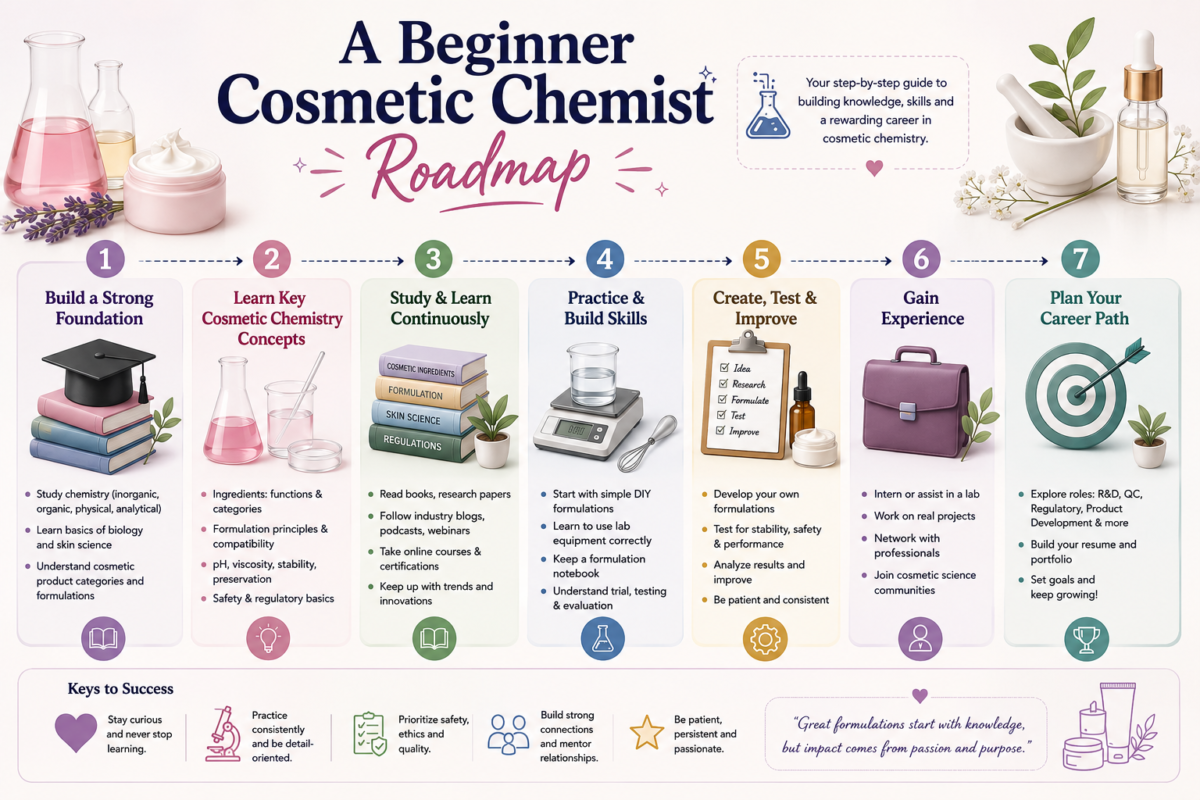
| Stage | Focus | Milestone |
| 1. Orientation | Ingredient categories and safety | Know what each ingredient does |
| 2. First makes | Tested anhydrous formulas | Reproduce a balm reliably |
| 3. Emulsions | Simple lotions and phases | A stable lotion at the correct pH |
| 4. Modification | Changing one variable at a time | Predict how a change affects feel |
| 5. Design | Building from a blank worksheet | An original, stability-tested formula |
The early stages reward patience over ambition. Reproducing a simple balm three times in a row teaches more than rushing into a complex serum that fails for reasons you cannot diagnose.
The later stages add responsibility as your skill grows. Documentation, stability testing, and proper preservation become non-negotiable once you move from following formulas to designing your own.
Common Beginner Mistakes
These are the errors that derail new formulators most often. Each one names the mistake, explains why it happens, and gives the exact fix.
- Measuring by volume instead of weight. Beginners reach for spoons because cooking taught them to, but ingredient densities vary, and volume destroys reproducibility. Weigh every ingredient on a scale accurate to 0.01 g.
- Starting with a complex water-based product. New formulators jump to creams and serums that demand emulsification, preservation, and pH control all at once. Begin with anhydrous balms and oils, then add one new skill at a time.
- Skipping the preservative in water-based products. Many believe a natural or refrigerated product needs no preservative, which invites invisible microbial growth. Include a broad-spectrum preservative at full strength in every water-containing formula.
- Adding extra ingredients to a tested formula. Beginners pile in oils and actives for a better result, which unbalances the formula and hides what each part was doing. Make the formula as written first, then change one variable at a time.
- Ignoring pH on water-based products. Formulators assume the product is fine because it looks fine, yet the wrong pH harms feel, stability, and preservation. Measure pH and adjust to the product’s target range before use.
- Keeping no records. Working without a worksheet means a good batch can never be repeated. Record the formula, batch size, pH, and observations for every single make.
Suitability Guide
This roadmap suits anyone beginning cosmetic formulation, from complete newcomers to crafters moving toward a more professional process. The staged approach lets you start at your current level and progress at your own pace.
Absolute beginners should start at the orientation and anhydrous stages, where no preservative or pH control is required. These projects build confidence and core habits with the lowest risk.
More confident makers can move sooner into simple emulsions, provided they respect preservation and pH from the start. Skipping those safeguards is the one shortcut that is never acceptable.
These principles apply across skincare and haircare alike, since both rest on the same weighing, sourcing, and record-keeping habits. A beginner who learns this process on a balm is well prepared for lotions, cleansers, and conditioners later.
Always conduct a 48-hour patch test with any new formula before wider use.
Frequently Asked Questions
Where do I start with cosmetic formulation?
Start with a tested anhydrous formula, such as a lip balm or body oil, since these need no preservative or pH adjustment. Reproduce it exactly before changing anything, then progress to a simple lotion. Building accuracy and good habits on easy projects sets up everything that follows.
Do I need a degree to formulate cosmetics?
No, a degree is not required to formulate safely at home or for a small brand. You do need to learn the core principles of usage levels, preservation, and pH, and to follow supplier guidance for every ingredient. Many professional formulators are self-taught through disciplined, documented practice.
What equipment do beginner formulators need?
The essentials are a scale accurate to 0.01 g, heatproof beakers, a thermometer, a pH meter or strips, and 70% isopropyl alcohol for sanitising. A second scale that reads to 1 g helps with water and larger amounts. Accurate weighing and pH measurement are the two capabilities you cannot skip.
Why weigh cosmetic ingredients by mass?
Ingredients are weighed by mass because their densities differ, so volume measurements are inconsistent and unrepeatable. A formula written in percentages converts directly to grams, which keeps every batch identical. Weighing also lets you scale a formula to any batch size with simple multiplication.
What is INCI and why does it matter?
INCI is the International Nomenclature of Cosmetic Ingredients, the standard naming system on cosmetic labels worldwide. It lets you identify exactly what is in a product and source the same materials by their precise names. Reading an INCI list also reveals which ingredients dominate a formula.
How small can a test batch be?
A test batch of 30 g to 50 g is usually the practical minimum for a beginner. It is large enough to judge texture, pH, and stability, while small enough to keep mistakes cheap. Just make sure your scale can weigh the smallest additions accurately at that size.
What should I formulate first as a beginner?
Begin with a lip balm, then a body oil, then a simple lotion. This sequence introduces melting, pouring, emulsification, and pH control one skill at a time. Each project builds directly on the last without overwhelming you.
Do beginners need to test product pH?
Yes, any water-based product needs its pH measured and adjusted into the correct range. The right pH supports skin comfort, emulsion stability, and preservative performance. Anhydrous products such as balms and oils contain no water, so they do not require a pH check.
Key Takeaways
You now have a clear path from your first balm to your first original formula. These are the points worth carrying into every project.
- Cosmetic formulation is a percentage-based discipline where every formula totals 100%, and every ingredient is weighed by mass.
- Beginners should start with tested anhydrous products, then progress to emulsions, one new skill at a time.
- A scale accurate to 0.01 g, safe handling, and small 30 g to 50 g batches keep early work accurate and inexpensive.
- Reading INCI and keeping a worksheet for every batch are what make your results reproducible and repeatable.
- Water-based products always need a full-strength preservative and a verified pH, with no exceptions.
Pick one tested balm formula, weigh it out at a 30 g batch this week, and record every step on a worksheet, and you will have taken the first real stage of cosmetic formulation for beginners.