
Introduction
Most first shampoos either refuse to thicken, sting the eyes, or separate within a week. The maker usually blames the surfactant when the real issue is that the system was built without understanding how its parts interact.
Learning how to formulate shampoo is less about finding a magic ingredient and more about balancing a surfactant system. A shampoo is a cleansing system built from anionic, amphoteric, and non-ionic surfactants, tuned for foam, mildness, viscosity, and pH.
This guide takes you from an empty beaker to a finished, salt-thickened, sulfate-free shampoo with a verified pH. You will learn the surfactant classes, the supporting ingredients, how to build viscosity and pH, and a complete professional formula explained step by step with percentages.
By the end, you will be able to read any shampoo label, understand the role of every line, and adjust a base to suit different hair types. That skill carries straight into conditioners, body washes, and facial cleansers, because they all sit on the same surfactant chemistry.
Shampoo Formula Structure: What a Shampoo Actually Is
A shampoo is a dilute surfactant system that lifts oil and dirt from hair and scalp, then rinses away cleanly. Water is the largest ingredient, and surfactants do the cleansing work.
The shampoo formula structure follows a predictable architecture. A primary surfactant provides the bulk of the cleansing and foam, secondary surfactants add mildness and stabilise the foam, and a set of supporting ingredients handles conditioning, thickening, preservation, and pH.
This structure is why shampoo formulation is more like assembling a balanced system than following a recipe. Change one surfactant, and you change foam, viscosity, mildness, and clarity all at once.
A professional shampoo formula always totals exactly 100% by weight. Surfactants are usually supplied as dilute solutions, so the percentage on your sheet refers to the material as supplied, not to its active content.
Water does more than fill the formula to 100%. It dilutes the concentrated surfactants to a mild, usable level, carries the water-soluble ingredients, and sets the stage for the salt curve that builds viscosity later.
Understanding active versus as-supplied content is fundamental. A surfactant sold at 30% active contributes far less cleansing power per gram than its weight suggests, which is why total active surfactant is the number experienced formulators track.
How to Formulate Shampoo: Building the Surfactant System
The surfactant system is the heart of every shampoo, and it determines almost everything the user experiences. Anionic surfactants in shampoo do most of the cleansing, while amphoteric and non-ionic surfactants soften the system and support the foam.
A surfactant is a molecule with a water-loving head and an oil-loving tail, which lets it lift oils into water so they rinse away. Surfactants are grouped by the charge on their head, and that charge defines their behaviour in the formula.
Active Content Versus As-Supplied Weight
Surfactants are sold as dilute solutions, and confusing the two figures is the most common performance error in shampoo work. A material listed at 30% active contributes only 30 g of true surfactant per 100 g of raw material.
To find the total active surfactant, multiply each surfactant’s formula percentage by its active content, then add the results. If disodium laureth sulfosuccinate at 22.00% is supplied at 39% active, it contributes 8.58% active to the finished shampoo.
Doing this for every surfactant gives the active surfactant level, which is the number that predicts cleansing strength and mildness. Two formulas with identical as-supplied percentages can clean very differently when their surfactants are supplied at different concentrations.
Always record the active percentage of every surfactant from its specification sheet. Building to an active target rather than an as-supplied target is what keeps a shampoo reproducible across suppliers.
Anionic Surfactants: The Primary Cleansers
Anionic surfactants carry a negative charge and provide the strongest cleansing and the richest foam. They form the primary surfactant in most shampoos because they remove sebum efficiently and lather well.
The classic anionic workhorses are Sodium Lauryl Sulfate and Sodium Laureth Sulfate, known as SLS and SLES. SLES is notably milder than SLS because its ethoxylated structure reduces irritation potential.
Gentler anionic options exist for sulfate-free work. Disodium Laureth Sulfosuccinate delivers mild cleansing with low irritation, which makes it a strong primary surfactant for a gentle daily shampoo.
Amphoteric and Non-Ionic Surfactants: Mildness and Foam
Amphoteric surfactants carry both positive and negative charges depending on pH, which makes them gentle and excellent at reducing the harshness of anionic surfactants. Cocamidopropyl Betaine is the most widely used amphoteric in shampoo, valued as a secondary surfactant and a foam booster.
Non-ionic surfactants carry no charge and are among the mildest options available. Coco-Glucoside and Decyl Glucoside are plant-derived non-ionics that add mildness, though they foam less and raise the pH of the system.
Foam boosters in shampoo are usually amphoteric or non-ionic surfactants added to improve lather quality and stability. The goal is a dense, stable foam rather than large, fast-collapsing bubbles, since users associate fine foam with effective cleansing.
Foam: What It Drives and What It Does Not
Foam is the visible sign of a surfactant system at work, but foam volume does not equal cleansing power. A low-foaming shampoo can clean as well as a high-foaming one, since cleansing comes from the surfactants lifting oil, not from the bubbles themselves.
Foam quality matters more than quantity for user perception. A creamy, stable lather feels cleansing and luxurious, while a thin, fast-draining foam feels weak even when the shampoo cleans well.
Sebum and oils suppress foam, which is why the first lather on dirty hair is smaller than the second. Building enough foam reserve into the surfactant system keeps the lather satisfying on the first wash.
SLS, SLES, and Sulfate-Free Alternatives
The conversation around SLS alternatives in shampoo comes down to irritation, label perception, and performance. SLS is an effective, inexpensive cleanser, but its high irritation potential and harsh skin feel have pushed many brands toward milder systems.
Sulfate-free does not automatically mean gentler, and it does not mean anionic-free. A sulfate-free shampoo simply replaces SLS and SLES with non-sulfate anionics such as sulfosuccinates, isethionates, or sarcosinates, often paired with glucosides and betaine.
The table below compares common primary surfactant options so you can choose deliberately rather than by reputation alone.
| Surfactant (INCI) | Type | Foam | Mildness | Notes |
| Sodium Lauryl Sulfate | Anionic | High | Low | Harsh, high irritation potential |
| Sodium Laureth Sulfate | Anionic | High | Moderate | Milder than SLS, salt-thickenable |
| Disodium Laureth Sulfosuccinate | Anionic | Moderate | High | Gentle sulfate-free primary |
| Sodium Cocoyl Isethionate | Anionic | Moderate | High | Very mild, supplied as a solid |
| Coco-Glucoside | Non-ionic | Low | High | Mild, raises pH, low foam |
| Cocamidopropyl Betaine | Amphoteric | Moderate | High | Secondary surfactant and foam booster |
Beyond Surfactants: The Supporting Cast
A working shampoo needs more than surfactants. The supporting ingredients turn a raw cleansing blend into a finished, stable, pleasant product.
Conditioning agents counter the rough feel that cleansing can leave behind. Cationic polymers such as Polyquaternium-7 and Polyquaternium-10 carry a positive charge that deposits onto negatively charged hair, improving wet combing and the feel of the dried hair.
Humectants improve the sensory profile and support conditioning. Glycerin is the standard choice, drawing moisture and softening the overall feel of the formula.
Chelators protect both clarity and preservation. Tetrasodium EDTA binds the metal ions found in hard water, which prevents cloudiness and supports the preservative system.
Preservatives are mandatory because shampoo is water-based. A broad-spectrum preservative protects against bacteria, yeast, and mould across the product’s life, and it is the single most important safety ingredient in the formula.
Panthenol and protein hydrolysates are common functional extras. Panthenol is widely used in formulations designed to improve the feel and manageability of hair, and it is included at low levels in the cool-down phase.
Opacifiers and pearlising agents change how the finished shampoo looks. A clear shampoo signals a light, gentle product, while a pearlised or opaque shampoo signals richness, and an agent such as Glycol Distearate creates the characteristic pearl shimmer.
Thickeners give body to systems that resist salt. Hydroxypropyl Guar, xanthan gum, and associative PEG thickeners build viscosity without electrolytes, which suits glucoside-heavy or low-salt formulas that the salt curve cannot thicken.
The Formula Chemistry approach is to add each support ingredient for a stated reason, never to pad a label. If an ingredient does not earn its place through function, it stays out of the formula.
Getting Viscosity and pH Right
Two finishing variables separate a professional shampoo from a thin, harsh one. Shampoo viscosity and shampoo pH balance are adjusted last, once the surfactant system is complete.
Building Shampoo Viscosity
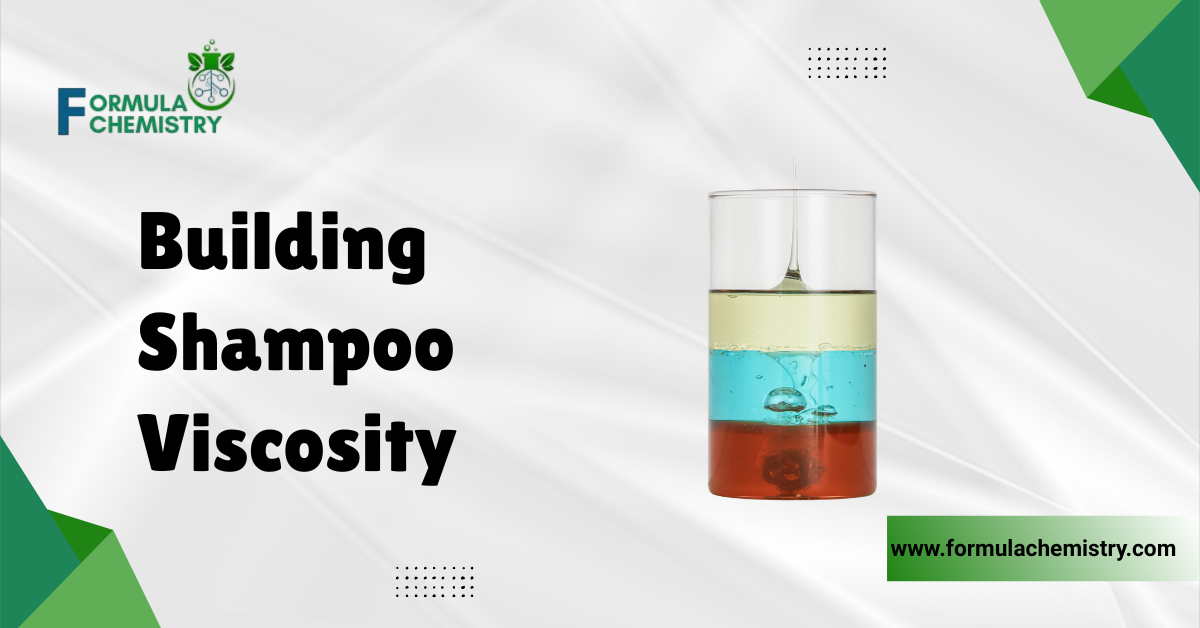
Many surfactant systems thicken when you add salt, a phenomenon known as the salt curve. Adding Sodium Chloride restructures the surfactant micelles, raising viscosity up to a peak before further salt thins the system back down.
The salt curve has a maximum, and overshooting it is a common error. Add salt as a dilute brine in small increments, measuring viscosity as you go, and stop once you reach the target rather than chasing thickness blindly.
Not every system responds to salt. Glucoside-heavy or highly diluted systems often need a different thickener, such as a hydroxypropyl guar, xanthan gum, or a PEG-150 distearate type associative thickener.
Balancing Shampoo pH
Shampoo pH balance matters for hair feel, mildness, and surfactant performance. A target pH of 4.5 to 5.5 keeps hair cuticles smooth, supports conditioning deposition, and keeps most surfactants and preservatives in their effective range.
Glucosides and some surfactant blends push the pH upward, so most shampoos need acidifying. Citric Acid added as a dilute solution brings the pH down into range, and a calibrated meter confirms the result.
Never guess pH on a rinse-off product. A shampoo formulated above pH 6 can leave hair feeling rough and reduce the effect of cationic conditioners.
Common Shampoo Types and How the Formula Shifts
Once you understand the base structure, you can shift it toward different products by changing a few variables. The surfactant level, the conditioning load, and the actives are the main levers.
A clarifying shampoo raises the anionic surfactant level and cuts the conditioning agents, which strips buildup more aggressively. A moisturising shampoo does the reverse, lowering the active surfactant and adding more cationic conditioner, humectant, and emollient.
A gentle or low-irritation shampoo leans on amphoteric and non-ionic surfactants while keeping the anionic share modest. A two-in-one shampoo carries a much higher conditioning load, often with silicones held in suspension, so it cleanses and conditions in a single step.
| Shampoo type | Active surfactant | Conditioning load | Defining change |
| Clarifying | Higher, 14% to 16% | Low | More anionic, fewer conditioners |
| Daily gentle | Moderate, 10% to 13% | Moderate | Balanced mild surfactant blend |
| Moisturising | Lower, 9% to 12% | High | More cationic polymer and humectant |
| Two-in-one | Moderate | Very high | Suspended conditioning agents |
The formula in this guide sits in the daily gentle category. Moving it toward another type is a matter of adjusting these levers and re-testing viscosity, pH, and stability each time.
How to Read a Shampoo Label
Reading an INCI list is a core skill, and it lets you reverse-engineer the structure of almost any shampoo. Ingredients appear in descending order of weight down to 1%, after which they can be listed in any order.
Water sits first on nearly every shampoo, followed by the primary surfactant. Spotting names such as sodium laureth sulfate, sodium cocoyl isethionate, or disodium laureth sulfosuccinate near the top tells you the cleansing base at a glance.
The secondary surfactants come next, with cocamidopropyl betaine and a glucoside being the usual companions. Their position tells you how the foam and mildness were balanced against the primary surfactant.
Lower down sit the supporting players, where the polyquaterniums signal conditioning, the EDTA signals chelation, and the citric acid signals pH adjustment. The preservative usually appears near the end, since it is used at a low level.
Learning this order means you can read a competitor product and build a starting structure from it. That single skill turns the entire market into a reference library for your own formulation work.
Shampoo Formulation Step by Step with Percentages
The fastest way to understand how to make shampoo professionally with INCI is to build one complete formula and see every principle in use. The formula below is a gentle, sulfate-free daily shampoo with a balanced surfactant system, cationic conditioning, salt-built viscosity, and a verified pH.
Read the ingredient breakdown before the table. Knowing why each ingredient is present is the entire purpose of this exercise.
Phase A: The Water Phase
Aqua (Water) makes up 53.95% of the formula and forms the base that dilutes the surfactants to a usable level. Distilled or deionised water is used to avoid introducing metal ions and microbes.
Glycerin at 2.00% is the humectant, chosen for its reliability and broad tolerance. It softens the overall feel and supports the conditioning effect.
Tetrasodium EDTA at 0.20% is the chelator, selected over disodium EDTA for its higher solubility in this system. It binds hard-water metal ions, keeping the shampoo clear and supporting the preservative.
Polyquaternium-10 at 0.30% is a cellulose-based cationic conditioner that needs full hydration in the water phase before surfactants are added. It deposits on hair to improve wet combing and is added first so it disperses without lumping.
Phase B: The Surfactant Phase
Disodium Laureth Sulfosuccinate at 22.00% is the primary anionic surfactant, chosen over SLS and SLES for its high mildness and low irritation potential. It provides the core cleansing and a moderate, stable foam.
Cocamidopropyl Betaine at 12.00% is the amphoteric secondary surfactant and foam booster. It increases lather, raises mildness, and contributes to the salt-responsive thickening of the system.
Coco-Glucoside at 5.00% is the non-ionic surfactant, added for extra mildness and a softer skin feel on the scalp. It is included at a modest level because higher amounts reduce foam and raise the pH.
Phase C: Conditioning Additives
Polyquaternium-7 at 1.50% is the second cationic conditioner, chosen alongside Polyquaternium-10 because the two deposit differently and improve both wet and dry feel. It enhances slip during rinsing and softness afterward.
Panthenol at 0.50% is the functional conditioning additive, included to support the feel and manageability of the hair. It is added to cool it from unnecessary heat exposure.
Phase D: Finishing Phase
Phenoxyethanol (and) Ethylhexylglycerin at 1.00% is the broad-spectrum preservative, selected for its wide pH tolerance and compatibility with surfactant systems. It protects against bacteria, yeast, and mould.
Parfum (Fragrance) at 0.30% is optional and included at a conservative level for a clean, light scent. It is added near the end because fragrance compounds are volatile.
Citric Acid at 0.25%, used as a dilute solution, brings the finished shampoo into the target pH range. The amount is adjusted to result rather than added blindly.
Sodium Chloride at 1.00%, added as a brine, builds the viscosity through the salt curve. The final amount is tuned to the target thickness rather than fixed.
Complete Formula Table
| Phase | INCI Name | Common Name | Percentage Weight |
| A | Aqua | Distilled Water | 53.95% |
| A | Glycerin | Vegetable Glycerin | 2.00% |
| A | Tetrasodium EDTA | Chelator | 0.20% |
| A | Polyquaternium-10 | Cationic Conditioner | 0.30% |
| B | Disodium Laureth Sulfosuccinate | Mild Anionic Surfactant | 22.00% |
| B | Cocamidopropyl Betaine | Amphoteric Surfactant | 12.00% |
| B | Coco-Glucoside | Non-Ionic Surfactant | 5.00% |
| C | Polyquaternium-7 | Cationic Conditioner | 1.50% |
| C | Panthenol | Provitamin B5 | 0.50% |
| D | Phenoxyethanol (and) Ethylhexylglycerin | Preservative | 1.00% |
| D | Parfum | Fragrance | 0.30% |
| D | Citric Acid | Citric Acid Solution | 0.25% |
| D | Sodium Chloride | Salt | 1.00% |
| Total | 100.00% |
The percentages are weight-based, so they convert to any batch size by multiplication. For a 100 g batch, each percentage equals its value in grams, so 22.00% becomes 22.00 g. For a 500 g batch, multiply each percentage by 5, so 22.00% becomes 110.00 g.
Weigh on a scale accurate to at least 0.01 g for the small additions, and treat water as the balancing ingredient if rounding shifts the total.
The Step-by-Step Method
This method assumes a 100 g batch and basic equipment: a beaker, an overhead or low-shear stirrer, a thermometer, a scale accurate to 0.01 g, and a pH meter. Surfactants foam readily, so mix slowly throughout and keep the stirrer below the surface.
Step 1: Weigh and Prepare
Weigh the water phase into your main beaker and keep each remaining phase in separate labelled containers. Sanitise all equipment with 70% isopropyl alcohol before starting.
Step 2: Hydrate the Water Phase
Warm the water phase gently to around 40°C and sprinkle in the Polyquaternium-10 while stirring slowly. Continue stirring until the polymer fully hydrates and the phase turns clear with no lumps, then let it cool to room temperature.
Step 3: Add the Surfactants
Add the Phase B surfactants one at a time, stirring slowly after each addition. Keep the speed low and the stirrer submerged to avoid whipping air into the batch, which is difficult to remove later.
Step 4: Add the Conditioning Additives
Stir in the Polyquaternium-7 and panthenol until the batch is uniform. Maintain slow mixing, since cationic polymers can cause temporary cloudiness that clears as they distribute.
Step 5: Add the Finishing Phase
Add the preservative and fragrance, mixing each in fully before the next. Low, steady stirring keeps the system clear and bubble-free.
Step 6: Adjust the pH
Measure the pH with a calibrated meter. Add the citric acid solution a few drops at a time, stirring and re-measuring, until the shampoo reads between 4.5 and 5.5.
Step 7: Build the Viscosity
Prepare a 25% sodium chloride brine and add it in small increments while stirring. Watch the viscosity rise toward your target, and stop before the salt curve peaks, because excess salt thins the shampoo back down.
Step 8: Rest, Inspect, and Bottle
Let the shampoo rest for several hours so trapped air rises and clears. Confirm the final pH and viscosity, then bottle into a sanitised container labelled with the date and batch number.
Technical Formulation Notes
These notes cover the decisions that turn a working batch into a reproducible, stable product. They are where shampoo formulation becomes professional.
Finished pH
The target pH for this shampoo is 4.5 to 5.5, which keeps hair cuticles smooth and supports the cationic conditioners. A reading outside this window calls for adjustment with citric acid solution before the product is used or stored.
Preservation Rationale
The formula is more than 50% water, which makes a broad-spectrum preservative mandatory. Phenoxyethanol (and) Ethylhexylglycerin at 1.00% covers bacteria, yeast, and mould across the shampoo’s pH range, and the tetrasodium EDTA supports it by removing metal ions that reduce preservative efficacy.
Preservation is a system rather than a single ingredient. Clean equipment, distilled water, and a chelator all contribute to keeping the product safe across its shelf life.
Stability and Clarity Considerations
The main risks in a shampoo are cloudiness, viscosity drift, and pH shift over time. Cationic polymers and hard water both cause haze, which is why the chelator and distilled water matter for a clear finished product.
Run basic stability checks before trusting any batch. Hold samples at room temperature, in a warm place around 40°C, and through several freeze-thaw cycles, then watch for separation, cloudiness, viscosity change, or odour shift over four to eight weeks.
Substitution Options and Trade-offs
The primary surfactant is the riskiest substitution. Swapping the sulfosuccinate for SLES changes the foam, the salt response, and the mildness, so any primary surfactant change should be treated as a new formula and retested for viscosity and pH.
The conditioning polymers are easier to adjust. You can raise or lower the Polyquaternium levels to tune slip and softness, though too much cationic material can leave a heavy, coated feel on fine hair.
The thickening route can change with the surfactants. A more glucoside-heavy system may resist salt, so a guar or xanthan thickener becomes the better tool, at the cost of a slightly different flow and feel.
Scale-Up Considerations
The formula scales linearly by weight, so the percentages hold from a 100 g test batch to a production run. What changes with scale is mixing, air management, and the precision of the salt and acid additions.
Larger batches trap more air and clear more slowly, so plan for longer rest times and gentle, controlled mixing. Add the salt brine and citric acid in stages at every scale, since both the salt curve and the pH endpoint are easy to overshoot in a big tank.
Quality Checks Before Release
Three measurements confirm a shampoo batch: pH, viscosity, and appearance. Record the pH against your target range, check the viscosity against a reference batch, and inspect the product for clarity, colour, and freedom from trapped air.
A short use test completes the picture. Wash with a small sample to confirm the foam quality, the ease of rinsing, and the after-feel match your target, since instrument readings alone never capture how a shampoo performs in the hand.
Common Shampoo Formulation Mistakes
These are the errors that derail new shampoo formulators most often. Each one names the mistake, explains why it happens, and gives the exact fix.
- Confusing the as-supplied weight with the active content. Beginners assume 22% of a surfactant means 22% active, but most surfactants are supplied dilute, so the real active level is far lower. Track total active surfactant using each supplier’s active percentage, and build to an active target rather than a weight target.
- Over-salting past the viscosity peak. Formulators keep adding salt, expecting it to keep thickening, but the salt curve peaks and then thins the system. Add salt as a dilute brine in small steps, measure as you go, and stop at the target viscosity.
- Skipping or under-dosing the preservative. A surfactant-heavy product feels self-cleaning, which leads people to believe it needs no preservative, but shampoo is water-based and supports microbial growth. Include a broad-spectrum preservative at its full recommended level in every batch.
- Ignoring pH on a rinse-off product. New formulators assume rinse-off means pH does not matter, yet the wrong pH leaves hair rough and weakens cationic conditioning. Measure the pH and adjust to the 4.5 to 5.5 range before use.
- Whipping air into the batch. Fast mixing or a raised stirrer fills the shampoo with bubbles that take days to clear and spoil the appearance. Stir slowly with the head submerged, and let the batch rest before bottling.
- Adding cationic polymers carelessly. Tipping in a conditioning polymer or hydrating it in the wrong order causes lumps and permanent haze. Disperse Polyquaternium-10 fully in the water phase first, and add other cationics slowly with steady stirring.
- Calling a formula finished without stability testing. A shampoo that looks clear on day one can cloud, thin, or drift in pH within weeks. Run room-temperature, warm 40°C, and freeze-thaw checks before trusting any formula.
Suitability Guide
This formula and the principles behind it suit a wide range of users, but a few cautions apply. Matching a shampoo to hair and scalp type is part of formulating responsibly.
The shampoo is well-suited to normal, dry, and colour-treated hair, where its gentle surfactant system cleanses without stripping. The cationic conditioners improve combing and softness, which benefits longer and coarser hair in particular.
Very oily hair and scalp may prefer a stronger clarifying system. Raising the anionic surfactant level or adding a more aggressive primary surfactant increases cleansing power for heavy buildup.
Sensitive or reactive scalps benefit from this sulfate-free, low-irritation base. Omitting the fragrance further lowers the irritation risk for those who react to scent.
This formula is built as a rinse-off cleanser and is not a leave-on product, though its surfactant principles transfer directly to body washes and facial cleansers. A formulator learning about this shampoo is well prepared to move into other surfactant systems next.
On experience level, this is an approachable intermediate formula. It is forgiving enough for a careful first surfactant project, while teaching active content, the salt curve, and pH balancing that professional work requires.
Always conduct a 48-hour patch test with any new formula before wider use.
Frequently Asked Questions
How do you formulate a shampoo from scratch?
You formulate a shampoo by building a balanced surfactant system in water, then adding conditioning, preservative, viscosity, and pH ingredients. Start with a primary anionic surfactant for cleansing, add an amphoteric for mildness and foam, then finish with a chelator, preservative, salt for viscosity, and citric acid for pH. Every shampoo formula totals 100% by weight and should be confirmed with a calibrated pH meter.
What surfactants are used in shampoo?
Shampoos use a blend of anionic, amphoteric, and non-ionic surfactants. Anionic surfactants such as sulfosuccinates, SLES, or SLS provide the main cleansing and foam, amphoterics like cocamidopropyl betaine add mildness and boost lather, and non-ionics such as coco-glucoside increase gentleness. The blend is tuned for foam, mildness, and viscosity rather than relying on a single surfactant.
Is sulfate-free shampoo better for hair?
Sulfate-free shampoo is often milder on the scalp and gentler on colour-treated hair, but sulfate-free does not automatically mean better for everyone. A well-built sulfate-free system using sulfosuccinates and glucosides cleanses effectively with lower irritation potential. Heavily oily hair may still prefer a stronger sulfate-based cleanser for deep cleaning.
How do you thicken a shampoo naturally?
Many surfactant systems thicken when you add sodium chloride, which restructures the micelles through the salt curve. Add salt as a dilute brine in small increments and stop at the viscosity peak, since excess salt thins the system. Glucoside-heavy systems that resist salt can be thickened with hydroxypropyl guar or xanthan gum instead.
What pH should shampoo be?
Shampoo is typically formulated to a pH of 4.5 to 5.5, which keeps hair cuticles smooth and supports cationic conditioning. This range also keeps most surfactants and preservatives in their effective window. Always confirm the value with a calibrated pH meter and adjust with citric acid solution if needed.
Do homemade shampoos need a preservative?
Yes, every water-based shampoo requires a broad-spectrum preservative with no exceptions. Water supports bacteria, yeast, and mould, and the contamination is usually invisible until it is advanced. A surfactant base does not preserve itself, so a full-strength preservative is essential for safety.
Can I make shampoo without SLS or SLES?
Yes, a sulfate-free shampoo replaces SLS and SLES with milder anionics such as disodium laureth sulfosuccinate, sodium cocoyl isethionate, or sarcosinates. These are usually paired with cocamidopropyl betaine and a glucoside for foam and mildness. The trade-offs are slightly lower foam and a different thickening response that may need adjusting.
How much active surfactant should a shampoo have?
A typical shampoo contains roughly 10% to 16% active surfactant, depending on how gentle or clarifying it is meant to be. Because surfactants are supplied dilute, you calculate active content from each supplier’s active percentage rather than the as-supplied weight. Lower active levels suit gentle daily shampoos, while higher levels give stronger cleansing.
Key Takeaways
You now have the framework that turns a random surfactant blend into a real, balanced shampoo. These are the points worth carrying into every future formula.
- A shampoo is a balanced surfactant system, combining anionic, amphoteric, and non-ionic surfactants for cleansing, mildness, and foam.
- Total active surfactant, not as-supplied weight, is the number that determines how a shampoo actually cleanses.
- Viscosity is built through the salt curve, which peaks and then reverses, so salt is added gradually to a target.
- Shampoo is formulated to a pH of 4.5 to 5.5 and always requires a full-strength broad-spectrum preservative.
- Stability testing across room, warm, and freeze-thaw conditions is what proves a formula, not how it looks on day one.
Build the sulfate-free shampoo above at a 100 g batch this week, track your active surfactant level, and tune the salt and pH to target, and you will understand how to formulate shampoo far better than any recipe alone can teach.