
Introduction
Every formulator eventually asks why their bench results do not match their stability data. The emulsion looks fine, the pH is correct, the preservative is in range and yet something is off. Nine times out of ten, the water is the problem.
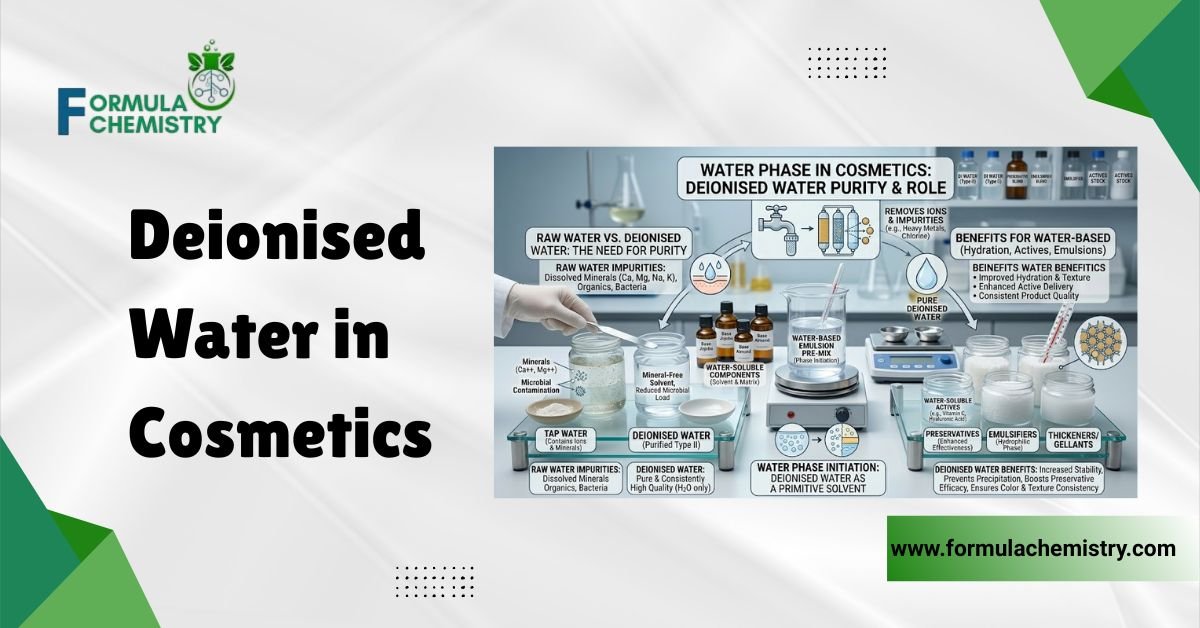
Deionised water is not a premium upgrade or a laboratory luxury. It is the baseline starting material for every professionally made cosmetic formula, and using anything else introduces a variable you cannot control.
This article explains what DI water is, what it does inside a formula, and why Formula Chemistry treats it as a non-negotiable foundation for serious cosmetic formulation.
What is the deionized water?
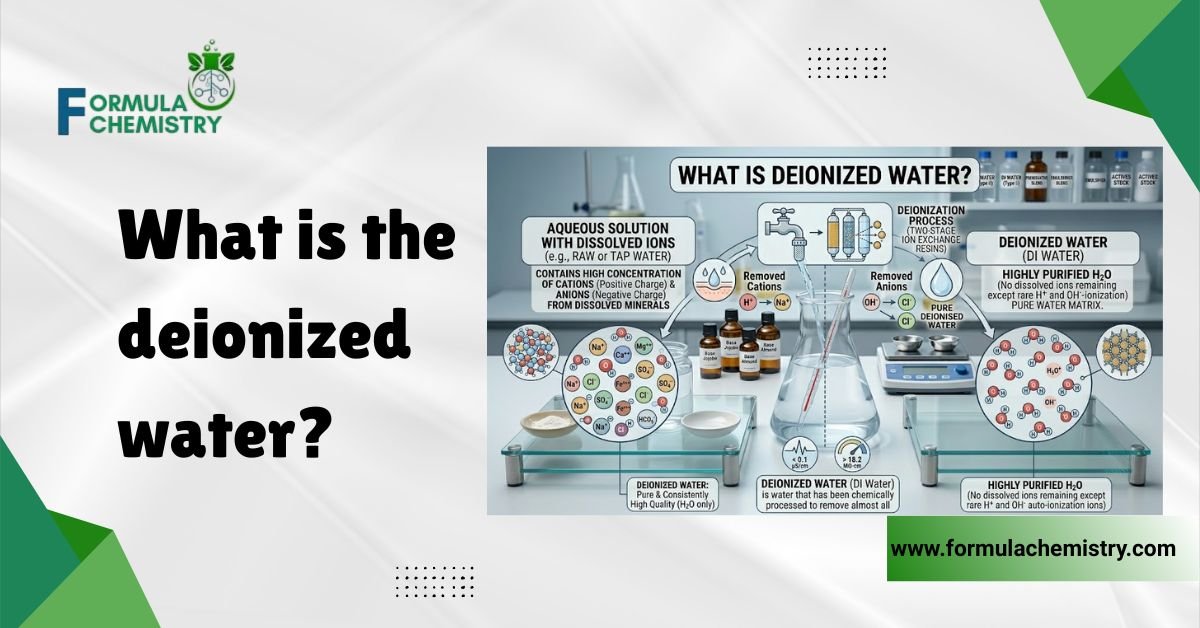
Tap water is not pure water. It carries dissolved cations and anions picked up from pipes, treatment facilities, and local geology. That mineral content varies by region, by season, and sometimes by time of day.
That variability is manageable when making tea. It is not manageable when formulating a cosmetic product that needs to perform identically batch after batch.
The ion exchange process passes water through resin beds. One bed carries hydrogen ions that swap for dissolved cations.
Another carries hydroxide ions that swap for dissolved anions. What comes out is water with a conductivity typically below 1 µS/cm, sometimes as low as 0.1 µS/cm in high-grade systems.
That low conductivity is the working measure of DI water quality. A conductivity meter is inexpensive, reliable, and should sit on every formulator’s bench.
If your DI water reads above 1 µS/cm, the resin is exhausted and needs replacement before that water goes into any formula.
Why Deionised Water Is Essential to Cosmetic Formulation Chemistry
Good formulation is built on controlled variables. Every ingredient you add carries known chemistry. The moment you introduce tap water, you add an uncontrolled mix of mineral ions whose concentration you cannot measure without specialist equipment and whose effects compound across multiple ingredient interactions simultaneously.
The three areas where this causes the most damage are emulsion stability, preservation efficacy, and surfactant performance. Understanding each one makes the case for DI water far more convincingly than any general recommendation ever could.
How Mineral Ions Disrupt Cosmetic Emulsion Chemistry
Divalent cations calcium and magnesium carry a double positive charge that interacts strongly with negatively charged ingredients. Anionic emulsifiers, carbomer thickeners, and anionic surfactants all carry negative charges at working pH.
When divalent cations enter that system, they bridge adjacent anionic sites and cause flocculation, viscosity collapse, or phase separation.
A carbomer gel that looks perfect at the bench will turn thin and grainy within weeks if made with hard tap water. Switching to DI water and retesting resolves the problem immediately.
Deionised Water and Cosmetic Preservation Chemistry
Hard water minerals interact with anionic preservative components and reduce their bioavailability the portion of the preservative that is free and active in solution. Phenoxyethanol blends, sodium benzoate, and other anion-active systems are all affected.
The mineral ions tie up part of the preservative, leaving the formula under-protected without any visible sign at the bench. The only way to detect it is challenge testing to ISO 11930 or USP 51 standards.
Including tetrasodium EDTA at 0.05–0.1% helps sequester residual ions and adds a further layer of security to the preservation system.
Deionised Water Versus Other Water Types in Cosmetic Science
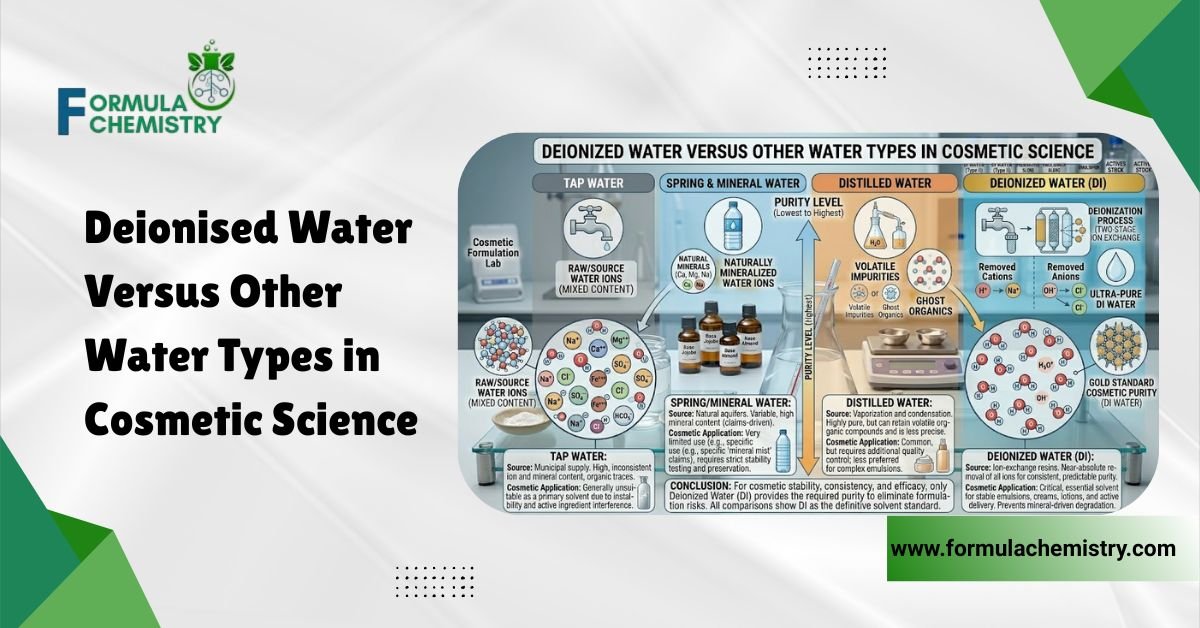
Formulators frequently ask whether distilled water or reverse osmosis water is an acceptable substitute for DI water. The answer depends on the conductivity achieved and the scale of production, not on the purification method itself.
Distilled water is purified by boiling and condensation, removing minerals, most bacteria, and many organic compounds.
DI water removes ions specifically through resin exchange. Both reach comparable conductivity at bench scale and both are suitable for cosmetic formulation when tested below 1 µS/cm.
Reverse osmosis water passes through a semi-permeable membrane under pressure and typically achieves conductivity of 1–10 µS/cm.
That is good but not always consistent enough for precision formulation. In professional production, RO is commonly used as a pre-treatment stage before a final DI polishing step to achieve the tightest ion control possible.
Formulation Considerations for Deionised Water in Cosmetic Chemistry
Every water-containing formula begins with DI water as its foundation, and how you handle that water before and during production directly affects the finished formula’s quality.
pH Behaviour and Phase Preparation
Fresh DI water has a theoretical pH of 7.0, but it absorbs carbon dioxide from the air rapidly and can read as low as 5.5 within minutes of exposure. This is carbonic acid formation from dissolved CO₂, not contamination.
Always measure and adjust the formula pH after all ingredients have been added, not at the water stage alone.
Heat the water phase to the required temperature, typically 70–80°C for emulsions, before adding heat-sensitive actives. Use stainless steel grade 316 or glass vessels. Reactive metals introduce ions into the water phase and undermine the purity you worked to achieve.
Microbial Control and Storage of DI Water
Ion exchange resin beds are wet environments that support microbial growth. DI water from a poorly maintained system can carry a higher microbial load than the tap water it started as. Store DI water in clean, sealed containers and use it within 24 hours of collection for bench work.
For production environments, UV sterilisation downstream of the resin beds is standard practice. Conduct regular microbial counts on production DI water and replace resin beds on the manufacturer’s recommended schedule, not just when conductivity rises.
Common Deionised Water Formulation Mistakes and How to Fix Them
- Using tap water for early-stage testing: Mineral content skews viscosity, pH, and emulsion stability from the very first trial. All bench testing, including rough prototyping, should use DI water to generate data you can trust.
- Not checking conductivity before use: Exhausted resin produces water that looks identical to high-quality DI water but performs like hard water. Test conductivity before every batch with a calibrated meter.
- Storing DI water in open containers: Exposure to air introduces CO₂ and microbial contamination. Seal containers immediately after filling and use within 24 hours.
- Assuming DI water removes the need for a chelating agent: Even low-conductivity water carries trace ions, and some ingredients introduce ions themselves during processing. Include tetrasodium EDTA or phytic acid in all water-containing formulas as standard.
- Heating DI water in reactive metal vessels: Prolonged heating in aluminium or reactive steel introduces metal ions into the water phase. Use stainless steel grade 316 or glass exclusively.
- Skipping microbial testing of stored DI water: Resin beds and storage containers harbour microbial growth that transfers directly into formulas. Run regular microbial counts and replace resin on schedule.
Suitability Guide for Deionised Water Across Cosmetic Formula Types
Deionised water is appropriate in every cosmetic and personal care product type emulsions, gels, serums, shampoos, conditioners, toners, and micellar waters. There are no skin type restrictions and no hair type contraindications.
Beginners should establish the habit of using DI water from their very first formula. The cost of a benchtop ion exchange unit or pharmaceutical-grade DI water from a laboratory supplier is negligible compared to the cost of reformulating a failed stability batch.
Always conduct a 48-hour patch test with any new formula before wider use.
FAQ’s about di water
What is DI water for?
DI water is used wherever a chemically neutral, ion-free water source is required in cosmetic formulation, laboratory analysis, and industrial processes.
In cosmetics, it prevents mineral ions from disrupting emulsifiers, preservatives, and thickeners. It is the standard water phase base for all professional formulas.
Is distilled water and DI water the same?
They are produced differently but perform similarly at bench scale. Distilled water is purified by boiling and condensation while DI water is purified by ion exchange resin. Both achieve low conductivity but neither is sterile, so microbial handling precautions apply to both.
Is drinking DI water good for you?
DI water is not recommended for regular consumption. It lacks the dissolved minerals the body expects from drinking water, and prolonged intake may affect electrolyte balance. It is a production and laboratory material, not a beverage.
Is DI water good for hair?
In a hair product formula, DI water means surfactants, conditioners, and actives perform without mineral interference. Hard water minerals dull surfactant lather and deposit on the hair shaft. Formulas made with DI water deliver cleaner, more consistent results regardless of the end user’s local water supply.
Which is better, DI water or RO water?
For bench-scale cosmetic formulation, high-quality DI water below 1 µS/cm is the more reliable choice. RO water reduces dissolved solids significantly but typically sits at 1–10 µS/cm. In production, RO is commonly used as a pre-treatment before a final DI polishing step.
Can I make DI water at home?
Benchtop ion exchange units are available and produce usable DI water for small-scale formulation. The resin cartridges require regular replacement and conductivity testing tells you when that is needed. Standard carbon filters do not deionise water and are not a substitute.
Which water is best to drink daily? F
or drinking, filtered tap water or properly sourced mineral water is the appropriate choice. The minerals in drinking water contribute to daily calcium and magnesium intake. DI water is not produced or intended for daily hydration and has no role in that context.
Is DI water healthier than tap water?
For cosmetic formulation, DI water is categorically the better choice as it removes the variables that cause formula instability and preservation failure. For drinking, tap water treated to municipal standards is appropriate in most regions. These are different applications and the comparison only makes sense within the correct context.
Key Takeaways
- Deionised water removes dissolved mineral ions through ion exchange, giving every formula a chemically neutral and consistent water phase foundation
- Divalent cations from tap water disrupt carbomer gels, anionic emulsifiers, surfactant systems, and preservation efficacy, often without any visible sign at the bench
- Conductivity below 1 µS/cm is the working quality standard test before every batch with a calibrated conductivity meter
- DI water does not eliminate the need for a chelating agent tetrasodium EDTA or phytic acid should be included as standard in all water-containing formulas
- Microbial control of DI water storage is as important as the deionisation step itself sealed containers, short storage windows, and scheduled resin replacement are all required
Audit your current water source today if you are not testing conductivity before every batch, that single process change will do more for your formula consistency than any ingredient switch.