
Introduction
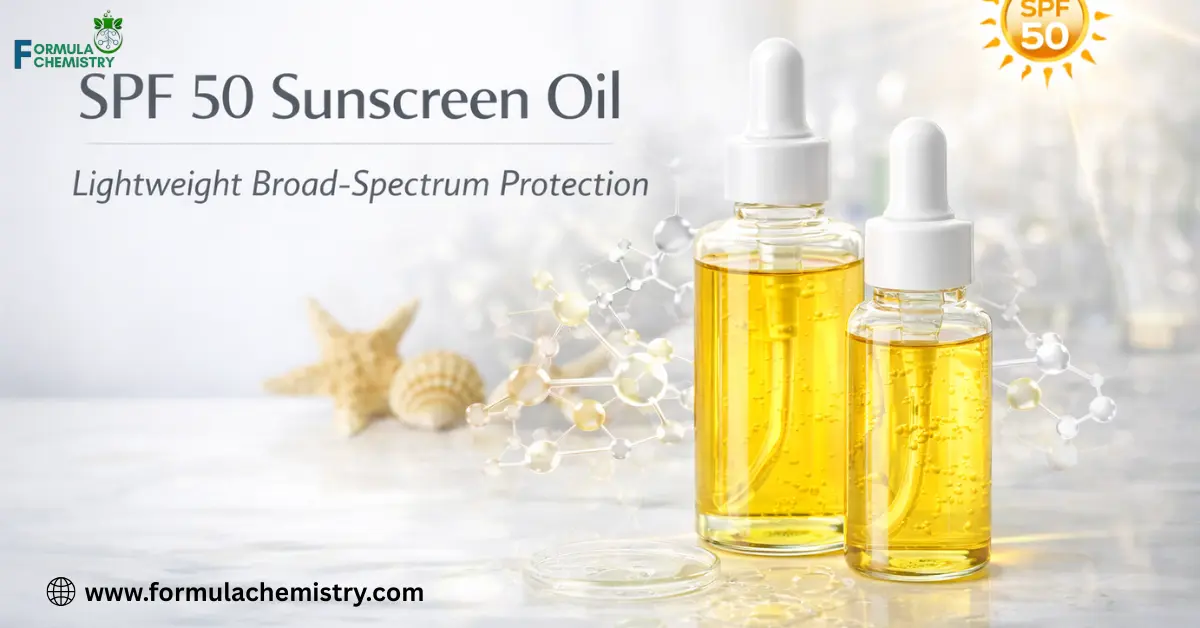
Sunscreen oil has evolved from the low SPF tanning oils of the past into sophisticated, high-performance protection. Modern formulations offer the nourishment of a body oil with the rigorous defense of a clinical sunscreen, protecting against UV damage without the chalky residue.
Understanding the chemistry of these clear fluids shows how scientists achieve high SPF in anhydrous bases. Selecting oil-soluble filters and emollients lets us create a product that feels luxurious while blocking 98% of UVB rays.
In the following section, we delve into the scientific principles that make SPF 50 sunscreen oils effective. We will analyze the ingredients that provide broad-spectrum coverage and explain why the chemical formula of an oil base might be superior for your skin’s hydration needs.
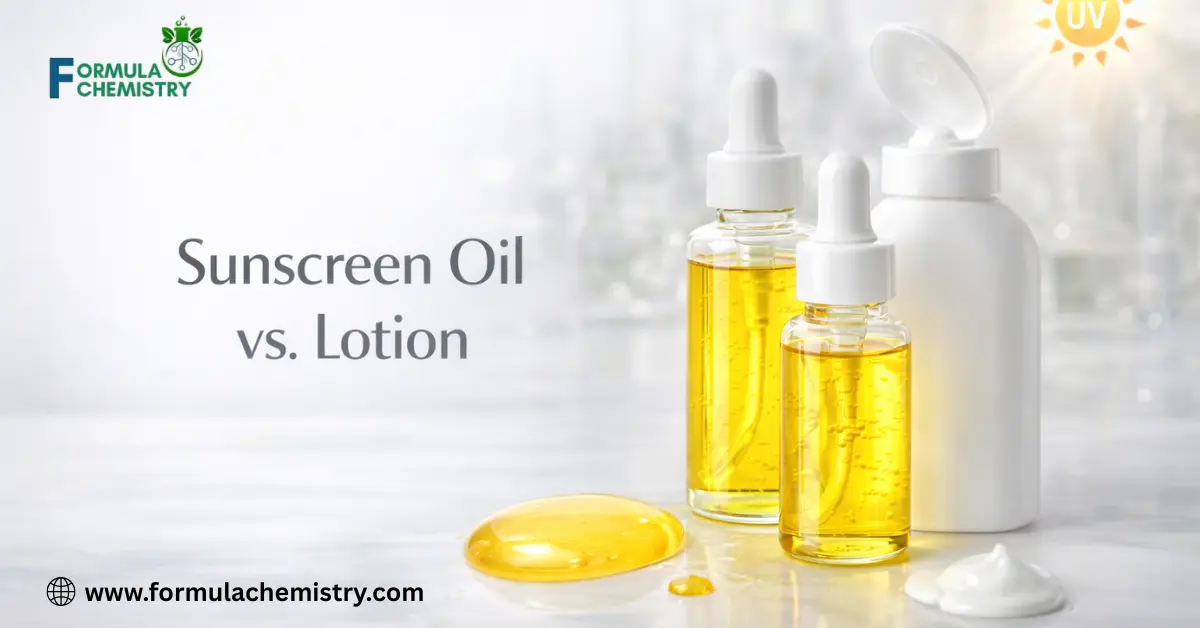
What Makes a Sunscreen Oil Different from a Lotion?
While lotions are emulsions of water and oil, sunscreen oils are anhydrous, meaning they rely entirely on lipid-soluble ingredients to deliver protection
The Absence of Water
Removing water from the equation significantly alters the chemical formula. Without water, there is no need for traditional emulsifiers or high levels of preservatives.
This results in a product that creates a continuous, water-resistant film on the skin more naturally. In Formula Chemistry skincare, we value this for its ability to lock in moisture immediately upon application, preventing the dehydration often caused by sun exposure.
Filter Solubility
High SPF requires a high concentration of UV filters. Many of the most effective chemical filters are lipophilic (oil-loving).
In a lotion, filters are forced into the oil phase. In a sunscreen oil, they dissolve easily, allowing actives like Homosalate or Octocrylene to remain stable and achieve SPF 50 without a heavy feel.
The Chemistry Formula of Organic UV Filters
To achieve invisible protection, sunscreen oils rely on organic (chemical) filters rather than mineral ones, which would sink to the bottom.
Mechanism of Absorption
Organic filters act as sponges for UV radiation. When UV photons hit the skin, these molecules absorb the energy.
This energy excites the electrons within the chemical formula of the filter. As the molecule returns to its ground state, it releases the energy as harmless heat. This process happens millions of times per second, shielding your DNA from radiation damage.
Common Oil-Soluble Filters
You will often see ingredients like Avobenzone (for UVA), Octisalate, and Octocrylene on the label.
These ingredients are selected for their solubility profiles. Formulators often use “solvent oils” like C12-15 Alkyl Benzoate to ensure these crystalline powders dissolve completely, assuring that the final formula chemistry is clear and uniform.
Achieving Broad Spectrum Protection in Oils
SPF only measures UVB protection; a true sunscreen oil must also protect against UVA rays, which penetrate deeper and destroy collagen.
Stabilizing Avobenzone
Avobenzone is the primary UVA filter used in the US, but it is unstable in sunlight.
To prevent degradation, we pair it with stabilizers such as Octocrylene or Bemotrizinol (in other regions). This interaction stabilizes the chemical formula, ensuring the oil continues to absorb aging rays even after an hour in the sun.
Critical Wavelength Requirements
To be labeled “Broad Spectrum,” the product must pass the critical wavelength test (over 370nm).
Achieving this in an oil requires a precise balance of filters. Unlike lotions, where scattering agents can boost UVA protection, oils rely solely on the absorption capacity of the dissolved ingredients, making the formulation process a complex exercise in formula chemistry.
Formula Chemistry Skincare: Selecting the Right Emollients
The “greasy” feel of traditional oils is a thing of the past; modern chemistry offers “dry oils” that absorb instantly.
Esters vs. Plant Oils
While plant oils like Coconut or Argan are nourishing, they can be heavy and slow to absorb.
Formulators use synthetic esters like Isopropyl Myristate or Dicaprylyl Carbonate. These molecules reduce surface tension, allowing the oil to spread rapidly and vanish into the skin, leaving a dry, satin finish.
Boosting Water Resistance
Lipids are naturally hydrophobic (water-repelling).
This makes sunscreen oils inherently more water-resistant than water-based lotions. Film-forming polymers are often added to the formula chemistry to bind the oil to the skin surface, ensuring protection holds up during swimming or sweating.
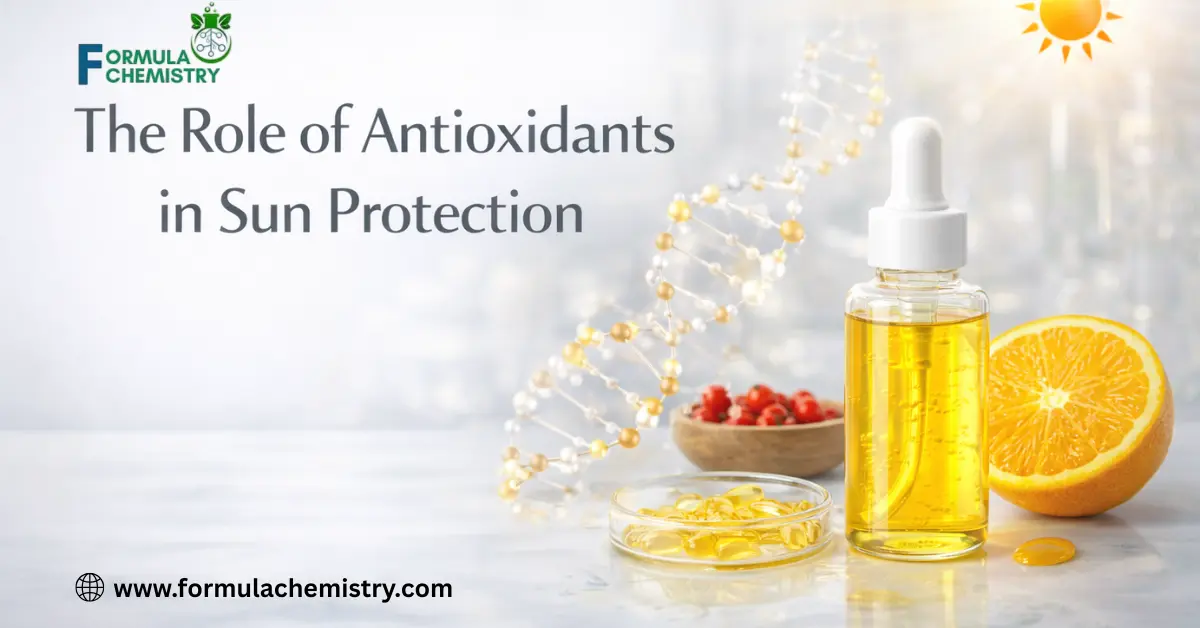
The Role of Antioxidants in Sun Protection
UV rays generate free radicals even when sunscreen is worn; antioxidants are the second line of defense.
Vitamin E (Tocopherol)
Vitamin E is essential in sunscreen oils. Not only does it scavenge free radicals in the skin, but it also protects the product itself.
Unsaturated oils can go rancid when exposed to heat and light. Vitamin E stabilizes the chemical structure of base oils, preventing oxidation and extending the product’s shelf life.
Oil-Soluble Vitamin C
Tetrahexyldecyl Ascorbate is a stable, oil-soluble form of Vitamin C.
Unlike water-soluble L-Ascorbic Acid, it mixes perfectly into sunscreen oils. It brightens the skin and inhibits melanin production, thereby boosting the sunscreen’s efficacy in preventing dark spots.
Formula Chemistry DIY: The Dangers of Homemade SPF
We strongly advise against making your own sunscreen oil, despite the popularity of DIY beauty.
The Myth of Natural Oils
Blogs often claim that Raspberry Seed Oil or Carrot Seed Oil has a natural SPF.
While they have a theoretical absorbance, it is extremely low (SPF 2-4) and varies by harvest. Relying on this for protection is dangerous and scientifically inaccurate. You cannot replicate the efficacy of a lab-tested Formula Chemistry DIY sunscreen at home.
Dispersion and Testing
Even if you buy FDA-approved filters, you cannot verify the SPF without in vivo testing.
You might mix a solution that looks perfect, but if the filters recrystallize or settle, you will end up with microscopic gaps in coverage. This leads to severe sunburn despite applying what appears to be a protective oil.
Application Techniques for Maximum Efficacy
The fluidity of sunscreen oil requires a different application method than a cream to ensure you meet the required dosage.
Measuring the Dosage
To get SPF 50 protection, you need 2mg of product per square centimeter of skin.
With spray oil, it is hard to judge. Do not just mist and walk away. Spray generously until the skin glistens, then rub it in to ensure an even layer. The sheer nature of the formula chemistry makes it easy to underapply.
Reapplication Strategy
Oil breaks down with sebum and friction.
Reapply every two hours, or immediately after toweling off. Because oils dissolve makeup, they are best used on the body or on a bare face at the beach, rather than over a full face of foundation.
Benefits for Dry and Mature Skin
Sunscreen oils offer unique benefits for skin types that struggle with moisture retention and barrier function.
Occlusive Barrier Repair
The oil base acts as an occlusive, trapping hydration into the skin.
For mature skin, which produces less sebum, this is vital. It prevents the “crepey” look that often happens after a day in the sun, keeping the skin pliable and plump.
Enhanced Glow
Oils have a high refractive index.
This means they reflect light better than matte lotions. Applying a sunscreen oil gives the skin an immediate, healthy luminosity that mimics the “glass skin” trend favored in Formula Chemistry skincare.
Environmental Considerations and Biodegradability
As we swim in oceans and lakes, the ingredients we wear wash off into the ecosystem.
Reef-Safe Oils
Many chemical filters, like Oxybenzone, are linked to coral damage.
Modern “clean” sunscreen oils use newer generation filters or reef-safe options like Avobenzone and Octisalate. Checking the label ensures your sun protection doesn’t harm marine life.
Biodegradable Base
The base oils (esters and plant oils) are generally biodegradable.
Unlike silicones found in waterproof lotions, which can persist in the environment, plant-derived emollients break down naturally, making sunscreen oils a potentially greener choice in formula chemistry.
Conclusion
SPF 50 sunscreen oil represents the perfect marriage of luxury and clinical science. It offers high-level protection in a texture that nourishes rather than suffocates.
By utilizing oil-soluble filters and advanced esters, these formulations provide broad-spectrum defense while sustaining the integrity of the skin barrier.
While Formula Chemistry DIY is great for moisturizers, leave the SPF to the experts. Enjoy the radiant, protected glow that only a scientifically formulated oil can provide.
| Ingredient | Function | Weight % | Amount (ml/g) |
|---|
⚠ Professional Lab Verification Required
- Water Percentage (q.s.): This is an anhydrous oil-based formula. No water phase is present. All percentages are fixed and must total exactly 100% by weight.
- SPF Value: SPF 50 claim requires mandatory in-vivo or in-vitro testing by an accredited laboratory per ISO 24444 and ISO 24443. No formula on paper can guarantee a specific SPF value without certified testing.
- pH Adjustment: Not applicable for this anhydrous oil system. However UV filter solubility and compatibility must be verified at lab scale before production.
- Preservation Efficacy: Preservative performance must be validated through Challenge Testing (PET) as per ISO 11930 before any commercial or consumer use of this formulation.
- Stability Testing: This formula requires accelerated stability testing at 4°C, 25°C, and 40°C over a minimum of 12 weeks to confirm physical, chemical, and microbiological stability before market release.
FAQ’s about SPF 50 Sunscreen Oil
Is sunscreen oil as effective as sunscreen lotion?
Yes, if it has the same SPF rating. SPF 50 in an oil offers the exact same UVB protection (blocking approx 98% of rays) as SPF 50 in a cream. The vehicle (oil vs. lotion) does not change the protection level, provided it is applied correctly and passed regulatory testing.
Will sunscreen oil make me tan faster?
No, an SPF 50 oil is designed to prevent tanning and burning. The “tanning oils” of the past had very low SPF (0-4). A modern high-SPF oil blocks the UV rays that stimulate melanin production, keeping your skin tone even and protected.
Can I use sunscreen oil on my face?
Yes, but it depends on your skin type. If you have dry or mature skin, facial oils can be wonderful. If you have oily or acne-prone skin, a heavy oil might be comedogenic. Look for “dry oil” formulas using non-comedogenic esters for facial use.
Does sunscreen oil clog pores?
Not necessarily. Many modern sunscreen oils use synthetic esters, such as C12-15 Alkyl Benzoate, or plant oils, such as Jojoba, which effectively mimic human sebum and are less likely to clog pores. However, always double-cleanse to remove oil completely at the end of the day.
Can I mix zinc oxide powder into my body oil?
No, never do this. Zinc oxide is heavy and will sink to the bottom of the oil bottle, leaving you with plain oil with no protection. Furthermore, you cannot disperse the particles evenly without industrial equipment, leaving your skin vulnerable to burns.
How often do I need to reapply sunscreen oil?
Just like any sunscreen, you must reapply every 2 hours or immediately after swimming/sweating. Oils can rub off easily on towels or sand, so be diligent about reapplication to maintain the integrity of the formula chemistry on your skin.
Is sunscreen oil water-resistant?
Many are, because oil naturally repels water. However, you must check the bottle for a “Water Resistant (40 or 80 minutes)” claim. If it doesn’t say water-resistant, assume it will wash off the moment you get wet.
Does sunscreen oil expire?
Yes, the active chemical filters can degrade over time, especially if the bottle is left in a hot car or beach bag. Check the expiration date. If the oil smells rancid or has changed color, the chemical formula has been compromised, and it should be discarded.