
Introduction
Formulating an SPF 30 sunscreen cream is one of the most technical challenges in cosmetic chemistry. It requires an exact balance between UV filter dispersion, sensory aesthetics, and photostability. An SPF 30 rating theoretically filters out approximately 97% of UVB rays, making it the industry standard for daily-wear photoprotection.
At Formula Chemistry, we provide practical formulation education and safety-forward guidance to help developers work through the complexities of sun care science. Achieving an “Enhanced UV Protection” profile entails more than just hitting a numerical value; it requires ensuring broad-spectrum coverage that guards against both UVA (aging) and UVB (burning) radiation.
Quick Facts
- What it is: An oil-in-water (O/W) or water-in-oil (W/O) emulsion containing active organic or inorganic UV filters.
- Primary Goal: To provide a Sun Protection Factor of 30, delaying erythema by thirty times compared to unprotected skin.
- Typical Usage Range: UV filters generally comprise 15% to 25% of the total formulation to reach SPF 30.
- Ideal pH Range: Most SPF creams are formulated at a pH of 6.5 to 7.5 to ensure the stability of the emulsifiers and filters.
- Who it’s for: Daily users pursuing a balance between high protection and a non-greasy skin feel.
- Key Compatibility: Inorganic filters like Zinc Oxide require specific dispersants to prevent agglomeration and “ghosting.”
- Common Mistake: Neglecting to consider the “SPF gap” caused by uneven film formation on the skin surface.
- Safety Note: Always perform a 24-hour patch test to test for potential sensitivity to chemical filters like Avobenzone or Oxybenzone.
Learn what makes BEA Skincare SPF stand out in Is BEA Skincare SPF Worth It?
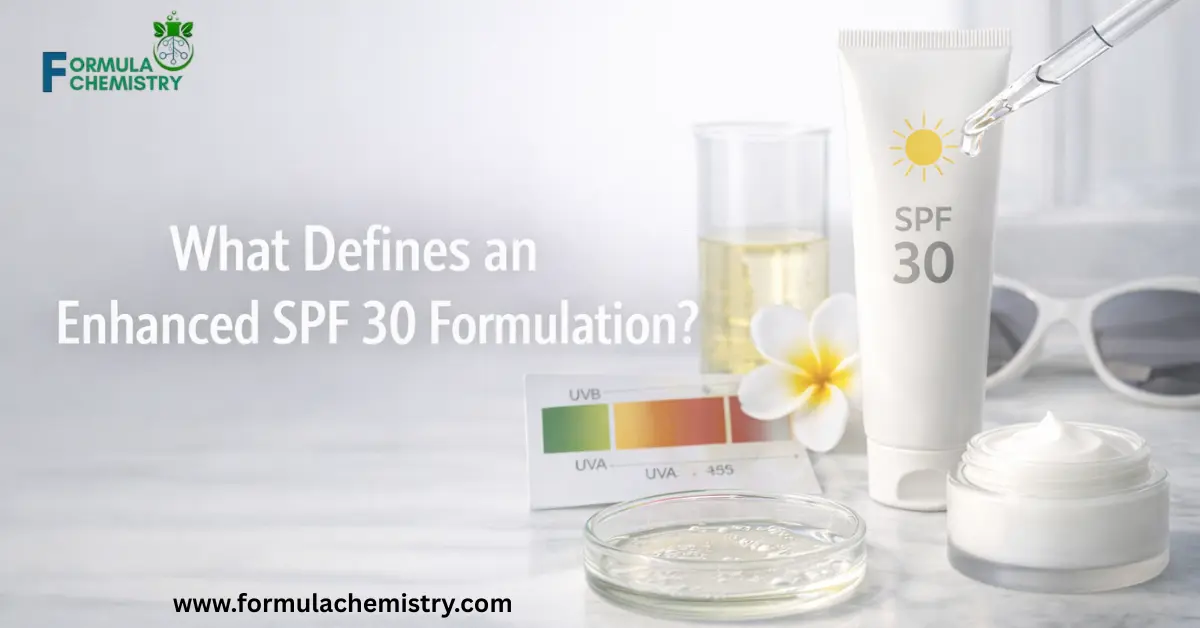
What Defines an Enhanced SPF 30 Formulation?
The efficacy of an enhanced SPF 30 cream relies on the cooperation between active filters and the vehicle. In modern formulation, “enhanced” refers to the inclusion of photostabilizers and antioxidants that prevent the UV filters from degrading under sun exposure. For instance, Avobenzone is a superior UVA filter but is notoriously unstable unless paired with ingredients like Octocrylene or Diethylhexyl 2,6-Naphthalate.
Enhanced protection also considers the Critical Wavelength. A high-quality SPF 30 should have a critical wavelength of at least 370nm, guaranteeing the product is truly broad-spectrum. This is achieved by blending large-particle inorganic filters with high-absorption organic molecules to cover the entire UV spectrum.
The Role of Film Formers in UV Retention
A common failure in DIY and professional sunscreens is the lack of “substantivity.” Without film-forming polymers (such as VP/Eicosene Copolymer), the sunscreen can migrate into skin folds or be easily wiped away. These polymers ensure a uniform, monolithic film across the epidermis, which is necessary for maintaining the rated SPF.
Balancing Organic and Inorganic Filters
Formulators often choose a hybrid method to maximize protection while lessening the “white cast.” Titanium Dioxide provides excellent UVB protection, while Zinc Oxide covers a wider UVA range. By using organic filters like Ethylhexyl Salicylate (Octisalate) at 3-5%, you can boost the SPF value without the heavy, pasty feel associated with purely mineral sunscreens.
Common Problems and Formulation Fixes
Even experienced chemists meet issues when working with high-load UV emulsions. Stability is the most frequent hurdle, as UV filters can interfere with standard emulsification systems.
| Zinc Oxide (Non-Nano) | Inorganic UV Filter | 10–20% | Requires high-shear mixing; pH sensitive. |
| Octocrylene | Photostabilizer | 7–10% | Excellent for stabilizing Avobenzone. |
| Tinosorb S | Broad Spectrum Filter | 1–5% | Oil-soluble; highly photostable. |
| Vitamin E (Tocopherol) | Antioxidant | 0.1–0.5% | Prevents lipid peroxidation in the formula. |
| Xanthan Gum | Stabilizer | 0.2–0.5% | Provides yield value to prevent filter settling. |
Resolving Graininess and Grittiness
If your SPF 30 cream feels “sandy,” it is likely due to mineral filter agglomeration. This occurs when Zinc Oxide or Titanium Dioxide particles clump together. The Fix: Use pre-dispersed mineral slurries or incorporate an ester like C12-15 Alkyl Benzoate as a wetting agent before adding the powders to the oil phase.
Managing Emulsion Separation (Coalescence)
High concentrations of chemical filters can act as solvents, thinning out the internal phase and leading to separation. The Fix: Increase the consistency of the external phase using cetyl alcohol or glyceryl stearate at 2–4%. Ensure your HLB (Hydrophilic-Lipophilic Balance) is tightly calculated for the specific oil phase load.
Optimizing the Sensory Profile and Stability
An enhanced SPF 30 cream must be wearable. If the product is too greasy, users will apply less than the required 2mg/cm², consequently reducing their protection to an SPF 10 or lower. To improve the “dry touch” feel, formulators use silica or modified corn starch to absorb excess oils from the chemical filters.
Furthermore, preservation is mandatory for any water-based cream. Since sunscreens are often stored in warm environments (beach bags, cars), the preservative system has to be robust. Phenoxyethanol combined with Ethylhexylglycerin is a common choice, provided the pH remains within the 5.0 to 7.5 range.
Incorporating Antioxidant Boosters
UV radiation generates free radicals that can damage the skin even if a burn is prevented. Adding Niacinamide (Vitamin B3) at 2–4% or Green Tea Extract provides a secondary layer of biological protection. These ingredients do not increase the SPF number, but they “enhance” the protection through mitigating oxidative stress.
Ensuring Photostability of Active Ingredients
A “photo-unstable” sunscreen loses its protective ability within 30 minutes of sun exposure. This is a major safety risk. Formulators must avoid combining incompatible ingredients, such as uncoated Titanium Dioxide alongside certain organic filters, as the photocatalytic activity of the titanium can degrade the organic molecules. Always use coated minerals (e.g., coated with Alumina or Stearic Acid) to ensure a stable, long-lasting shield.
Advanced Testing and Safety Issues
Before any SPF 30 cream can be marketed, it must undergo in-vivo SPF testing according to territorial regulations (FDA, ISO 24444). While “SPF calculators” exist for the development phase, they cannot replace clinical testing. As a formulator, you have to prioritize the safety and irritation profile of the final product.
Preservation and Microbiological Safety
Sunscreens are categorized as high-risk products because they are frequently exposed to moisture and heat. It is critical to include formula. Who should avoid: Individuals with known allergies to benzophenones should stick to purely mineral-based (Zinc/Titanium) SPF 30 formulations.
Proper Application and Usage Alerts
To achieve the “Enhanced UV Protection” promised on the label, the cream must be applied liberally.
Warning:
Applying a thin layer greatly reduces the protection level. Users should be instructed to reapply every two hours or after water exposure or sweating. Note: Sunscreen should not be applied to broken or irritated skin; if a rash develops, discontinue use immediately.
| Ingredient | Function | Weight % | Amount (ml/g) |
|---|
FAQ’s about SPF 30 Sunscreen Cream Enhanced UV Protection
Is SPF 30 enough for daily use?
Yes, SPF 30 is the dermatological “sweet spot” for daily use, blocking about 97% of UVB rays. Higher SPFs offer diminishing returns (SPF 50 blocks 98%).
What is the difference between chemical and mineral SPF 30?
Chemical sunscreens absorb UV rays and convert them to heat, while mineral sunscreens (Zinc/Titanium) primarily reflect and scatter UV rays.
Can I mix my SPF 30 cream with foundation?
No. Mixing sunscreen with other products dilutes the filter concentration and interferes with the protective film, significantly lowering the actual SPF.
Why does my SPF 30 cream sting my eyes?
Sting is usually caused by organic filters like Avobenzone or Octocrylene migrating into the eyes. Use a mineral-based stick around the eye area to prevent this.
Does SPF 30 expire?
Yes. Most sunscreens are stable for three years, but heat exposure can degrade filters faster. If the texture or smell changes, discard it.
Is a “water-resistant” SPF 30 better?
“Water-resistant” means the SPF remains effective for 40 or 80 minutes of swimming. It is superior for outdoor activities, but not always necessary for office wear.
What pH should my SPF 30 cream be?
The ideal pH is between 6.5 and 7.5. If the pH drops too low, certain filters can crystallize, and the emulsion may crash.
How much SPF 30 cream should I use on my face?
The standard recommendation is approximately 1/4 teaspoon for the face and neck combined to ensure the labeled protection is achieved.
Would you wish me to create a sample formulation frame for an SPF 30 Mineral Sunscreen?