
Introduction
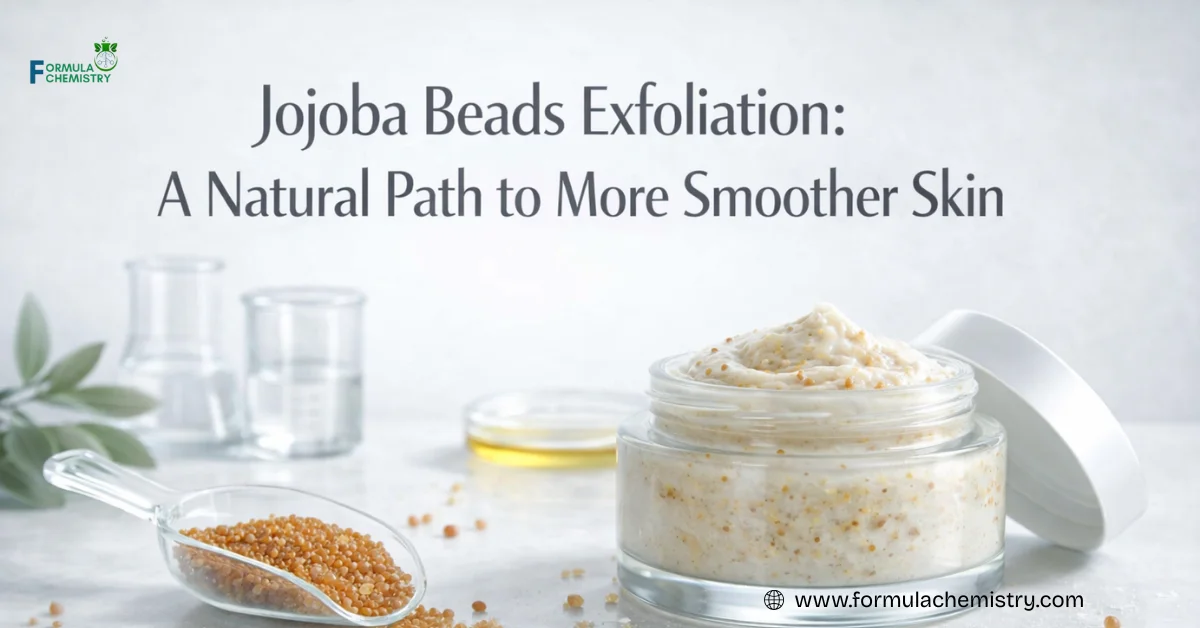
Jojoba beads have emerged as a chief choice for formulators seeking an environmentally responsible alternative to plastic microbeads.
Derived from hydrogenated jojoba oil, these spherical esters provide a mild yet effective mechanical exfoliation suitable for sensitive skin types. At FormulaChemistry, we focus on ingredients that balance high-performance results with eco-friendly sourcing and skin barrier respect.
Quick Facts
- What it is: Solid, spherical wax esters derived from the jojoba plant (Simmondsia chinensis).
- Who it’s for: All skin types, particularly those with sensitive or acne-prone skin who require non-abrasive physical exfoliation.
- How to use: Incorporate into cleansers, shower gels, or cream-based scrubs during the final cooling phase.
- Typical usage range: 1% to 15%, depending on the desired visual impact and exfoliation intensity.
- Compatibility: Oil-miscible; compatible with most surfactants and emulsifiers but sensitive to high heat.
- Common Mistakes: Adding beads to a hot phase (causing melting) or using them in high-alcohol formulas, which may soften the wax.
- Safety Note: Always perform a patch test when adding new exfoliants to a skincare routine.
The Science of Jojoba Esters
Jojoba beads are unique because they are technically wax esters, not fats. This chemical structure mimics the skin’s endogenous sebum, allowing the beads to glide across the stratum corneum without causing the micro-tears often associated with crushed nut shells or pumice.
Their perfectly spherical shape ensures that pressure is distributed evenly, lessening the risk of mechanical irritation.
As a Senior SEO Editor at FormulaChemistry, I observe that the transition toward biodegradable exfoliants is no longer a fad but a regulatory standard.
Jojoba beads fulfill this requirement while offering the added benefit of moisturizing the skin as they slightly soften during use.
What are the Benefits of Jojoba Beads in Skincare?
Gentle Mechanical Exfoliation
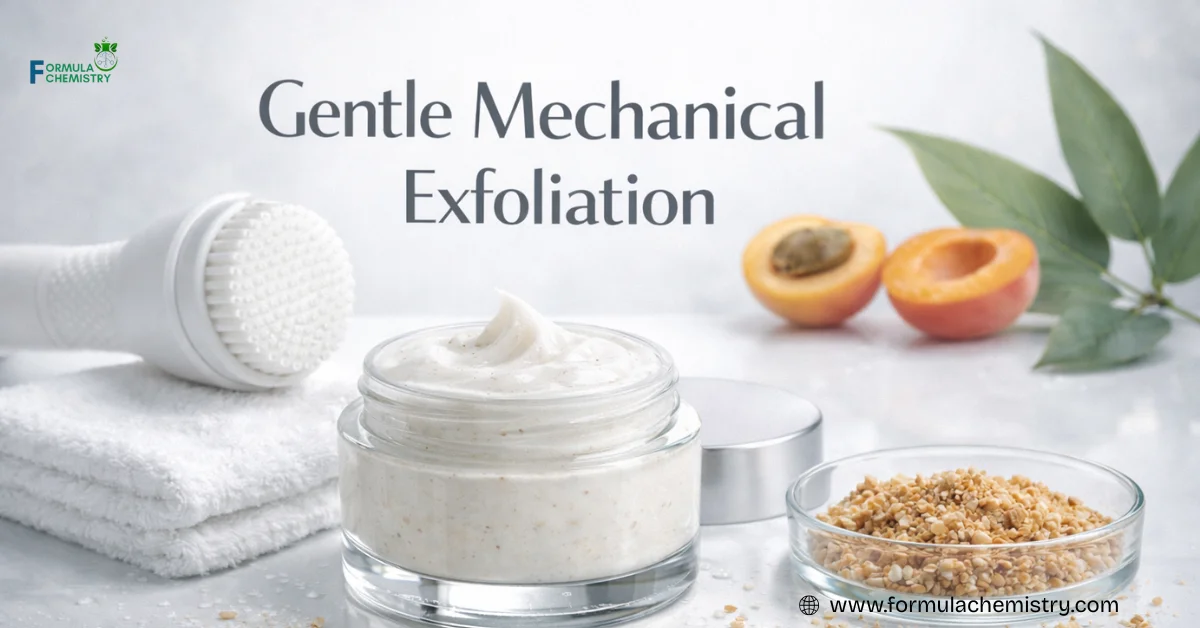
The main advantage of jojoba beads is their smooth, uniform surface. Unlike crystalline exfoliants, these beads do not have sharp edges. This makes them a great option for facial applications where the skin is thinner and more prone to redness.
They effectively lift dead skin cells and debris, promoting a fresher complexion while not compromising the lipid barrier.
Because they are made of wax, they have a lower hardness scale than silica or salt. This “soft” exfoliation is ideal for daily-use cleansers.
For formulators, the variety of available micron sizes permits customization smaller beads for facial refinement and larger beads for body smoothing.
Scalp and Body Integration
Beyond facial care, jojoba beads are increasingly used in scalp treatments to remove product residue and dandruff flakes.
Their melting point is typically around 65°C to 72°C, meaning they remain stable in most room-temperature applications but can provide a slight emollient feel when massaged vigorously into the skin.
| Feature | Jojoba Beads | Plastic Microbeads (Obsolete) | Crushed Walnut Shells |
| Shape | Perfectly Spherical | Spherical | Irregular/Jagged |
| Biodegradability | 100% Biodegradable | Non-biodegradable | 100% Biodegradable |
| Skin Feel | Smooth/Soft | Smooth | Abrasive |
| Usage Rate | 1%–15% | N/A | 1%–5% |
| Source | Plant-based Wax | Synthetic | Botanical |
Gently polish and brighten your skin with Hydrated Silica in Skincare: Secret to Smooth and Radiant Skin.
How to Formulate with Jojoba Beads Effectively
Temperature and Phase Management
When working with jojoba beads, temperature control is the most essential factor. Since these are hydrogenated waxes, they will melt if added to a formulation that is too hot. They should always be added during the “cool down” phase, typically below 45°C, to ensure they maintain their physical integrity and visual appeal.
If the formulation requires a high-viscosity gel, ensure the base is thick enough to suspend the beads. Without proper rheology modifiers like Carbomer or Xanthan Gum, the beads will either sink to the bottom or float to the top over time.
Compatibility and Stability
Jojoba beads are generally inert and do not react with other cosmetic actives. However, they are sensitive to certain solvents.
High concentrations of surfactants or alcohols can eventually soften the wax, leading to a loss of the “scrub” sensation. FormulaChemistry provides practical formulation education to help developers deal with these stability problems.
- Common Problems and Fixes:
- Problem: Beads sinking to the bottom of the bottle.
- Fix: Increase the yield value of your formula using a thickening agent like Aristoflex AVC or a high-grade Xanthan Gum.
- Problem: Beads are melting during the manufacturing process.
- Fix: Ensure the batch temperature is below 50°C before introduction; use a side-sweep mixer rather than high-shear equipment.
- Problem: Color bleeding from pigmented beads into the base.
- Fix: Verify the dye stability with the supplier or switch to uncolored (white/clear) beads for high-pH formulas.
Safety Considerations and Skin Health
Appropriate Usage and Frequency
While jojoba beads are gentle, over-exfoliation is still a risk with any physical scrub. Users should be advised to limit mechanical exfoliation to 2–3 times per week.
Key warnings include avoiding use on broken, sunburned, or extremely inflamed cystic acne, as any friction can worsen these conditions.
Who should avoid Individuals with active rosacea flares or severe skin barrier compromise should consult a professional before using mechanical exfoliants. Although jojoba esters are non-comedogenic, the base formula must also be checked for pore-clogging ingredients.
Preservation and Purity
Any formulation containing water and jojoba beads requires a strong preservation system. While the beads themselves are anhydrous, they are often introduced into water-based cleansers.
Ensure that the preservative used is effective across the pH notes of your specific formula, ordinarily ranging from pH 4.5 to 6.0 for skin compatibility.
FormulaChemistry emphasizes safety-forward guidance: always conduct microbial challenge testing (USP <51>) on any finished product intended for sale to ensure the suspension of botanical particles does not compromise the preservative’s efficacy over time.
FAQs about Jojoba Beads Exfoliation: A Natural Path to More Smoother Skin
Are jojoba beads biodegradable?
Yes, jojoba beads are made from hydrogenated jojoba oil, which is a natural wax ester. They are fully biodegradable and serve as an eco-friendly alternative to plastic microbeads that damage marine life.
Can I use jojoba beads on acne-prone skin?
Jojoba beads are generally safe for acne-prone skin because they are spherical and non-abrasive. However, they should be avoided during active, painful inflammatory breakouts to prevent further irritation.
What is the melting point of jojoba beads?
Most jojoba beads have a melting point between 65°C and 72°C. They must be added to formulations during the cool-down phase to prevent them from mixing into the oil phase.
Do jojoba beads expire?
As a wax ester, they are quite stable, but they can undergo oxidation over time. Store them in a cool, dry place and check the manufacturer’s retest date, usually 12–24 months.
Are they better than chemical exfoliants?
They serve a different purpose. Chemical exfoliants (AHAs/BHAs) dissolve the “glue” between cells, while jojoba beads physically lift dead skin. Many users prefer the immediate tactile smoothness provided by beads.
Do jojoba beads clog pores?
Jojoba oil and its derivatives are considered non-comedogenic. Because the beads are rinsed off, the risk of them blocking pores is extremely low.
Can jojoba beads be used in anhydrous (waterless) scrubs?
Yes, they perform exceptionally well in oil-based scrubs or balms. In these formulas, you don’t need to worry about suspension as much if the base is a solid at room temperature.
What colors do jojoba beads come in?
They are naturally white or colorless but are commonly available in various colors (blue, green, red, yellow) using cosmetic-grade pigments for visual appeal in clear gels.