

Introduction
In the world of cosmetic skincare science and professional aesthetics, the timing of product application is often debated.
While the desire for a quick routine is common, the efficacy of high-performance ingredients frequently depends on the skin’s ability to absorb specific molecular weights and maintain a stable physiological pH.
At FormulaChemistry, we focus on the intersection of formulation stability and skin biology to ensure that active ingredients deliver their intended benefits without provoking undue irritation.
Understanding wait times is not only about patience; it is about respecting the “dry down” period and the chemical environment required for certain molecules to penetrate the stratum corneum.
Applying products too rapidly can lead to “pilling” where the formula rolls off the skin or unintended neutralization of pH-dependent actives.
Quick Answer
- What it is: The intentional pause between applying different skincare layers to allow for absorption and pH stabilization.
- Who it’s for: Individuals using multi-step routines, particularly those using retinoids, L-ascorbic acid, or chemical exfoliants.
- How to use: Generally, wait 30–60 seconds between most layers, or until the skin feels “tacky” rather than wet.
- Active Wait Times: High-activity ingredients like Vitamin C or AHAs may require 15–20 minutes for maximum efficacy if the formulation is pH-dependent.
- pH/Compatibility: Avoid mixing low-pH acids with high-pH soaps or niacinamide unless the formula is pre-stabilized to prevent flushing.
- Common Mistakes: Applying oil-based products before water-based serums, which creates an occlusive barrier that blocks penetration.
- Typical Usage Range: Most routines consist of 3–7 layers applied in order of increasing molecular weight.
- Safety Note: Always perform a patch test when adding new actives to monitor for delayed contact dermatitis.
The Science of Layering and Absorption
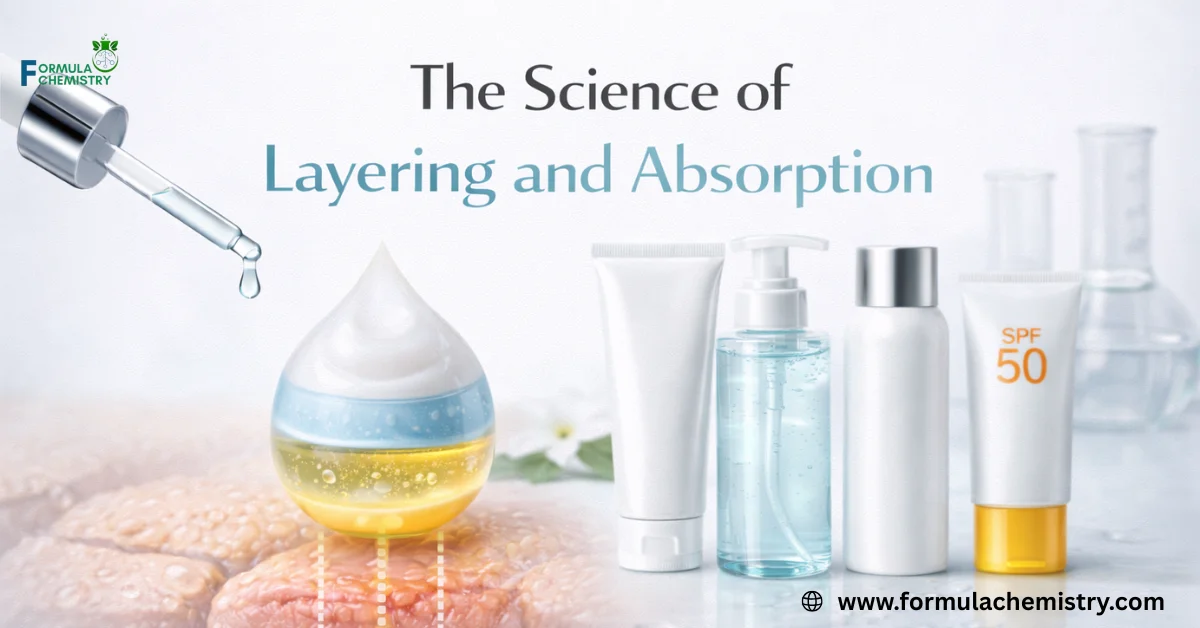
The rate at which a product penetrates the skin depends on its vehicle (gel, cream, or oil) and the size of the active molecules.
Water-based serums with low molecular weights travel through the skin’s lipid bilayers faster than heavy, occlusive creams.
Formula Chemistry provides practical formulation education and safety-forward guidance to help users understand that “more” is not always better if the delivery system is compromised by poor timing.
Wait times also prevent the dilution of preservatives and stabilizers. When two products are mixed directly on the face, the preservative system of one may be overwhelmed by the water content of the other, theoretically increasing the risk of microbial instability when left in a humid bathroom environment over time.
Find out how to safely follow your routine after shaving in Can You Do Your Skincare Routine After Shaving?
What Factors Determine Wait Times?
Molecular Weight and Product Texture
The primary rule of skincare layering is to move from the thinnest consistency to the thickest. This sequence is governed by the ability of the ingredients to bypass the skin barrier.
A watery essence containing hyaluronic acid or polypeptides should be applied first, as these small molecules need direct access to the epidermis.
If an anhydrous (waterless) oil is applied first, the subsequent water-based serum will simply sit on top, unable to penetrate the lipid layer.
Waiting for a thin layer to dry makes certain that the next, more viscous layer doesn’t physically “slide” the previous ingredients away from the target area. This is particularly important for sunscreens.
Applying a moisturizer and immediately following with an SPF can dilute the UV filters, resulting in uneven coverage and reduced protection. For mineral sunscreens, a dry “anchor” layer is essential for the zinc oxide or titanium dioxide to form a uniform film.
pH Dependency and Chemical Stability
Many active ingredients, such as L-ascorbic acid (Vitamin C) and Alpha Hydroxy Acids (AHAs), are formulated at a low pH (usually between pH 2.5 and 3.5) to remain effective and stable. The skin’s natural pH is slightly acidic, around pH 4.7 to 5.75.
When you apply a highly acidic product, the skin’s pH drops temporarily. If you immediately follow this with a neutral or basic product (like some moisturizers), you may prematurely raise the pH, neutralizing the acid before it has finished exfoliating or neutralizing free radicals.
In these specific cases, a wait time of 15 to 20 minutes allows the active ingredient to work at its optimal acidity before the skin naturally returns to its baseline pH or is altered by the next step.
Optimizing Your Routine for Efficacy
Guidelines for Water-Based and Oil-Based Steps
For a standard routine involving a cleanser, toner, and moisturizer, long wait times are generally unnecessary.
A 30-second interval is usually sufficient for the solvents to evaporate. However, if you notice “pilling” the formation of small flakes or balls of product it is a clear sign that the layers are not compatible or the first layer has not dried sufficiently.
This often happens when silicone-heavy primers are applied over water-rich gels.
| Product Type | Recommended Wait Time | Primary Reason |
| Cleanser to Toner | 0 seconds (Apply to damp skin) | Enhances humectant absorption |
| Active Serums (C, AHA) | 15–20 minutes | pH stabilization |
| Hyaluronic Acid | 0–30 seconds | Needs moisture to “lock in” |
| Retinoids | 5–10 minutes | Ensure skin is dry to reduce irritation |
| Moisturizer to SPF | 2–5 minutes | Prevents dilution of UV filters |
| SPF to Makeup | 5–10 minutes | Allows film-former to set |
Managing Potent Actives and Retinoids
Retinoids are notorious for causing irritation, especially when applied to damp skin. Water on the skin’s surface can speed up the absorption of retinol or tretinoin too quickly, leading to redness and peeling.
It is widely recommended to wait at least 10–20 minutes after washing your face before applying a retinoid. This ensures the moisture barrier is stable and the penetration is controlled and even.
- Common Problems and Fixes:
- Problem: Pilling when applying foundation. Fix: Increase wait time after moisturizer to 5 minutes and test for silicone-water incompatibility.
- Problem: Stinging after applying Vitamin C. Fix: Ensure skin is completely dry before application or switch to a stabilized derivative with a higher pH note.
- Problem: Dryness despite using moisturizer. Fix: Apply your humectant serum to damp skin immediately after cleansing, then seal with cream.
- Problem: Redness with Retinol. Fix: Use the “sandwich method” (moisturizer-retinol-moisturizer) and make sure a 10-minute wait between layers.
Safety Considerations and Ingredient Compatibility
Preventing Irritation and Sensitivity
The most significant risk of improper timing is raised sensitivity. When multiple acids or high-strength actives are layered without pause, the cumulative effect can overwhelm the acid mantle.
At FormulaChemistry, we emphasize that the “wait” is a safety mechanism. For those with compromised barriers, such as individuals with rosacea or eczema, skipping wait times for humectants (applying to wet skin) is beneficial, whereas skipping wait times for exfoliants can be disastrous.
Who should avoid long wait times:
Those with severely dehydrated skin may find that waiting too long between cleansing and moisturizing leads to Trans-Epidermal Water Loss (TEWL).
In these cases, the “3-second rule” applying moisturizer within seconds of patting the face is more effective than waiting for a complete dry-down.
Preservation and Formula Integrity
Every manufactured skincare product contains a preservation system designed to prevent mold and bacteria.
When users “cocktail” or mix products on their palms rather than layering with wait times, they risk destabilizing these systems.
While this is unlikely to cause immediate harm, it can lead to a less effective product over its shelf life.
Key warnings
include avoiding the mixing of sunscreen with any other product, as this directly compromises the SPF rating and leaves the skin vulnerable to UV damage.
Usage ranges for high-activity serums are typically 3–5 drops. Using more than this often results in excess product sitting on the surface, which increases the required wait time and the likelihood of irritation.
If a product takes longer than 2 minutes to absorb, you are likely using too much.
Editorial responsibility at FormulaChemistry makes certain that we focus on the physiological needs of the skin.
While marketing might suggest a 10-step routine is necessary, the science suggests that fewer, well-timed steps are often more helpful for maintaining a healthy barrier.
FAQs about How Long Should You Wait Between Skincare Steps?
Does pilling mean the product isn’t working?
Not necessarily, but it means the product is not absorbed into the skin. Pilling is usually a physical incompatibility between ingredients like silicones and carbomers, or it means the first layer hadn’t dried before the second was applied.
Can I mix my serum into my moisturizer to save time?
You can mix simple hydrating serums, but you should never mix sunscreens, retinoids, or low-pH acids into other products, as this can change the concentration and effectiveness of the active ingredients.
Why do I have to wait for my face to dry before using Retinol?
Applying retinoids to dry skin increases the rate of absorption significantly, which can lead to excessive irritation, redness, and peeling for many users.
How long should I wait to apply makeup after sunscreen?
You should wait at least 5–10 minutes. This allows the sunscreen to form a uniform, protective film on the skin that won’t be disrupted or “streaked” by the application of foundation or powder.
Is a 20-minute wait for Vitamin C really necessary?
If you are using pure L-ascorbic acid, a wait time helps ensure the pH remains low enough for the ingredient to work. If you use a derivative like THD Ascorbate, no significant wait time is required.
Does applying products to wet skin help absorption?
For humectants like Hyaluronic Acid or Glycerin, yes. Water on the skin helps these ingredients pull moisture into the deeper layers. For “active” ingredients like acids, it can increase irritation.
Can I use a fan to speed up the wait time?
Yes, using a fan to speed up the evaporation of solvents (water or alcohol) is generally safe and will not impact the efficacy of the ingredients.
What happens if I don’t wait between steps?
The most common results are pilling, decreased efficacy of pH-dependent ingredients, and possible irritation if multiple strong actives are “flushed” into the skin simultaneously.