
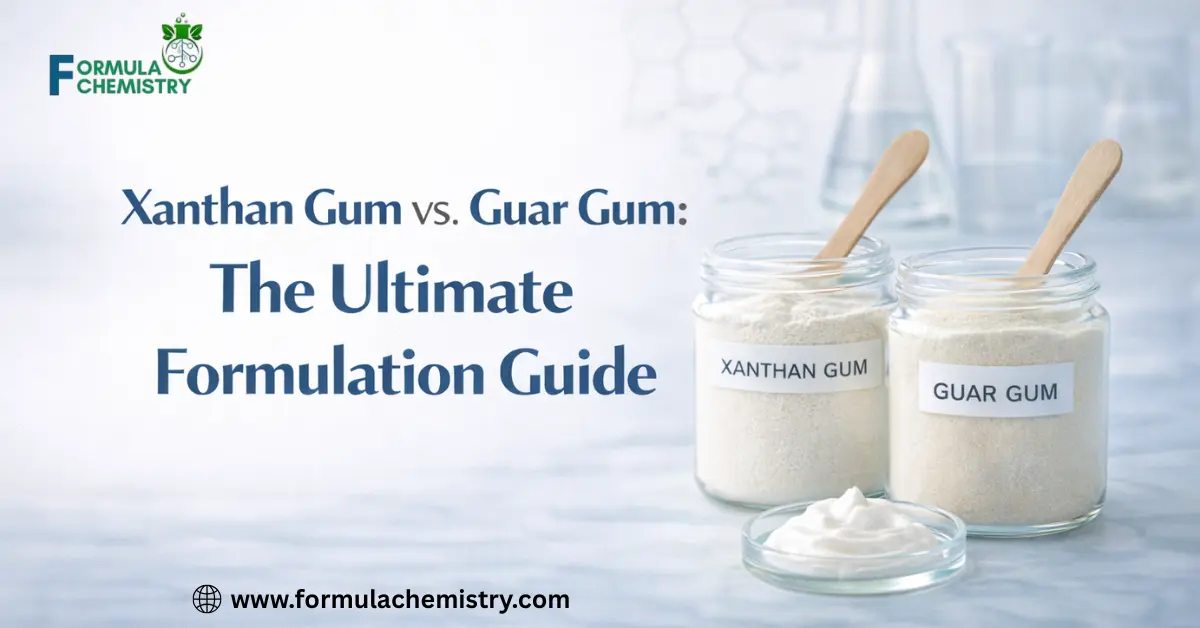
In cosmetic science, texture is as important as the actives; it determines feel, spread, and absorption. Xanthan Gum vs Guar Gum are common thickening agents in both commercial and home labs.
While they may look identical, white powders have distinct biological origins and behaviors that drastically alter the final product. Understanding the specific formula chemistry of each is crucial for preventing separation and achieving a professional finish.
This guide explores molecular differences, stability, and optimal uses for these polymers, helping you select the best modifier for your next DIY project. Let’s begin by defining rheology modifiers and their importance in modern cosmetic science.
What Are Rheology Modifiers in Formula Chemistry?
Before comparing specific ingredients, it is essential to understand the role of rheology modifiers ingredients that control how a liquid flows (its viscosity) and how easily it moves. In cosmetics, rheology modifiers help decide whether a product feels watery, thick, or gel-like.
The Role of Polysaccharides
Both Xanthan and Guar belong to a class of carbohydrates called polysaccharides. Polysaccharides are long, chain-like molecules made of many sugar units. In a water-based solution, these molecules uncoil and tangle together.
This physical entanglement creates a net that traps water molecules, slowing down their movement. This change in the liquid phase’s chemical formula turns a runny toner into a luscious gel or stabilizes an emulsion.
Stability and Suspension
Beyond thickening, these gums provide yield stress. Yield stress is the force required to initiate flow in a thickened liquid.
A high yield stress allows a product to suspend particles—such as exfoliation beads or mica without them settling to the bottom. Mastering this aspect of Formula Chemistry skincare ensures your products look as good as they work.
The Science of Xanthan Gum: Bacterial Fermentation
Xanthan Gum is arguably the most robust and versatile thickener available to formulators, derived through a fascinating biological process.
Origin and Production
Xanthan is produced by the fermentation of glucose or sucrose by the Xanthomonas campestris bacterium.
It is an anionic (negatively charged) polysaccharide. Its robust structure makes it highly resistant to enzymes and breakdown, which is why it is a staple in professional formula chemistry.
Texture Profile: The “Snotty” Factor
The main drawback of Xanthan Gum is its texture. At high concentrations (above 1%), it can feel stringy or slimy.
To combat this, manufacturers often create “cosmetic grade” or clear versions that have been processed to reduce the stringiness, offering a smoother flow that feels elegant on the skin.
The Science of Guar Gum: Plant-Derived Softness
Guar Gum offers a different sensory experience and is often preferred for its natural origin and conditioning properties.
Extraction from Guar Beans
Guar gum is derived from the endosperm of the guar bean (Cyamopsis tetragonoloba).
Unlike Xanthan, Guar Gum is non-ionic (neutral charge). This allows compatibility with a wide range of ingredients, including salts and some cationic surfactants, without formula instability.
Texture Profile: Creamy and Short
Guar gum typically produces a “short” flow, meaning it isn’t stringy like Xanthan.
It delivers a creamier, softer skin feel but may become sticky if overused, so balance is key in DIY formulas.
Keep your products smooth and effective with Xanthan Gum in Skincare: The Key to Stability & Hydration.
Comparing the Chemical Formula and Charge
The electrical charge of your thickener (positive, negative, or neutral) dictates which other ingredients you can use in your formulation, because like charges repel and opposites attract in chemical mixtures.
Anionic vs. Non-Ionic Behavior
Xanthan Gum, being anionic, repels similarly charged ions but interacts with cationic ingredients.
If you mix Xanthan with a cationic conditioning agent (like BTMS-50), they will clump together and precipitate out of the solution. Understanding this formula chemistry rule prevents disastrous separation.
Cationic Guar Derivatives
While native Guar is non-ionic, the cosmetic industry often uses a modified version, Guar Hydroxypropyltrimonium Chloride.
This derivative is cationic (positively charged). It binds to the hair and skin, providing conditioning benefits. This is a prime example of how altering a chemical formula changes an ingredient’s function from a simple thickener to an active conditioner.
Stability in Extreme Environments
Your product must survive various conditions, from the acidic pH of an AHA peel to the heat of a summer shipping container.
pH Tolerance
Xanthan Gum is the clear winner here. It maintains its viscosity across a massive pH range (pH 2 to 12).
This makes it the ideal choice for acid toners or high-alkaline cleansers. Guar Gum, however, relies on pH for hydration and can lose viscosity if the environment becomes too acidic, leading to hydrolysis of its chemical structure.
Temperature Resistance
Xanthan Gum is remarkably heat-stable. It does not thin out significantly when heated.
Guar Gum can degrade under prolonged high heat. For emulsions heated to 75°C, Xanthan provides a more reliable structure for your final product.
Clarity and Appearance in Gels
The visual appeal of a serum is often determined by the clarity of the thickening agent used.
Xanthan Gum Transparency
Standard Xanthan Gum can create a slightly hazy or cloudy gel.
However, “Clear” grades are available that produce a glass-like finish. For a high-end, clear serum, choosing the right grade of Xanthan is essential to maintain the aesthetic integrity of the formula chemistry.
Guar Gum Opacity
Guar Gum naturally creates a translucent to opaque solution.
Achieving a crystal-clear gel with Guar is difficult. It’s best for creams, lotions, or opaque cleansers where clarity is not a primary concern.
Formula Chemistry Skincare: Best Uses for Xanthan
Xanthan Gum excels in formulations that require suspension and stability in difficult chemical environments.
Suspending Exfoliants and Pigments
Because of its high yield, Xanthan is perfect for body washes with beads or for shimmering body oils.
Its network holds particles in place, whereas Guar-based suspensions often fail, leading to settling over time.
Gel-Creams and Serums
For oil-free moisturizers, Xanthan provides the necessary body without adding wax.
Used at 0.2% to 0.5%, it stabilizes the water phase, preventing the water from evaporating too quickly and giving the product a substantial feel during application.
Formula Chemistry Skincare: Best Uses for Guar
Guar Gum is the thickener of choice when skin feels dry, and conditioning is the priority.
Conditioners and Haircare
Cationic Guar is a staple in shampoos and conditioners.
Its positive charge allows it to cling to negatively charged damaged hair strands, smoothing the cuticle. This is a functional application of formula chemistry where the thickener doubles as an active ingredient.
Lotions and Creams
In emulsions, Guar Gum (non-ionic) can provide a lubricious “slip.”
It reduces the soaping effect (whitening) during the cream’s rub-in stage. This makes it a valuable additive for improving the sensory application of Formula Chemistry skincare lotions.
Dispersion and Hydration Techniques
Gums are notorious for clumping (“fish eyes”) when added to water incorrectly; technique is everything.
The Glycerin Slurry
Never dump gum powder directly into water. It will form a gel on the outside of the clump, preventing water from reaching the inside.
Pre-disperse the gum in a humectant like Glycerin or Propanediol. This separates the particles, allowing the water to hydrate the chemical formula evenly once added.
Vortex Mixing
If you don’t use a slurry, you must create a vortex in your water using a high-shear mixer.
Sprinkle gum slowly into the vortex. This prevents clumping, ensuring a smooth DIY creation.
Synergistic Combinations
Formulators often combine gums to minimize their individual drawbacks and enhance their benefits.
Xanthan and Guar Blend
Blending Xanthan and Guar results in a higher viscosity than either alone.
A 50/50 blend reduces Xanthan’s stringiness and enhances Guar’s stability, resulting in an optimized, pleasant texture.
Xanthan and Veegum
Magnesium Aluminum Silicate (Veegum), combined with Xanthan Gum, creates a super-stabilizing network.
This combination is widely used in difficult-to-stabilize formulas, like mineral sunscreens or foundations, where heavy pigments need to remain suspended.
Troubleshooting Common Issues
Even with the best recipes, things can go wrong. Here is how to diagnose texture problems.
Stringiness
If your serum trails like cheese on a pizza, you have used too much Xanthan or the wrong grade.
Reduce the percentage to 0.2% or switch to a high-shear mixing process to slightly break down the long chains in the chemical formula.
Loss of Viscosity
If your product thins out over time, check your pH and preservatives.
Bacteria love to eat polysaccharides. If your preservative system fails, the bacteria digest the gum, turning your thick cream into water. Always ensure your Formula Chemistry skincare is properly preserved.
Conclusion
The choice between Xanthan Gum and Guar Gum is not about which is “better,” but which is right for your specific formula chemistry.
Xanthan offers unmatched stability and suspension, making it the workhorse of serums and cleansers. Guar provides a softer feel and conditioning benefits, ideal for hair care and creams.
By understanding the chemical formula and behavior of these rheology modifiers, you elevate your formulations from simple mixtures to professional-grade cosmetic science.
FAQ’s about Xanthan Gum vs. Guar Gum
Which gum is better for clear serums?
Xanthan Gum is significantly better for clear serums, especially “cosmetic grade” or “clear” variants. Guar gum naturally produces a cloudy or hazy solution, which can make a serum look impure or unstable.
Can I substitute Guar Gum for Xanthan Gum?
Not always. While they both thicken, Xanthan is anionic, and Guar is non-ionic. Substituting them can affect emulsion stability and compatibility with other ingredients, especially cationic emulsifiers or preservatives.
Why does my Xanthan Gum gel feel sticky?
Stickiness usually results from using too high a percentage. For facial products, aim for a usage rate between 0.2% and 0.5%. Adding a humectant, such as glycerin, or a silicone alternative can also reduce the tacky after-feel.
Is Cationic Guar different from regular Guar Gum?
Yes, chemically they are very different. Cationic Guar has been modified to carry a positive charge, making it substantive to hair and skin (conditioning). Regular Guar is non-ionic and is used primarily for thickening without the conditioning deposition.
Does Xanthan Gum clog pores?
No, Xanthan Gum is considered non-comedogenic. It forms a breathable mesh on the skin’s surface rather than penetrating the pores. It is a safe ingredient for acne-prone skin formulations in Formula Chemistry skincare.
How do I prevent lumps when mixing gums?
The best method is to create a “slurry.” Mix the gum powder with a liquid that doesn’t hydrate it, such as Glycerin or Oil, before adding it to your water phase. This ensures the particles are separated and hydrated evenly without clumping.
Can I use Xanthan Gum in Vitamin C serums?
Yes, Xanthan Gum is an excellent choice for Vitamin C (L-Ascorbic Acid) serums because it remains stable at the low pH (around 3.0-3.5) required for Vitamin C to be effective. Guar gum may lose viscosity in such acidic environments.
Are these gums natural?
Yes, both are considered natural. Xanthan Gum is a product of bacterial fermentation, and Guar Gum is ground from a bean. They are both widely accepted in natural and organic Formula Chemistry DIY standards like COSMOS and ECOCERT.