
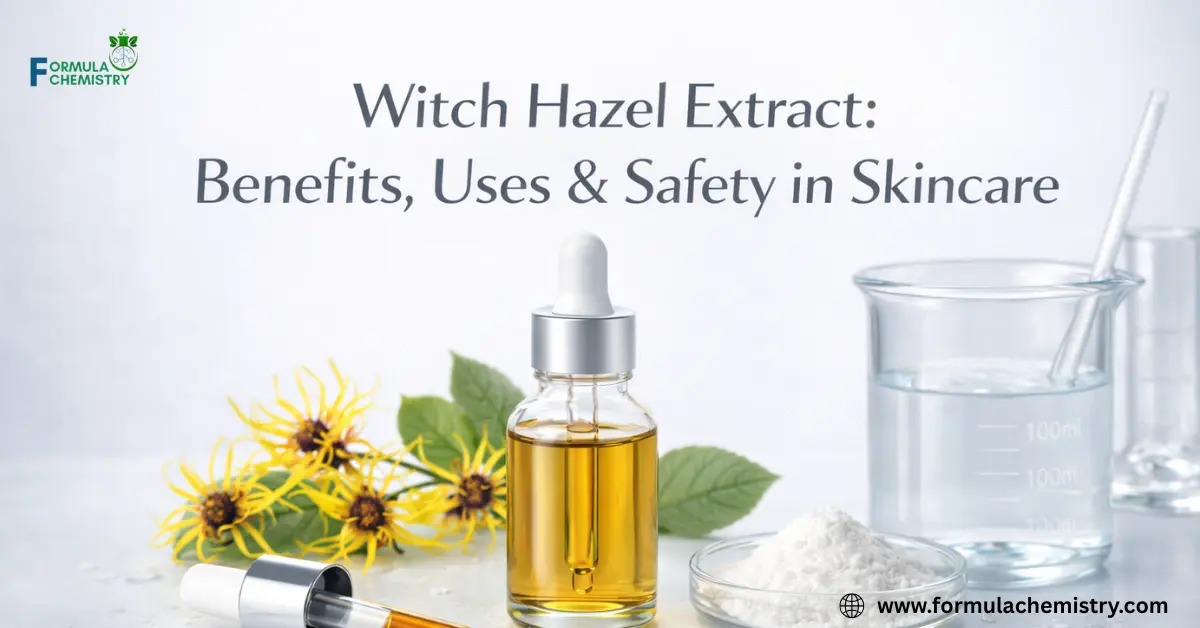
Witch hazel extract (Hamamelis virginiana) is a staple botanical in both traditional remedies and modern dermatological formulations.
Derived from the bark and leaves of the North American witch hazel shrub, this extract is prized for its high tannin content and astringent properties.
At FormulaChemistry, we focus on the science behind these botanicals to ensure formulators understand how to utilize them effectively without damaging the skin barrier.
Quick Facts
- What it is: A botanical extract rich in polyphenols and tannins, typically available as a steam distillate (hamamelis water) or a hydro-glycolic extract.
- Who it’s for: Primarily those with oily, acne-prone, or inflamed skin; use with caution on sensitive or dry skin types.
- How to use: Commonly used in toners, aftershaves, and spot treatments at the water phase of production.
- Typical usage range: 1% to 10% in leave-on products; up to 20% in rinse-off or specialized astringent formulations.
- pH/Solubility: Water-soluble; functions best in formulas with a pH of 4.0 to 6.0.
- Compatibility: Highly compatible with other soothing agents such as Aloe Vera and Niacinamide, but can be destabilized by certain cationic surfactants.
- Common Mistakes: Using alcohol-heavy distillates on compromised skin or not considering the natural tannin color in clear gels.
- Safety Note: Always ensure the extract is properly preserved, as botanical waters are highly susceptible to microbial contamination.
Introduction
Witch hazel is often misunderstood in the skincare industry, frequently associated with the harsh, high-alcohol drug-store toners of the past. However, in professional formulation, the extract serves as a sophisticated bioactive ingredient.
Its primary appeal consists in its ability to constrict body tissues, which gives a temporary “pore-tightening” effect and helps soothe minor skin irritations.
Understanding the chemical composition of Hamamelis virginiana is essential for any formulator. The extract contains gallotannins, proanthocyanidins, and essential oils. While the tannins provide the astringency, the volatile oils add to its anti-inflammatory potential.
FormulaChemistry provides practical formulation education and safety-forward guidance to help you deal with these active components without causing irritation.
The Chemistry of Tannins and Polyphenols
The efficacy of witch hazel is largely caused by its tannin content. These compounds react with the proteins in the skin to create a protective, tightening film.
This mechanism is why witch hazel is the leading standard for treating “weeping” skin conditions or excess sebum production.
Beyond astringency, the polyphenols in witch hazel offer antioxidant protection. These molecules help neutralize free radicals generated by UV exposure and pollution.
When formulating, it is important to remember that heat can degrade these sensitive compounds, so adding the extract during the cool-down phase is often recommended to maintain potency.
Sourcing and Distillation Methods
Not all witch hazel is created equal. The most common form found in retail is “Witch Hazel Water” (Hamamelis Water, USP), which is a steam distillate usually containing 14% ethanol. Formulators may also opt for alcohol-free extracts or glycerin-based versions to avoid the drying effects of alcohol.
Choosing the right format depends on the end goal of your product. If you are creating a soothing serum, a glycerin-based extract is preferable. For a clarifying toner, a distillate might provide the desired “clean” feel.
FormulaChemistry emphasizes that the extraction method dictates the final concentration of tannins, as steam distillation often leaves behind the heavier, non-volatile tannins.
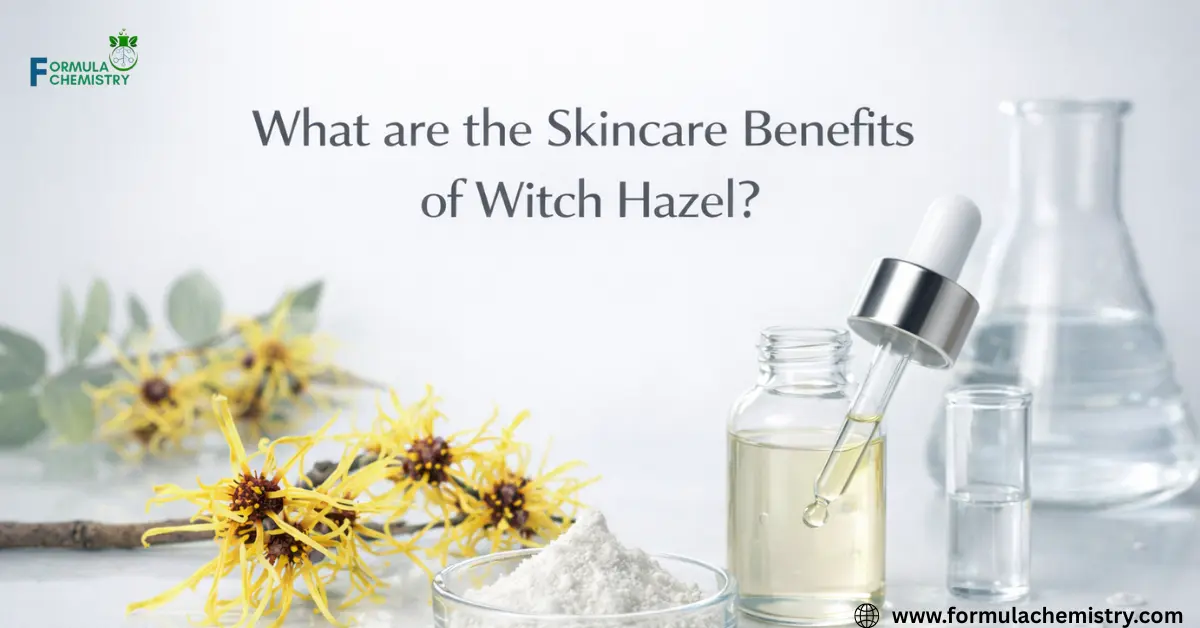
What are the Skincare Benefits of Witch Hazel?
The versatility of witch hazel allows it to address multiple skin concerns simultaneously. Its main roles are as an astringent, an anti-inflammatory agent, and a mild antimicrobial. In work settings, it is often utilized to balance the skin’s pH and refine texture, making it a popular option for oily and combination skin types.
Because it can reduce swelling and redness, it is also a popular addition to products designed for the undereye area or for post-shave care. However, its potency means it must be handled with respect for the skin’s acid mantle.
Who should avoid:
Individuals with extremely dry, eczematous, or cracked skin should avoid high concentrations of witch hazel.
Sebum Control and Pore Refinement
Witch hazel is highly effective at removing excess oil from the skin surface. By constricting the skin proteins, it temporarily reduces the appearance of enlarged pores. This makes it a great ingredient for pre-makeup primers or mattifying lotions.
- Common Problems and Fixes:
- Problem: Formula feels too drying or “stripping.”
- Fix: Reduce the usage range to 2-3% and pair with humectants like Propanediol or Sodium Hyaluronate.
- Problem: The final product has a strange “earthy” odor.
- Fix: Use a decolorized/deodorized version or mask with a skin-safe, low-percentage essential oil blend.
- Problem: Microbial instability in a water-based toner.
- Fix: Ensure a strong broad-spectrum preservative system is used, as witch hazel provides a nutrient-dense environment for mold.
Anti-Inflammatory and Soothing Action
The proanthocyanidins in witch hazel help to decrease vascular permeability, which reduces redness and swelling. This is particularly useful in formulations for acne-prone skin, where inflammation is a primary concern. It helps to “calm” the skin after deep cleansing or exfoliation.
While it is soothing, key warnings include the fact that the tannins can be sensitizing if used in excess.
Patch testing advice:
Always perform a patch test when introducing witch hazel-based products, especially if the formula contains alcohol. This ensures the skin’s barrier can tolerate the astringent action without developing contact dermatitis.
Usage Guidelines and Formulation Compatibility
Incorporating witch hazel into a formula needs a balanced approach to preserve stability and efficacy. It is primarily a water-soluble ingredient, making it easy to incorporate into serums, toners, and gels. However, its interaction with other ingredients must be monitored, notably in complex emulsions.
| Feature | Specification/Detail |
| Solubility | Fully Water Soluble |
| Heat Stability | Heat sensitive; add below 40°C |
| Optimal pH Range | 4.0 – 6.0 |
| Common Dosage | 1% – 10% (General); up to 20% (Astringent) |
| Compatibility | High with Glycols, most AHAs/BHAs |
| Incompatibility | Some highly cationic polymers |
Formulation Best Practices
When working with witch hazel, the order of addition is important. Because many extracts contain delicate volatile components, they should be added during the “C” or cool-down phase of an emulsion.
This prevents the degradation of the active polyphenols and retains the characteristic scent and efficacy of the botanical.
For clear aqueous systems, such as toners, witch hazel is quite straightforward. However, if using a distillate that contains alcohol, you must ensure your preservative system is compatible with the final ethanol percentage.
FormulaChemistry recommends checking the specific gravity and alcohol content of your supplier’s lot to ensure batch-to-batch consistency.
Synergy with Other Actives
Witch hazel works exceptionally well when paired with other botanicals and functional actives. For acne-targeted products, combining witch hazel with Salicylic Acid is able to enhance the clarifying effect, though the pH notes must be monitored to ensure the acid remains effective without becoming overly irritating.
- For Soothing: Pair with Chamomile or Calendula extract.
- For Oil Control: Pair with Niacinamide or Zinc PCA.
- For Hydration: Pair with Panthenol (Vitamin B5) to offset astringency.
Safety, Stability, and Regulatory Considerations
Safety is the foundation of any cosmetic product. While witch hazel is generally recognized as safe (GRAS) for topical use, it is not risk-free.
The primary concern in modern skincare is the “over-astringency” that can lead to a compromised moisture barrier. As an editorial responsibility, FormulaChemistry reminds formulators that a “squeaky clean” feeling frequently indicates the removal of essential lipids.
Stability is a further obstacle. Witch hazel extracts are prone to oxidation, which can change the color of the formula from clear to a pale amber over time.
Using chelating agents and antioxidants like Vitamin E or Sodium Metabisulfite in the formula can help lessen these changes and extend the shelf life of the product.
Preserving Witch Hazel Formulations
Because witch hazel extract is a natural plant derivative, it is highly susceptible to contamination.
Preservation reminder:
Any aqueous formula containing witch hazel must include a strong, broad-spectrum preservative. Ingredients like Phenoxyethanol combined with Ethylhexylglycerin are common choices to protect against bacteria, yeast, and mold.
If you are using an “alcohol-free” witch hazel, the risk of contamination is even higher because the natural antimicrobial properties of ethanol are absent.
Consistently verify that your raw material supplier has pre-preserved the extract, but remember that you are still responsible for the preservation of the final finished product.
Detecting Possible Irritation
While witch hazel is often used to treat irritation, it can also cause it. This paradox is usually because of the concentration of tannins or the presence of fragrance allergens like Eugenol, which is naturally found in the plant.
Irritation cautions:
Discontinue use if pruritus (itching), stinging, or persistent erythema occurs.
Formulators ought to prioritize high-quality, USP-grade extracts to minimize impurities.
By adhering to the guidance provided by FormulaChemistry, you can create effective products that harness the power of witch hazel while preserving the highest standards of skin safety and product integrity.
FAQs about Witch Hazel Extract: Benefits, Uses & Safety in Skincare
Is witch hazel safe for daily use?
Yes, for most skin types, witch hazel is safe for daily use when formulated at a usage range of 5% or less and balanced with hydrating ingredients.
Can I use witch hazel if I have dry skin?
It is generally not recommended as a primary toner for dry skin, as its astringent nature can further deplete surface oils. Use only in localized areas or very low concentrations.
Does witch hazel expire?
Yes, the extract typically has a shelf life of 12–24 months. Over time, its potency decreases and the risk of microbial contamination increases.
What is the difference between witch hazel extract and distillate?
An extract is usually a concentrated version made with a solvent like glycerin or water/alcohol, while a distillate (hydrosol) is the byproduct of steam distillation.
Can witch hazel help with acne?
Witch hazel can assist by reducing inflammation and removing excess oil, but it is best used as a beneficial ingredient alongside proven actives like Salicylic Acid.
Should I use alcohol-free witch hazel?
Alcohol-free versions are generally better for the long-term health of the skin barrier, as they avoid the drying and sensitizing effects of denatured alcohol.
Does witch hazel interact with Vitamin C?
There are no known direct contraindications, but because witch hazel is an astringent, using it immediately before high-strength L-Ascorbic acid may increase stinging in sensitive individuals.
Can witch hazel be used in a leave-on product?
Absolutely. It is common in serums, lotions, and creams, provided the pH notes are followed and the formula is properly stabilized.