
Introduction
For decades, the word “sunscreen oil” has conjured images of thick, white pastes that require endless rubbing. However, contemporary advancement has given rise to a luxurious alternative: sunscreen oil.
An SPF 30 Oil offers the same rigorous broad-spectrum defense as a lotion but with the nourishing finish of a body oil. It is the perfect marriage of formula chemistry and luxury, designed for those who want their skin to look as good as it is protected.
This guide examines the unique science behind anhydrous (water-free) sun protection, revealing how these silky oils defend against UV rays while delivering a non-greasy, satin glow.
What Makes an SPF Oil Different from a Lotion?
Understanding the vehicle (the base of the product) is important to appreciating the special features and application of a sunscreen oil.
The Anhydrous Advantage
Most sunscreens are emulsions (oil and water mixed). An SPF oil is anhydrous, meaning it contains zero water.
This chemistry formula is inherently water-resistant because oil repels water. It creates a durable film on the skin that doesn’t wash off easily with sweat, making it surprisingly effective for active days despite its lightweight feel.
Transparency by Design
Mineral sunscreens often leave a white cast because the solid particles reflect light.
SPF oils typically use organic (chemical) filters such as Homosalate or Octocrylene. These are soluble in oil, meaning they dissolve completely. The result is a crystal-clear formula that is truly invisible on every skin tone, from the deepest ebony to the palest ivory.
The Chemistry Formula of Oil-Soluble Filters
To achieve SPF 30 in an oil base, formulators must select UV filters that are not only effective but also miscible with plant oils.
Stability in Lipids
Not all sunscreen actives play nice with oils. Avobenzone, a primary UVA filter, can degrade in unsaturated vegetable oils.
To solve this, Formula Chemistry skincare experts use photostabilizers such as Octocrylene or specific carrier oils (such as Jojoba) that resist oxidation. This ensures the SPF protection remains stable on your skin even under the hot sun.
Uniform Film Formation
The key to protection is an unbroken film.
If the oil spreads too thin, you get gaps in protection. Formulators add “film formers” or polymers to the oil. These invisible structures hold the UV filters in a uniform layer, guaranteeing uniform coverage across every inch of skin.
Nourishing Ingredients: More Than Just Sunscreen
An SPF oil doubles as a body treatment, delivering potent antioxidants and fatty acids deep into the stratum corneum.
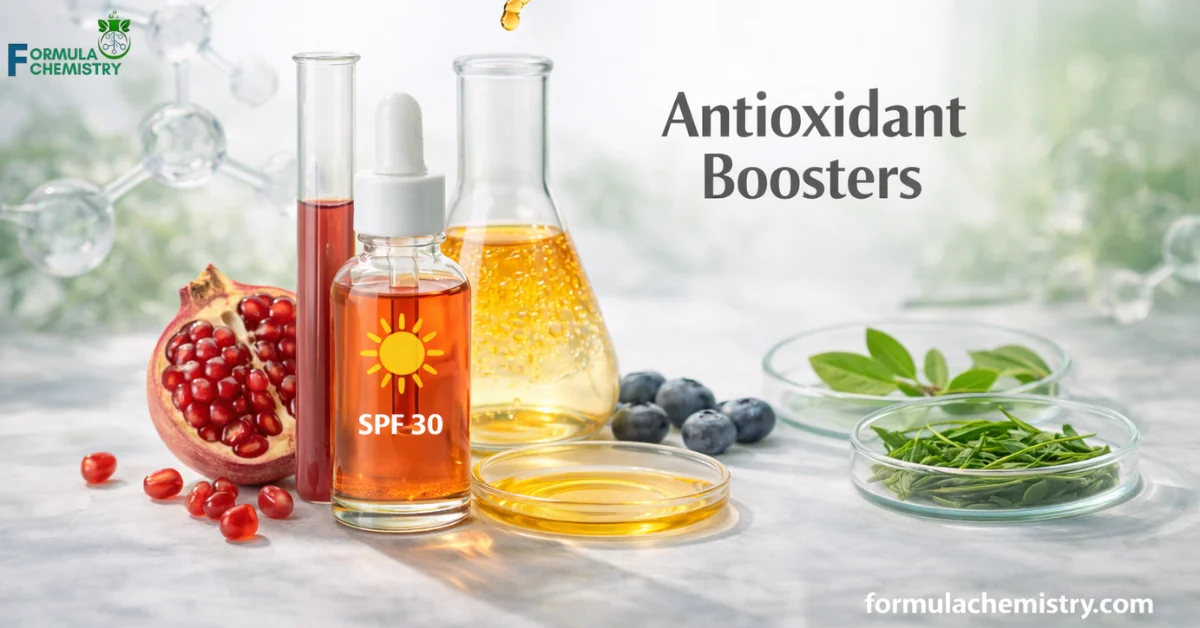
Antioxidant Boosters
Sunlight generates free radicals. Adding antioxidants like Vitamin E (Tocopherol) or Rosemary Leaf Extract neutralizes this threat.
In a formula chemistry context, these ingredients do double duty: they protect the skin cells from aging and prevent the oils in the bottle from going rancid.
Barrier-Repairing Lipids
Oils like Argan, Meadowfoam, and Grapeseed are rich in linoleic and oleic acids.
Unlike water-based lotions that evaporate, these oils integrate into the skin’s lipid barrier. They lock in hydration physically, leaving the skin soft, supple, and resilient against salt water and chlorine dryness.
Keep your skin protected every day with SPF 15 Oil: Lightweight Daily Protection.
Formula Chemistry DIY: Can You Make SPF Oil?
The attraction of mixing oils at home is strong, but sunscreen is a medical drug in many regions for a reason.
The Risk of “Natural” SPF
Red Raspberry Seed Oil and Carrot Seed Oil are often touted as natural sunscreens.
While they have minor UV-absorbing properties, their SPF is low (often 2-4) and inconsistent. Relying on them for a day at the beach is dangerous. In Formula Chemistry DIY, we strongly advise against making primary sunscreens; the risk of burns and long-term DNA damage is too high.
Modifying Existing Oils
Instead of making SPF from scratch, you can add a drop of sparkling mica to a store-bought SPF 30 oil.
This safe customization adds a bronzed glow without compromising the UV filters’ tested efficacy, giving you a personalized product with guaranteed protection.
Application Best Practices for Oils
Because oils spread so easily, there is a common tendency to under-apply, which drastically reduces protection.
The “Sheen” Indicator
With lotions, you rub until the white disappears. With oils, you rub until you see a uniform sheen.
If your skin looks matte, you haven’t applied enough. You need approximately one ounce (a shot glass full) for the entire body. The “glistening” look is your visual confirmation of a secure formula chemistry shield.
Wait Before Water
Although oils are water-resistant, they need time to “set.”
Apply your SPF 30 oil at least 15 minutes before swimming. This allows the oil to bond with the skin’s surface. Jumping in immediately can cause the oil to slick off into the water, leaving you unprotected and polluting the pool.
Who Is SPF 30 Oil Best For?
While luxurious, oil-based sunscreens are not the perfect fit for every skin type or situation.
Dry and Mature Skin
This is the target demographic. As we age, our skin produces less sebum.
An SPF oil replaces these lost lipids instantly. It smooths rough elbows and knees while protecting them, providing a level of comfort and hydration that water-based sprays cannot match.
Body vs. Face
Unless formulated specifically as “non-comedogenic” or “dry oil,” standard SPF oils can be too heavy for the face.
They may clog pores in acne-prone individuals. Stick to using these luxurious oils from the neck down, and choose a dedicated Formula Chemistry skincare lotion for the face.
Environmental Considerations
Using oils in the ocean requires a conscious choice of ingredients to protect marine life.
Biodegradability
Silicone-based oils can linger in aquatic environments.
Look for formulas based on plant esters, such as Coco-Caprylate/Caprate. These are derived from coconut oil and biodegrade rapidly, guaranteeing your sun protection doesn’t harm the coral reefs or marine ecosystems.

Reef-Safe Filters
Avoid oils containing Oxybenzone or Octinoxate if you are swimming in the ocean.
While these chemical filters are common in clear oils, many brands are shifting to “clean chemical” screens that provide the same clear finish without the environmental toxicity profile.
Conclusion
An SPF 30 Oil is a sophisticated upgrade to your sun care routine, offering broad-spectrum defense in a nourishing, invisible format.
By understanding the formula chemistry of oil-soluble filters and anhydrous stability, you can enjoy the sun responsibly.
It turns the chore of applying sunscreen into a luxurious ritual, ensuring that you actually want to wear it every single day, which is the most important factor in preventing skin damage.
FAQ’s about SPF 30 Oil ,Broad-Spectrum Sunscreen Oil for Daily Protection
Is SPF 30 oil as effective as SPF 30 lotion?
Yes, absolutely. The SPF rating is determined by standardized testing, regardless of the product form (oil, lotion, spray). An SPF 30 oil blocks roughly 97% of UVB rays, just like an SPF 30 lotion, provided you apply the correct amount.
Will sunscreen oil make me tan faster?
Historically, “tanning oils” had low SPF (2-4) to encourage burning. An SPF 30 oil is designed to prevent burning. While you may still tan slightly because no sunscreen blocks 100% of rays, it is not a tanning accelerator; it is a protective device.
Does SPF oil leave a greasy residue?
It depends on the carrier oils used. “Dry oils” use lightweight esters like Fractionated Coconut Oil or Isopropyl Myristate that absorb instantly, leaving a satin finish. Heavier oils with Olive or Mineral Oil bases will feel greasier and stay on the surface longer.
Can I use SPF oil on my hair?
Yes! UV rays bleach hair color and dry out the cuticle. Running the leftover SPF oil from your hands through the ends of your hair is an excellent Formula Chemistry DIY hack to protect your color and prevent “fried” ends during summer.
Does sunscreen oil stain clothes?
It can. Avobenzone (a chemical filter) can react with iron in hard water to create orange rust stains, and oils themselves can leave grease marks. Allow the oil to absorb for 10-15 minutes before getting dressed to minimize transfer.
Is SPF 30 enough for a tropical vacation?
For most people, SPF 30 is sufficient if reapplied diligently every 2 hours. However, if you have very fair skin or a history of skin cancer, dermatologists often recommend bumping up to SPF 50 due to the high UV index in tropical regions.
How do I remove sunscreen oil?
Sunscreen oils are water-resistant and cling to the skin. Standard body wash might not cut it. Use a specialized shower oil or scrub to emulsify the sunscreen and completely break down the formula’s chemical film at the end of the day.
Can I add essential oils to my sunscreen oil?
We generally advise against this. Citrus essential oils (such as Lemon or Bergamot) are phototoxic, meaning they can cause severe burns and blistering when exposed to sunlight. It is safer to use fragrance-free or professionally formulated scented sunscreens.