
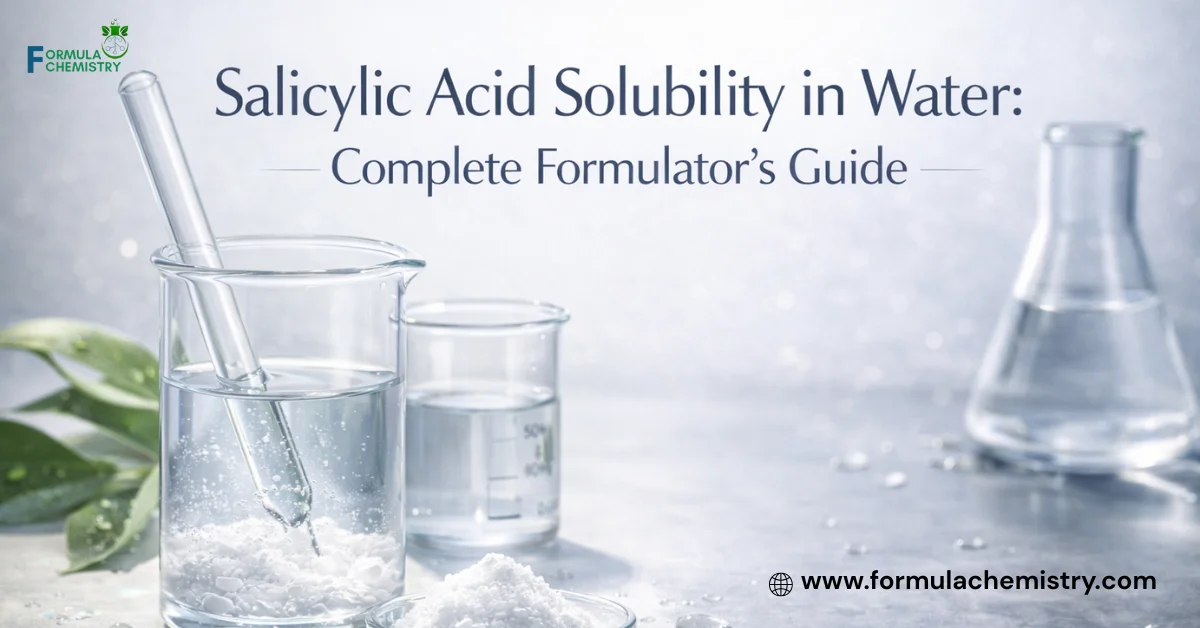
Salicylic acid solubility in water is one of the most critical factors cosmetic formulators must understand before working with this BHA (beta-hydroxy acid) active.
At room temperature, salicylic acid dissolves in water at only about 2 g/L (0.2%), making it notoriously challenging to incorporate into aqueous products like toners and serums. Getting the solubilization right determines whether your formula performs or fails.
Ingredient Overview
INCI Name: Salicylic Acid
Common Names: BHA, Beta-Hydroxy Acid, 2-Hydroxybenzoic Acid
Category: Active (Exfoliant / Keratolytic)
CAS Number: 69-72-7
Molecular Weight: 138.12 g/mol
Salicylic acid is a monohydroxybenzoic acid derived naturally from willow bark (Salix alba) or produced synthetically.
It is oil-soluble by nature due to its aromatic benzene ring, yet it exhibits limited, pH-dependent water solubility. This dual character, part lipophilic, part ionizable in water defines nearly every formulation decision you will make when using it in water-based cosmetics.
Function in Cosmetic Formulation
Salicylic acid serves multiple roles in cosmetic products:
- Primary function: Exfoliant it helps loosen the bonds between dead skin cells (corneodesmosomes), supporting a smoother-looking skin surface.
- Secondary roles: Oil-soluble penetration into pores, helps improve the appearance of congested or blemish-prone skin, mild preservative boosting effect at low pH.
- Why formulators choose it: It is one of the few exfoliants that can penetrate through lipid-rich sebum, making it particularly effective in formulas targeting oily or acne-prone skin types.
The key functional form is the unionized (protonated) form, which is responsible for skin penetration. This is why pH management is non-negotiable when working with salicylic acid.
Recommended Usage Rate (%)
| Product Type | Typical Usage Range | Notes |
| Toner (leave-on) | 0.5–2.0% | Most common at 1–2% |
| Serum (leave-on) | 0.5–2.0% | Solubilization critical |
| Cleansing gel (rinse-off) | 0.5–3.0% | Higher due to rinse-off dilution |
| Spot treatment | 1.0–3.0% | May use alcohol base |
| Exfoliating mask | 0.5–2.0% | Combine with other exfoliants carefully |
| Body wash / acne wash | 0.5–2.0% | Typically surfactant-based |
Beginner Note: Start at 0.5–1.0% when formulating for sensitive skin. At 2%, which is the maximum concentration commonly referenced in cosmetic guidelines, ensure thorough solubilization before scaling up batches. Undissolved salicylic acid crystals are a common and preventable formulation failure.
Solubility & Phase Information
This is where most formulation challenges begin. Salicylic acid has a water solubility of approximately 2 g/L at 20°C (room temperature), which equates to roughly 0.2% w/v in pure water.
However, in a real cosmetic formula, effective solubilization of up to 2% can be achieved using the appropriate solvents and conditions.
Solubility summary:
| Solvent | Solubility |
| Water (20°C) | ~0.2% (2 g/L) |
| Water (boiling, 100°C) | ~7.4% |
| Ethanol | Very high (soluble) |
| Propylene Glycol | Moderately soluble |
| Butylene Glycol | Moderately soluble |
| Oils / Esters | Soluble (lipophilic character) |
Boiling point: 211°C (412°F): This is relevant for processing safety, not typical cosmetic use.
Density: Approximately 1.44 g/cm³ (solid crystalline form).
Phase Handling
- Add salicylic acid to the water phase, but only after pre-dissolving it in a small amount of suitable solvent (ethanol, propylene glycol, or butylene glycol)
- Do not add raw salicylic acid crystals directly into water; they will not dissolve reliably at typical usage levels.
- For alcohol-free formulas, use propylene glycol or butylene glycol as the primary solubilizer before incorporating into the aqueous phase.
- Mildly heating the water phase to 40–50°C can assist initial dissolution, but do not exceed this unnecessarily, as it may affect other heat-sensitive components.
pH Range & Stability
At formula Chemistry, pH management is arguably the most important technical consideration for any salicylic acid formula.
Ideal Working pH: 3.0–4.0
The pKa of salicylic acid is 2.97. This value is the critical reference point for understanding its ionization behavior:
- At pH values below the pKa (~3.0): The majority of salicylic acid exists in its unionized (free acid) form — this is the active, skin-penetrating form.
- At pH values above the pKa, the molecule progressively ionizes into salicylate anion, reducing both its lipid solubility and its penetration efficacy.
- At pH 4.0, approximately 91% remains unionized — still highly effective.
- At pH 5.0, the unionized fraction drops significantly, resulting in reduced efficacy.
This ionization-pH relationship (with the unionized form being the functional form) explains why toners and serums containing salicylic acid are almost always formulated at pH 3.0–4.0.
Stability Notes
- Salicylic acid is relatively stable in acidic aqueous solutions.
- It is susceptible to hydrolysis at high pH (alkaline conditions should be avoided entirely)
- Sensitive to prolonged heat exposure avoid sustained temperatures above 70°C during processing
- Light and oxidation have minimal effect on salicylic acid itself, but can degrade co-ingredients in the formula.
- Store finished products away from heat and UV exposure to protect the overall formula integrity.
Compatibility & Incompatibilities
Compatible with:
- Niacinamide: Can be combined, but the final pH should be carefully balanced; the low pH required for salicylic acid efficacy may reduce niacinamide performance.
- Hyaluronic acid: Works well in the same water phase at the correct pH.
- Glycerin and humectants: Fully compatible
- Alcohol (ethanol): Excellent solubilizer; often used in toning solutions
- Azelaic acid: Compatible in many formats; complementary skin tone-evening benefits
- Panthenol (Provitamin B5): Compatible and helps support skin barrier appearance
Avoid Combining with:
- High-pH actives (pH >6): Retinol, peptides, and certain fermented actives require higher pH ranges; combining them in one formula forces a compromise that reduces the efficacy of both.
- Strong oxidizing agents: Can degrade the acid
- Alkaline raw materials: Sodium hydroxide, potassium hydroxide, triethanolamine these neutralize salicylic acid and convert it to sodium salicylate, eliminating its exfoliating function
- Cationic polymers at low pH: May cause compatibility issues in some systems
- Vitamin C (L-Ascorbic Acid): Both require low pH, so pH compatibility exists, but combined use may increase irritation potential use with caution in leave-on formulas
Formulation Tips (Pro Notes)
Solubilization method (most critical step):
Pre-dissolve salicylic acid in a solvent before adding it to your water phase. A practical approach is to dissolve it in 10–20% propylene glycol or butylene glycol relative to the amount of salicylic acid, then slowly add this solution to your water phase while stirring.
For alcohol-based formulas (toners), dissolving in ethanol is the most efficient method.
Processing temperature:
Mild heating of the aqueous phase to 40–50°C significantly improves initial dissolution. Once dissolved and cooled, crystallization should not occur in properly formulated, stable systems.
Common beginner mistakes:
- Adding dry salicylic acid crystals directly to cold water results in undissolved particles
- Formulating above pH 4.5 and expecting exfoliant efficacy the ionized form does not penetrate effectively.
- Not checking for crystal reformation after cold storage always performs freeze-thaw stability testing.
- Over-relying on heat alone for dissolution without a co-solvent
Sensory impact:
Salicylic acid itself has a slightly astringent quality in aqueous formulas. At 2%, some users may detect mild tingling on first application, particularly in toners with a high alcohol content. This is expected and not inherently a sign of irritation.
Best product formats:
Alcohol-based toners, gel serums, water-gel formulas, exfoliating pads, and cleansing gels are all ideal delivery systems for salicylic acid.
Benefits in Cosmetic Products (Non-Medical)
- Supports smoother-looking skin texture through surface exfoliation
- Helps improve the appearance of congested, oily, or blemish-prone skin
- Assists in reducing the visible appearance of enlarged pores with regular use
- Encourages a more even-looking skin tone by supporting cell turnover
- Its lipophilic character allows it to work within the pore environment, which purely water-soluble exfoliants cannot reach as effectively.
- Commonly used to help manage excess sebum appearance and surface shine in oily skin types.
Common Product Applications
Salicylic acid is a versatile active used across multiple rinse-off and leave-on cosmetic formats:
- Exfoliating toners: Most common leave-on application at 1–2%
- BHA serums: Typically gel or water-gel texture, 1–2%
- Facial cleansers and cleansing gels: 0.5–2%, rinse-off format
- Acne spot treatments: Up to 3% in some markets
- Exfoliating masks: Combined with clay or other exfoliants
- Scalp treatments and anti-dandruff shampoos: Effective for scalp conditions due to their keratolytic properties
- Body wash: For back acne and body blemish-prone skin
- Exfoliating pads/cotton pads: Pre-saturated with toner formula
Substitutes / Alternatives
If salicylic acid is not suitable for your formula or target audience, consider these alternatives:
- Lactic Acid: AHA, water-soluble, gentler option for sensitive skin, exfoliates at the surface without pore-penetrating lipophilicity; pH range similar (3.0–4.0); better for dry or sensitive skin types.
- Glycolic Acid: AHA, water-soluble, smallest molecular size for deepest surface penetration; more potent and potentially more irritating than salicylic acid; suited for normal to oily skin without congestion focus
- Mandelic Acid: AHA with a larger molecular size, gentler penetration profile, suitable for sensitive and darker skin tones; does not offer the oil-soluble pore-penetrating character of salicylic acid.
- Willow Bark Extract: Contains salicin, a salicylic acid precursor; much lower active concentration than isolated salicylic acid; suitable for formulas targeting a more natural positioning.
Safety & Regulatory Notes
- Salicylic acid can cause skin irritation and increased sensitivity at higher concentrations or in users with compromised skin barriers.
- Always recommend a patch test for end consumers, particularly for leave-on products at 2%
- Avoid use around the eye area too irritating for periorbital skin.
- Avoid application on broken, sunburned, or inflamed skin.
- In the EU, salicylic acid is regulated under the Cosmetics Regulation (EC) No 1223/2009, with specific usage restrictions for rinse-off and leave-on products; always verify the current regulatory status for your target market.
- Not recommended for use during pregnancy in leave-on formats at higher concentrations always include appropriate label guidance.
- At recommended cosmetic usage rates, salicylic acid is considered safe for most users; however, individuals with aspirin sensitivity should be made aware of the chemical relationship.
FAQ’s about Salicylic Acid Solubility in Water: Complete Formulator’s Guide
What is the ideal pH for salicylic acid in a toner or serum?
The optimal working pH is 3.0–4.0. At this pH, the majority of salicylic acid remains in its unionized form, which is the form capable of penetrating. Formulating above pH 4.5 significantly reduces efficacy.
Is salicylic acid soluble in water?
Only slightly. Salicylic acid is approximately 0.2% soluble in water at room temperature (20°C), rising to around 7.4% at the boiling point (100°C). In cosmetic formulas, solubilization up to 2% is achieved by using co-solvents such as ethanol, propylene glycol, or butylene glycol.
What is the pKa of salicylic acid, and why does it matter?
The pKa is 2.97. This tells you the pH at which half the salicylic acid is ionized, and half is unionized. Below the pKa, the active, unionized form dominates. In practical terms, formulating at pH 3.5–4.0 ensures the majority remains in the skin-penetrating unionized state without requiring an uncomfortably low pH.
Can salicylic acid be used in alcohol-free formulas?
Yes, but solubilization requires more planning. Use propylene glycol or butylene glycol to pre-dissolve the salicylic acid before incorporating it into the aqueous phase. Mild heating (40–50°C) of the water phase also assists. Freeze-thaw stability testing is recommended to ensure crystal reformation does not occur.
What is the best substitute for salicylic acid for sensitive skin?
Lactic acid or mandelic acid are the most common alternatives. Both are gentler AHAs, water-soluble, and well-tolerated by sensitive skin types. They do not offer the pore-penetrating, oil-soluble character of salicylic acid, but they provide effective surface exfoliation with a better tolerance profile.
Does the salicylic acid boiling point affect cosmetic processing?
Not in standard cosmetic manufacturing. The boiling point of 211°C is far above any temperature used in cosmetic processing. It is relevant for chemical synthesis contexts, not for typical formulation work. What matters in processing is staying below 70°C to avoid degrading sensitive co-ingredients.
Final Summary
Quick reference for formulators:
- Primary role: Exfoliant active (BHA), oil-soluble pore penetration
- Usage rate: 0.5–2.0% in leave-on; up to 3.0% in rinse-off
- Water solubility: ~0.2% at room temperature co-solvents required for cosmetic use
- pKa: 2.97 unionized form is the active, penetrating form
- Optimal pH: 3.0–4.0
- Best applications: Exfoliating toners, BHA serums, cleansing gels, acne spot treatments, scalp treatments
- Key formulation step: Always pre-dissolve in ethanol, propylene glycol, or butylene glycol before adding to the water phase
- Avoid: High-pH formulas, alkaline co-ingredients, and the direct addition of crystals to cold water.
Understanding salicylic acid solubility in water and the chemistry behind its ionization behavior at different pH levels is the foundation of every successful BHA formula. Master the solubilization step, control your pH, and validate stability through testing.