

Introduction
In the world of cosmetic science, understanding product longevity constitutes a critical element of consumer safety and formulation integrity. Every skincare product, from basic moisturizers to complex serums, undergoes chemical and physical shifts over time. Yes skincare expires.
At FormulaChemistry, we focus on the intersection of ingredient stability and user safety to make certain that every application remains effective without damaging the skin barrier.
Expiration is not simply a suggestion; it is a timeline dictated by preservative efficacy and ingredient degradation.
When a product passes its prime, its molecular structure changes, possibly resulting in reduced potency or, more concerningly, microbial contamination. Understanding how to identify these shifts is important for anyone managing a professional or personal skincare regimen.
Quick Answer
- What it is: Skincare expiration refers to the date after which a product is no longer guaranteed to be safe or effective due to preservative failure or active ingredient degradation.
- Who it’s for: All skincare users, particularly those using products containing water, botanical extracts, or unstable actives like Vitamin C.
- How to use: Check the Period After Opening (PAO) symbol—a small open jar icon—to determine how many months a product lasts after the seal is broken.
- Typical usage range: Most water-based products last 6–12 months, while anhydrous (water-less) balms or powders can last 2 years.
- pH/Solubility/Compatibility: Changes in a product’s pH over time can indicate chemical instability; for instance, a considerable drop in pH may suggest ingredient fermentation or breakdown.
- Common mistakes: Storing products in high-humidity environments like bathrooms or using fingers to scoop product from a jar, which introduces bacteria.
- Safety note: Never use a product that has changed color, developed a foul odor, or shows visible mold; those who should avoid using expired items include those with compromised skin barriers or inflammatory conditions like eczema.
The Science of Preservative Efficacy
Modern skincare relies on a strong preservative system to inhibit the growth of bacteria, yeast, and mold. Most formulations use a combination of broad-spectrum preservatives to ensure stability throughout the product’s intended shelf life.
However, these systems are not infinite. Once the container is opened, the formula is exposed to oxygen and environmental contaminants, which slowly exhaust the preservative’s ability to protect the product.
At FormulaChemistry, we emphasize that “clean” or “preservative-free” marketing often masks a shorter shelf life, as these products lack the synthetic stabilizers required to prevent rapid spoilage.
High water content provides a breeding ground for pathogens, making the preservation of lotions and toners significantly more volatile than oil-based serums or waxes.
What Factors Determine Skincare Shelf Life?
The longevity of a skincare product is determined during the formulation phase using stability testing. Chemists evaluate how ingredients react to light, heat, and contact with air over time.
Several variables dictate whether a product will last three months or three years, including the packaging type and the specific chemical nature of the active ingredients.
Packaging and Environmental Exposure
Packaging plays a primary role in protecting a formula from external stressors. Airless pumps are the gold standard for longevity, as they minimize oxygen contact and prevent the user from touching the bulk product. Conversely, open-mouth jars are the most susceptible to degradation and contamination.
Light-sensitive ingredients, such as retinoids and certain antioxidants, require opaque or amber-colored glass to prevent photo-degradation.
When these ingredients are exposed to UV light, their molecular bonds break, rendering them useless or even irritating to the skin. Storing products in a cool, dark place is the most effective way to extend their functional lifespan.
Ingredient Stability and Active Degradation
Not all ingredients age at the same rate. Actives like L-ascorbic acid (Vitamin C) are notoriously unstable and can oxidize within weeks if not formulated with specific stabilizers or stored correctly.
Sunscreen filters are also highly sensitive; once a sunscreen expires, the SPF rating is no longer accurate, leaving the skin vulnerable to UV damage.
| Product Type | Typical Shelf Life (Unopened) | PAO (After Opening) | Primary Reason for Failure |
| Water-based Serums | 2 Years | 6–12 Months | Preservative exhaustion |
| Oil-based Balms | 2–3 Years | 12–18 Months | Lipid oxidation (rancidity) |
| Sunscreens | 3 Years | 6–12 Months | Active filter degradation |
| Powder Products | 3+ Years | 24 Months | Moisture absorption |
| Mascara/Liquid Eye | 1–2 Years | 3 Months | High bacterial load risk |
Signs Your Products Have Expired
Identifying expired skincare requires a combination of checking labels and performing sensory evaluations. Even if a product is technically within its “best by” date, improper storage can cause it to spoil prematurely.
FormulaChemistry provides practical formulation education to help users recognize these chemical shifts before they cause adverse reactions.
Sensory Changes and Physical Separation
The most obvious sign of expiration is a change in the physical state of the emulsion. If a cream begins to separate into oily and watery layers that do not recombine when shaken, the emulsifiers have likely failed.
This structural collapse means the ingredients are no longer evenly distributed, bringing about inconsistent application.
Odors are another definitive indicator. When oils oxidize, they produce a distinct “sour” or “crayon-like” smell. Similarly, a change in color such as a clear serum turning yellow or brown indicates oxidation.
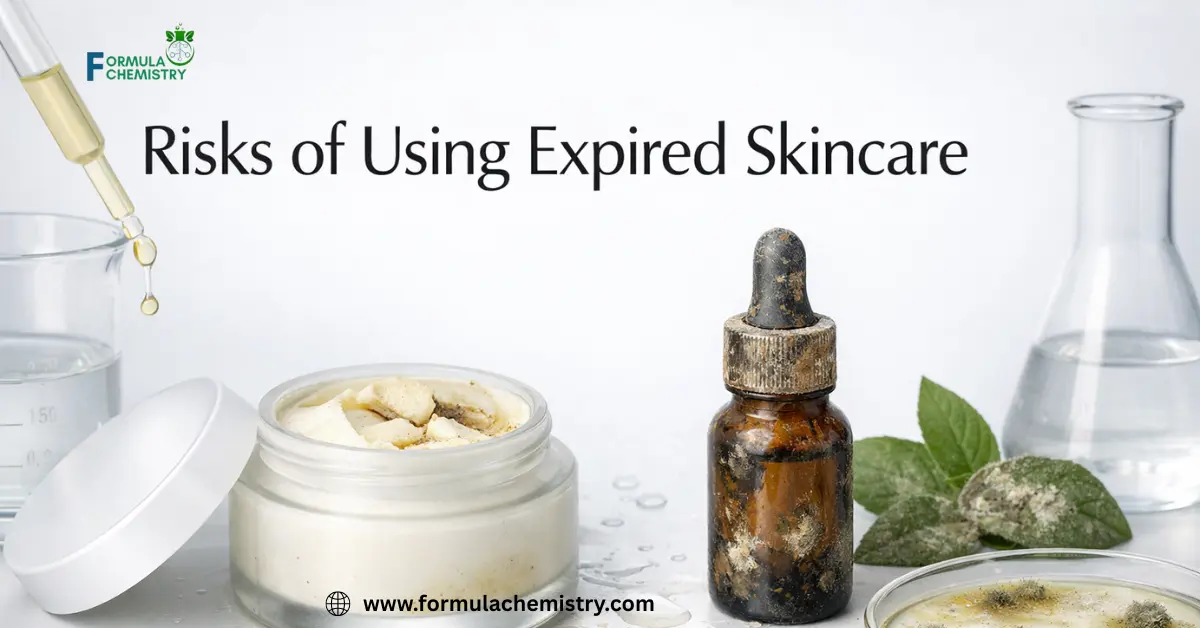
Key warnings include the presence of black spots (mold) or a fuzzy film on the surface of the product, which entails immediate disposal.
Decreased Efficacy and Skin Irritation
Apart from physical changes, expired skincare often loses its biological activity. An expired salicylic acid treatment may no longer penetrate pores effectively, while an expired moisturizer may fail to provide adequate occlusion. Using products past their prime also increases the risk of contact dermatitis.
- Common Problems and Fixes:
- Problem: Serum has turned slightly darker but hasn’t reached its PAO date. Fix: Examine for heat exposure; if it smells normal, use it on the body instead of the face, but discard it if it causes tingling.
- Problem: The moisturizer has separated into liquid and solid. Fix: Do not attempt to stir back together; the emulsion has broken, and the preservative system may be compromised. Discard immediately.
- Problem: Sunscreen feels gritty or “pilled” upon application. Fix: The filters have crystallized. This product provides zero protection; discard and replace with a fresh batch.
Risks of Using Expired Skincare
The dangers of using expired products range from mild ineffectiveness to severe infection. When preservatives fail, the product becomes a medium for microorganisms such as Staphylococcus aureus or Pseudomonas.
Applying pathogens to the face, especially near the eyes or on broken skin, may cause significant health issues.
Microbial Contamination and Infections
Microbial growth is not always visible to the naked eye. Bacteria can flourish in a liquid foundation or eye cream long before a smell develops.
Using contaminated eye products is particularly risky, as it can lead to conjunctivitis or keratitis. FormulaChemistry emphasizes safety-forward guidance: if a product is water-based and past its PAO, the risk of sub-clinical infection outweighs any potential benefit.
Those who should avoid using products near or past their expiration dates include individuals with acne-prone skin, as the bacteria in spoiled products can worsen breakouts and lead to painful cysts. Furthermore, those using prescription-strength topicals should be extra vigilant, as expired formulas can cause unpredictable chemical interactions on the skin surface.
Chemical Alterations and Skin Sensitivity
As ingredients break down, they may transform into different chemical compounds that are more irritating than the original formula.
For example, certain preservatives can release formaldehyde-donating agents as they degrade, leading to redness, itching, and rashes.
PH notes are also relevant here; as a formula destabilizes, its pH may drift into a range that is too acidic or too alkaline for the skin’s natural mantle.
Key warnings for those with sensitive skin: an expired product may cause a “latent” reaction, where the skin doesn’t react immediately but develops a sensitized response over several days of use. Always perform a patch test on the inner forearm if you are unsure about a product’s freshness.
FAQ about Does Skincare Expire?
How do I find the expiration date on a skincare bottle?
Look for the PAO (Period After Opening) symbol, which looks like a small jar with a number followed by an “M” (e.g., 12M). This indicates the product is good for 12 months after it is first opened.
Can I use expired sunscreen if I haven’t opened it?
If the “Use By” date on the crimp or bottom of the bottle has passed, do not use it. Sunscreen filters degrade even in sealed containers, and the SPF rating will no longer be accurate.
Is it safe to use expired moisturizer on my body instead of my face?
While the skin on the body is generally thicker, it is still susceptible to discomfort and infection from spoiled preservatives. If the product smells off or has separated, it should be discarded entirely.
Why does my Vitamin C serum turn brown?
This is a sign of oxidation. L-ascorbic acid reacts with oxygen and light to become dehydroascorbic acid. Once it turns dark orange or brown, it has lost its antioxidant benefits and may cause irritation.
Does organic skincare expire faster?
Yes. Organic or “natural” skincare often uses weaker preservative systems or essential oils that oxidize quickly. These products typically have a shorter PAO of 3–6 months.
Can I store skincare in the fridge to make it last longer?
Cold storage can help slow down the oxidation of certain actives like Vitamin C or Retinol, but it can also cause some emulsions to “crash” or separate. Check the label for storage instructions.
What happens if I use an expired face mask?
Sheet masks are highly prone to mold because they are saturated in water-based essence. Using an expired one can cause immediate breakouts, redness, or fungal folliculitis.
Should I throw away a product if the smell changes slightly?
Yes. A change in scent is one of the most dependable indicators that the chemical composition has altered or that bacteria are emitting gases within the formula.
Editorial responsibility at FormulaChemistry makes certain that we provide the most accurate, science-based information regarding cosmetic safety. Would you wish me to create a guide on how to properly perform a patch test for new or questionable products?