
Introduction
The beauty industry is undergoing a seismic shift. It is moving beyond the exhausted debate of natural versus synthetic ingredients. Biotech beauty represents the marriage of biology and technology, offering sustainable solutions without compromising efficacy.
By harnessing the power of microorganisms like yeast and bacteria, scientists can now produce potent actives in a lab setting.
This evolution ensures we can achieve high performance while protecting our planet’s dwindling resources.
What Defines Biotech Beauty in Modern Cosmetic Science?
Biotechnology in skincare involves using living organisms to produce active ingredients in a controlled environment.
The Fusion of Nature and Lab
Biotech beauty is often described as “lab-grown natural.” It uses biological processes, primarily fermentation, to create ingredients.
In the world of formula chemistry, this means we can replicate the exact molecular structure of a natural ingredient without needing to harvest the plant itself.
Fermentation
It is a central metabolic process in this field. Microorganisms are provided with nutrients to produce specific compounds.
This results in a final product that is biologically active and often more potent than its natural counterpart.
The Superiority of the Lab-Grown Chemical Formula
Natural ingredients are subject to weather, soil conditions, and harvest timing, leading to inconsistent final products.
This ensures that the chemical formula of the active ingredient remains identical across every batch, guaranteeing reliable results for consumers.
Eliminating Contaminants
Field-grown botanicals often carry risks of pesticide residues, soil-borne heavy metals, or insect contamination.
Lab-grown ingredients are sterile. This purity is essential for sensitive skin formulations. Trace impurities can cause reactions.
Top Biotech Ingredients Transforming Formula Chemistry Skincare
Several high-performance ingredients are already dominating the market thanks to biosynthetic innovation, offering superior alternatives to animal or plant-derived sources.
Biosynthetic Squalane:
Historically, Squalane was harvested from shark livers, a practice that devastated marine populations.
Advances in formula chemistry now make it possible to ferment sugarcane for the production of Squalane. This approach produces a molecule identical to its shark-derived counterpart and is both vegan and sustainable.
Epidermal Growth Factors (EGF):
EGF is a protein that stimulates cell growth, naturally found in human skin but decreasing with age.
Biotech allows us to engineer barley plants to produce human-like EGF. This provides powerful anti-aging benefits without using human or animal tissues.
Lab-Grown Collagen:
Traditional collagen molecules are too large to penetrate the skin and are sourced from bovine or marine waste.
Biotech has developed vegan collagen (often of distinct types, such as Type 21) with a lower molecular weight for better absorption and efficacy.
Sustainability: The Core of Formula Chemistry
Biotech facilitates performance while supporting scalable, environmentally responsible practices in the beauty industry.
Saving Endangered Species
Many prized ingredients, such as Sandalwood or certain orchids, are endangered due to over-harvesting.
By replicating the scent and therapeutic profiles in a lab, we can enjoy these ingredients without cutting down a single tree.
Reducing Water and Land Use
Traditional farming requires massive amounts of water and arable land.
Bioreactors take up a fraction of the space. They use significantly less water, making the supply chain more efficient.
Bio-Fermented Actives and the Skin Barrier
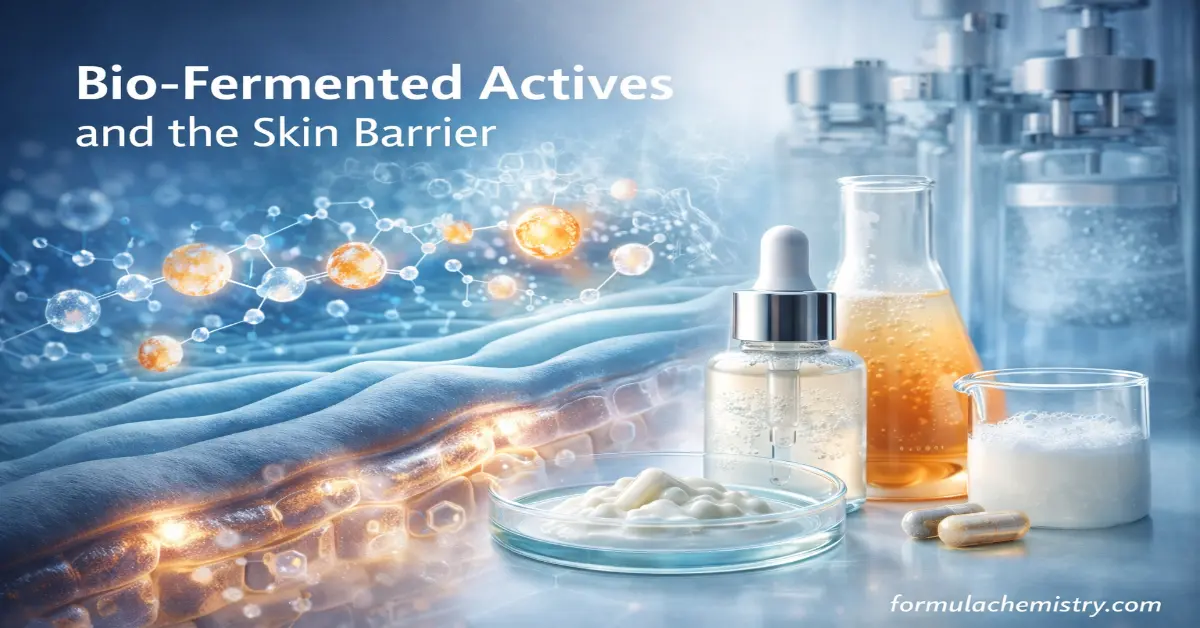
Fermentation breaks down large molecules into smaller ones, making them easier for the skin to absorb and utilize.
Enhanced Bioavailability
The skin barrier is designed to keep things out. Large molecules sit on top.
Fermented ingredients have a lower molecular weight. This altered chemistry formula allows them to penetrate deeper into the epidermis, where they can work effectively.
Microbiome Support
Biotech ingredients often function as prebiotics or postbiotics.
These compounds support the skin’s resident bacteria. They strengthen the acid mantle and reduce inflammation associated with acne and eczema.
Formula Chemistry DIY: Using Biotech at Home
For the home formulator, the rise of biotech makes professional-grade ingredients accessible for custom creations.
Incorporating Peptides
You can now purchase lab-grown peptide solutions to add to your simple base serums.
Peptides are water-soluble and generally stable, making them suitable for beginner-friendly DIY formulations.
Using Ferment Filtrates
Galactomyces or Saccharomyces ferments are popular in Korean skincare and available for home use.
These may serve as the water phase in toners or essences, elevating basic formulas to premium treatments.
The Role of DNA Analysis in Personalization
Biotech enables hyper-personalized skincare, tailored to individual genetic profiles. Companies can now analyze your DNA. This tells them how quickly you break down collagen or how prone you are to sun damage.
Based on this, a specific formula chemistry profile is created. This targets your biological weaknesses before they become visible concerns.
Microbiome Mapping
Swabbing your face to analyze your bacterial landscape is becoming more common.
Biotech enables the creation of custom probiotic serums that introduce the specific bacterial strains your skin lacks.
Safety and Regulation in Lab-Grown Beauty
There is a misconception that “lab-grown” implies “artificial” or “unsafe,” but the opposite is often true.
Rigorous Testing Standards
Biotech ingredients undergo arguably more testing than raw natural extracts.
Because they are novel, regulatory bodies require extensive safety data on the chemical formula before it hits the market.
Hypoallergenic Properties
By removing the proteins and allergens often found in whole-plant extracts, biotech ingredients are often safer for allergy-prone individuals.
A lab-grown rose scent can exclude the specific allergens found in natural rose oil. It keeps the pleasant aroma.
Integration with Green Chemistry Principles
Biotech is a subset of the broader Green Chemistry movement, which seeks to design chemical products and processes that reduce the use of hazardous substances.
Solvent-Free Extraction
Traditional extraction often uses harsh solvents like hexane.
Biotech processes typically use enzymatic extraction or water-based fermentation, resulting in a cleaner final product that aligns with clean formula chemistry.
Biodegradability
Ingredients created through biological processes are naturally biodegradable.
Unlike synthetic silicones or microplastics, biotech ingredients break down harmlessly in water systems, protecting our oceans.
Conclusion
Biotech beauty is not a fleeting trend; it is the necessary evolution of the cosmetic industry.
It resolves the conflict between efficacy and ethics, allowing us to use nature’s precise chemical formula without depleting it.
Whether you are a consumer looking for high-performance Formula Chemistry skincare or a hobbyist exploring Formula Chemistry DIY, biotech offers the purest, most effective path to healthy skin.
FAQ’s about Biotech Beauty
What is the difference between synthetic and biotech skincare?
Synthetic skincare is created through chemical reactions using petroleum or other non-living feedstocks. Biotech skincare uses living microorganisms (like yeast or bacteria) to biologically produce ingredients. This often results in molecules that are more compatible with human biology.
Is biotech skincare considered natural?
It sits in a middle ground often called “natural-identical.” While the ingredients are created in a lab, they are biologically derived and structurally identical to those found in nature, avoiding the environmental impact of farming.
Are lab-grown ingredients safe for sensitive skin?
Lab-grown ingredients are often safer than raw botanical extracts. Controlled production eliminates risks from pesticides, heavy metals, and allergens, providing a purer formula that is less likely to cause irritation.
Can I use biotech ingredients in my homemade skincare?
Absolutely. Many suppliers now sell bio-fermented extracts, peptides, and biosynthetic squalane. These are perfect for Formula Chemistry DIY projects as they are potent, water-soluble, and easy to incorporate into serums and toners.
Why is fermentation important in skincare?
Fermentation breaks down large molecular compounds into smaller, more absorbable nutrients (amino acids, enzymes). It also creates acidic byproducts that are compatible with the skin’s pH, enhancing the efficacy of the final formulation.
Is vegan collagen as effective as animal collagen?
Yes, and often more so. Animal collagen molecules are typically too large to penetrate the skin. Biotech “vegan collagen” is engineered to have a smaller molecular weight, allowing it to signal the skin to produce its own structural proteins.
Does biotech beauty hurt the environment?
No, it is significantly more eco-friendly. It requires a fraction of the land and water used in traditional agriculture and prevents the overharvesting of endangered plants, making it a cornerstone of sustainable formula chemistry.
What are the most common biotech ingredients?
The most common ingredients include Squalane (from sugarcane), Hyaluronic Acid (from bacterial fermentation), Peptides, Resveratrol, and various fermented plant filtrates. These are now staples in high-performance skincare.