
Introduction
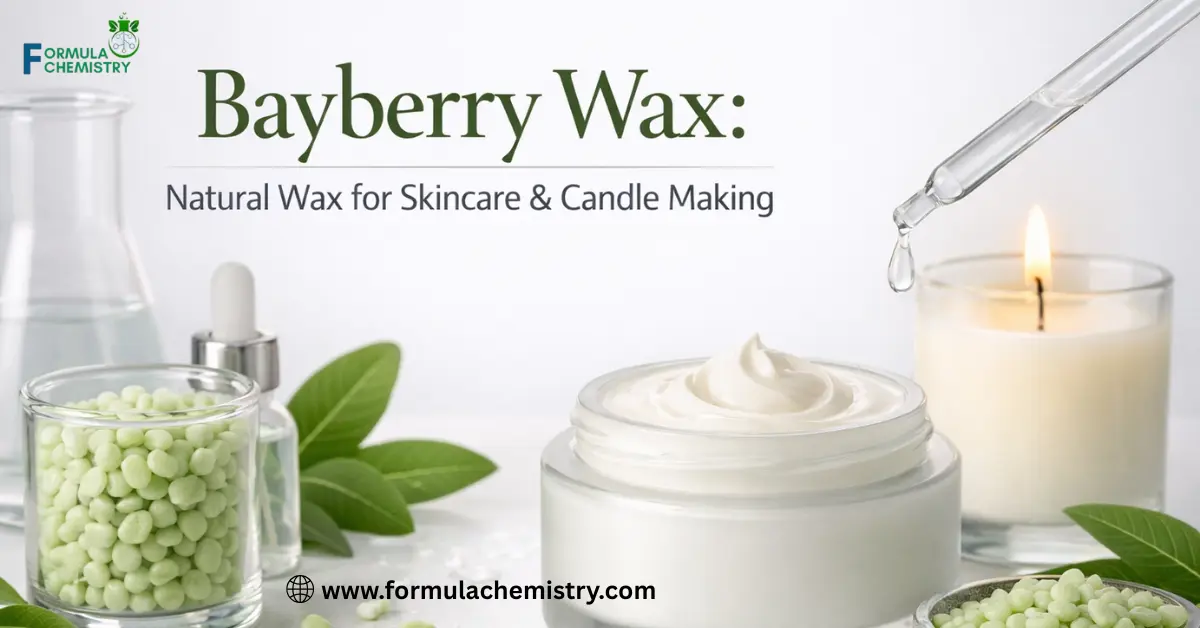
Bayberry wax, often referred to as myrtle wax, is a premium vegetable-based wax derived from the drupes (fruit) of the Myrica cerifera shrub. Unlike beeswax or paraffin, this wax is prized for its naturally aromatic, forest-green hue and its distinct herbaceous scent.
At FormulaChemistry, we categorize bayberry wax as a specialty consistency agent that connects the divide between traditional hardening waxes and soft vegetable butters.
Its unique chemical composition, primarily consisting of palmitic and myristic acid esters, provides a non-greasy feel that is highly sought after in luxury cosmetic formulations.
Quick Facts
- What it is: A natural, vegan-derived wax extracted from the berries of the bayberry shrub.
- Who it’s for: Formulators looking for a sustainable, plant-based alternative to beeswax with a high scent-retention profile.
- How to use: Melt with other oils or waxes during the oil phase of production; it has a relatively low melting point of approximately 45°C to 50°C.
- Typical usage range: In skincare, 2% to 10%; in candle making, 10% to 100% (though often blended for stability).
- Solubility: Soluble in cosmetic oils and organic solvents; insoluble in water.
- Compatibility: Highly compatible with soy wax, beeswax, and most vegetable oils and butters.
- Common mistakes: Overheating the wax, which may degrade its natural fragrance and delicate green pigment.
- Safety note: Always perform a patch test when adding new botanical waxes to skincare to test for individual sensitivities.
Chemical Composition and Sourcing
The extraction of bayberry wax is a labor-intensive process, as the berries contain a relatively small percentage of wax compared to their mass. This rarity often places bayberry wax at a greater price point than carnauba or candelilla waxes.
From a chemical perspective, it is technically a “fat” rather than a true wax because it lacks the long-chain alcohols found in beeswax.
FormulaChemistry provides practical formulation education and safety-forward guidance to help developers deal with these technical distinctions. Since it is composed largely of triglycerides, it offers superior emolliency and a lower melting point, making it exceptionally skin-compatible and easy to spread in anhydrous balms.
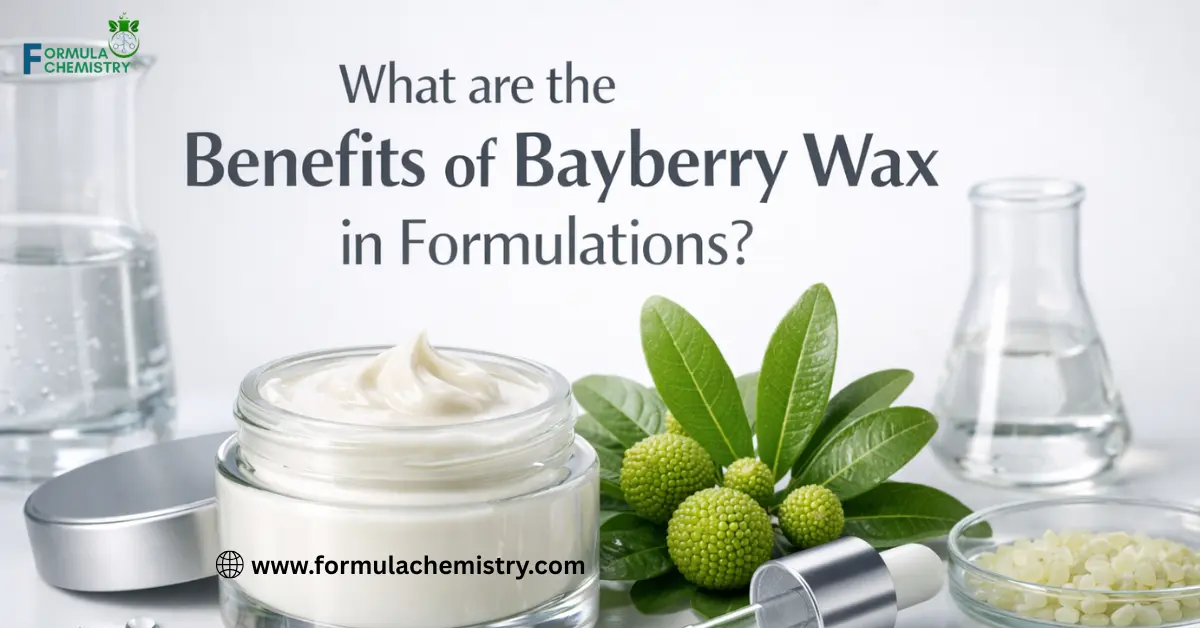
What are the Benefits of Bayberry Wax in Formulations?
Enhanced Texture and Emolliency in Skincare
Bayberry wax functions as a powerful thickening agent that does not impart the heavy, draggy notion often associated with high concentrations of beeswax.
In emulsions and anhydrous balms, it provides a smooth, “velvety” finish that absorbs relatively quickly into the stratum corneum. Because of its triglyceride structure, it acts as an occlusive agent, trapping moisture without being excessively comedogenic.
In lip care, it provides a glossy finish and excellent structural strength. When used at usage ranges of 5% to 15% in lip balms, it prevents “sweating” in warmer temperatures while continuing a soft, spreadable consistency.
It is especially beneficial for people seeking a vegan label claim without sacrificing the creamy texture provided by animal-derived waxes.
Clean Burning and Fragrance Retention in Candles
In the field of candle making, bayberry wax is legendary for its clean-burning properties and its ability to act as a natural fragrance fixative.
Historically, bayberry candles were burned during the holidays because they produce a pleasant, naturally occurring scent even without added fragrance oils.
When blended with softer waxes like soy, it increases the hardness of the pillar and improves the “cold throw” (the fragrance of the candle when unlit).
The wax’s natural green color is a significant aesthetic advantage, allowing candle makers to avoid synthetic dyes. However, because it is a brittle wax when used at 100% concentration, it is often blended with 10–20% coconut or soy wax to prevent cracking during the cooling process.
This versatility renders it a mainstay for high-end, eco-conscious artisanal brands.
| Property | Bayberry Wax | Beeswax (Yellow) | Soy Wax (464) |
| Source | Plant (Berries) | Animal (Bee secretion) | Plant (Soybean oil) |
| Melting Point | 45°C – 50°C | 62°C – 65°C | 46°C – 49°C |
| Texture | Tacky, soft, smooth | Hard, elastic | Soft, flaky |
| Primary Use | Luxury balms, candles | Structure, emulsions | Container candles |
| Vegan Status | Yes | No | Yes |
Formulation Guidelines and Best Practices
Inclusion in Cosmetic Emulsions
Integrating bayberry wax into O/W (oil-in-water) emulsions calls for careful temperature monitoring.
Since its melting point is lower than that of many functional waxes, it should be added to the oil phase and heated until just melted. To sustain the integrity of its natural compounds, avoid holding the oil phase at high temperatures for extended periods.
- Common problems and fixes:
- Problem: Grainy texture in the final balm. Fix: Cool the mixture rapidly (e.g., in an ice bath or refrigerator) to prevent the triglycerides from forming into large grains.
- Problem: Loss of natural green color. Fix: Keep heating temperatures below 65°C and store the final product in opaque or amber packaging to prevent UV degradation.
- Problem: Formulation feels too soft. Fix: Increase the concentration of a harder wax, like Carnauba, at 1% to 2% to provide structural reinforcement.
- Problem: Formula separates over time. Fix: Ensure a strong emulsifier system is used if water is present, as bayberry wax does not have emulsifying properties on its own.
Performance in Anhydrous Systems
In waterless systems like salves, body butters, and solid perfumes, bayberry wax acts as a stabilizer. It helps to reduce the “greasiness” of liquid carrier oils like jojoba or sweet almond oil.
For solid perfumes specifically, the natural fragrance of bayberry wax complements woody, earthy, or spicy fragrance notes, permitting a more complex olfactory profile.
Who should avoid: Individuals with known allergies to the Myricaceae family of plants should avoid products containing bayberry wax.
While rare, botanical sensitivities can occur. Furthermore, while the wax itself does not have a specific pH note (as it is anhydrous), any water-based formula containing it must be properly preserved and adjusted to a skin-neutral pH of 4.5 to 5.5.
Safety, Sustainability, and Storage Standards
Environmental Impact and Sourcing
Bayberry wax is often considered a highly eco-friendly choice because the shrubs are hardy and require minimal pesticides or fertilizers. However, because it takes a significant amount of berries to produce a small yield of wax, responsible procurement is of utmost importance. FormulaChemistry emphasizes selecting suppliers who practice responsible harvesting to ensure the long-term health of the wild shrub populations.
As a biodegradable ingredient, it complies with “Blue Beauty” and “Green Chemistry” standards. It is a non-toxic alternative to petroleum-derived paraffin, making it safer for both the user and the environment.
When making candles, the lack of petroleum soot contributes to better indoor air quality, a key selling point for current consumers.
Storage and Shelf Life Requirements
To maintain the quality of bayberry wax, it must be stored in a cool, dry location away from direct sunlight. Exposure to heat can cause the wax pellets to clump together, making accurate weighing difficult.
Under ideal conditions, bayberry wax has a shelf life of approximately 24 months.
Key warnings:
Do not leave melting wax unattended, especially over an open flame. Always use a double boiler (bain-marie) to ensure even heating and to prevent the wax from reaching its flash point.
In skincare, ensure that the total wax concentration does not exceed 20% in leave-on products, as this can create an excessively heavy barrier that may lead to follicular congestion in acne-prone individuals.
Editorial responsibility at FormulaChemistry guarantees that these safety parameters are emphasized for both amateurs and professional manufacturers.
FAQs about Bayberry Wax: Natural Wax for Skincare & Candle Making
Is bayberry wax vegan?
Yes, bayberry wax is 100% plant-derived, making it a suitable alternative for vegan and plant-based formulations.
Can I swap beeswax for bayberry wax 1:1?
No. Bayberry wax has a lower melting point and a softer texture than beeswax. You generally need more bayberry wax or a secondary hardener to achieve the same load-bearing capacity.
Does bayberry wax smell like berries?
It has a distinct, mild, herbaceous, and slightly spicy scent. It does not smell like “sweet” berries but rather like a pine forest or myrtle leaves.
Is bayberry wax comedogenic?
It is generally considered low on the comedogenic scale, but like all waxes, high concentrations can be occlusive. Those with very oily skin should use it sparingly.
What is the melting point of bayberry wax?
The melting point usually ranges between 45°C and 50°C (113°F – 122°F).
Why is my bayberry candle cracking?
Bayberry wax is naturally brittle. To prevent cracking, blend it with a small amount of a softer oil or wax, such as coconut oil or soy wax.
Can it be used in water-based lotions?
Yes, but it must be dissolved in the oil phase and requires an emulsifier to stay incorporated with the water. A preservation system is mandatory for any formula containing water.
Does bayberry wax require colorants in candles?
Typically no. It provides a beautiful, natural olive-green color on its own, which is one of its most desirable features in candle making.