
Introduction
Many people picture a cosmetic chemist mixing colourful creams in a glamorous lab, when the real work is closer to disciplined problem-solving under tight constraints. The job blends bench science, regulation, cost control, and creativity into one role that turns an idea into a product on a shelf.
This guide gives a complete picture of a cosmetic chemist’s career, from what the work involves day to day to how the path grows over time. A cosmetic chemist formulates and develops cosmetic and personal care products, balancing performance, safety, stability, cost, and regulation in every formula.
You will learn what the role actually involves, the daily responsibilities, the work environment, the education and skills needed, the salary and job outlook, and how the career progresses. The aim is an honest view of the field, including who it suits and where its real challenges lie.
By the end, you will understand whether this path fits your interests and strengths, and what it takes to enter and grow in the field.
What a Cosmetic Chemist Does
A cosmetic chemist designs the formulas behind skincare, haircare, colour cosmetics, and personal care products. The cosmetic chemist’s role sits at the centre of product development, translating a marketing concept into a stable, safe, manufacturable formula.
The work is far broader than mixing ingredients. A cosmetic chemist selects raw materials, builds and tests formulas, solves stability and performance problems, and shepherds a product from the first lab sample to full-scale production.
The products span every category of personal care. A cosmetic chemist may work on skincare creams and serums, shampoos and conditioners, colour cosmetics such as lipstick and foundation, sun care, deodorants, or cleansers, often specialising in one area as their career develops.
Cosmetic chemist responsibilities also reach beyond the bench. The role involves working with regulatory teams on compliance, with suppliers on raw materials, with marketing on claims and feel, and with manufacturing on scaling a formula without losing its quality.
The defining skill is balancing competing demands. A formula must perform well, feel pleasant, stay stable, meet regulations, and hit a cost target all at once, and the cosmetic chemist is the person who reconciles those pressures into a single working product.
A Cosmetic Chemist’s Daily Tasks and Responsibilities
The daily reality of the job mixes lab work, documentation, and collaboration. Cosmetic chemist daily tasks vary by employer and seniority, but most weeks include formulation, testing, and a good deal of record keeping.
Formulation and Bench Work
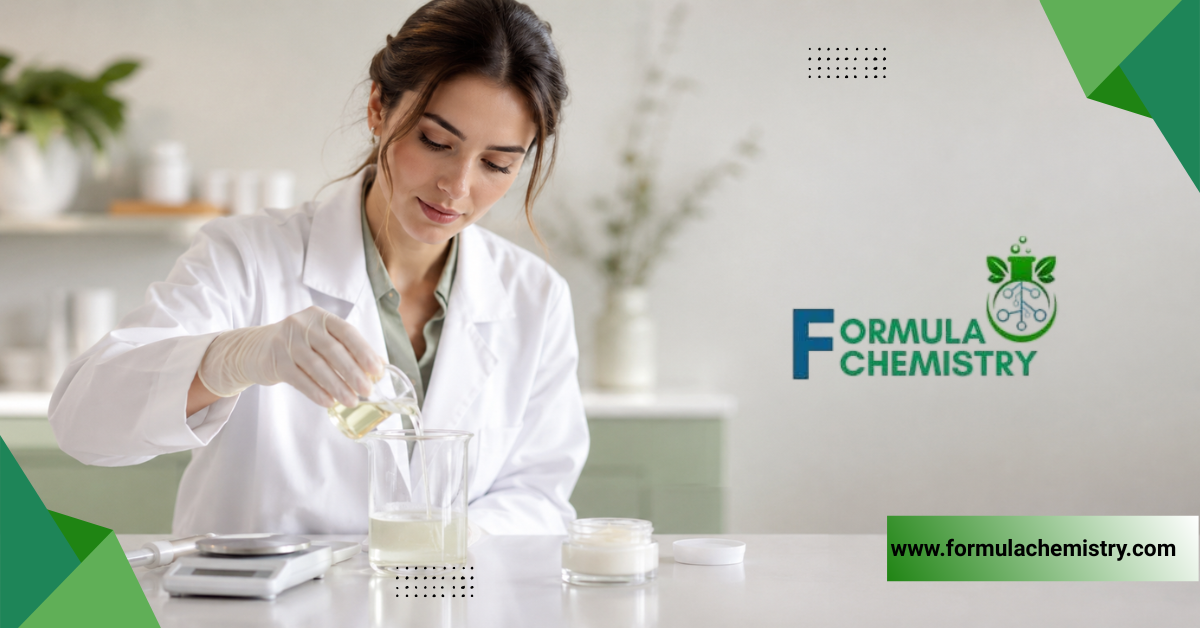
Bench formulation is the core activity for most cosmetic chemists. This means weighing raw materials, making lab batches, adjusting ratios, and refining a formula until it meets its performance and feel targets.
Each formula goes through many iterations. A chemist changes one variable at a time, records the result, and narrows toward a version that balances every requirement, which is slow, methodical work rather than instant creativity.
Testing and Documentation
Stability testing fills much of a chemist’s time. Samples are held at different temperatures and conditions and checked over weeks for separation, colour change, odour shift, and pH drift, since a formula is not finished until it proves stable.
Documentation underpins everything. A cosmetic chemist records formulas, batch details, test results, and observations precisely because reproducibility and traceability are professional requirements rather than optional habits.
Collaboration Across Teams
A cosmetic chemist rarely works alone. The role involves regular contact with regulatory affairs on compliance, with marketing on claims and sensory direction, with procurement on raw materials, and with manufacturing on scale-up.
This cross-team work is a large part of the job. A chemist who can explain technical limits clearly to non-technical colleagues is far more effective than one who stays only at the bench.
A Day in the Life of a Cosmetic Chemist
No two days are identical, but a typical day shows the rhythm of the work. The morning often starts at a desk, reviewing the previous day’s stability samples and planning the bench work ahead.
Mid-morning usually move to the lab. The chemist weighs raw materials, makes new trial batches, and adjusts formulas from the last round of testing, recording each change in detail.
The middle of the day frequently includes collaboration. A chemist might meet with marketing to discuss a product’s target feel, talk to regulatory about an ingredient’s status, or update a project team on progress and problems.
The afternoon often returns to the bench and the records. Tests are set up, results are logged, and observations on colour, texture, and stability are written down while they are fresh.
Some days break the pattern entirely. A scale-up trial at a factory, a supplier meeting about a new raw material, or a deadline before a launch can reshape a day around a single priority.
The constant across all of it is documentation. Whatever the day holds, a cosmetic chemist records what they did and what they saw, because that record is what makes the work reproducible and trustworthy.
The Cosmetic Chemist Work Environment
Most cosmetic chemists work in a mix of laboratory and office settings. The cosmetic chemist’s work environment centres on an R&D or formulation lab, with time also spent at a desk handling documentation, planning, and meetings.
Employers range widely across the industry. Cosmetic chemists work for large multinational beauty companies, contract manufacturers, raw material suppliers, indie brands, and testing or consulting firms, and the setting shapes the pace and breadth of the work.
Safety is part of the environment. Chemists handle raw materials and follow safety procedures, wearing protective equipment and respecting handling and storage rules, which the US Bureau of Labor Statistics also notes as a standard feature of chemist roles.
Hours are typically full-time and fairly regular. Deadlines around product launches or time-sensitive testing can extend the day, but the role generally avoids the extreme hours of some other technical fields.
How to Become a Cosmetic Chemist: Education and Skills
Most cosmetic chemists enter the field through a science degree. A bachelor’s degree in chemistry, chemical engineering, biology, or a related science is the common starting point, and surveys of the role show that the majority hold a bachelor’s degree.

Specialised routes exist alongside the general science path. Some universities and professional bodies offer cosmetic science programmes and diplomas, which teach formulation directly and can shorten the path into the industry.
Degree Options and Self-Study
The most common degree route is a bachelor’s in chemistry or chemical engineering, which gives the scientific foundation employers expect. Degrees in biology, biochemistry, or pharmaceutical science also lead into the field.
Cosmetic science programmes offer a more direct path. Specialised undergraduate and postgraduate courses teach formulation, raw materials, and regulation explicitly, giving graduates a head start in the industry.
Self-study has a real place too, especially for those entering through indie formulation. Online courses, professional society training, and disciplined hands-on practice build genuine skill, though a formal employed role usually still expects a degree.
A degree opens the door, but skills earn the role. Practical formulation experience, an understanding of cosmetic regulation, and the ability to work methodically and document carefully matter as much as the qualification itself.
Several core skills define a strong cosmetic chemist. They include hands-on formulation ability, knowledge of raw materials and their functions, an understanding of stability and preservation, familiarity with regulatory requirements, and clear communication with non-technical teams.
Entry-level routes often start below the formulation title. Many chemists begin as laboratory technicians or assistants, building bench experience before moving into a formulation role, which is a practical way into the field for new graduates.
Essential Skills for a Cosmetic Chemist
Success in the field rests on a blend of technical and personal skills. The strongest cosmetic chemists pair deep formulation knowledge with the ability to work across teams and adapt to constant change.
Technical Skills
Formulation ability sits at the centre of the role. A chemist must understand how raw materials behave, how emulsions and surfactant systems work, and how to build a stable, effective product from a blank page.
Supporting technical knowledge rounds out the core. Stability testing, preservation, pH control, basic analytical methods, and an understanding of manufacturing and scale-up all make a chemist more capable and independent.
Regulatory Knowledge
Regulation shapes nearly every formulation choice, so a working knowledge of it is essential. A chemist needs to understand ingredient restrictions, labelling rules, and claim requirements for the markets a product will sell into.
This knowledge is not optional detail. A formula that ignores the rules of its market cannot launch, so regulatory awareness is part of formulating well rather than a separate task.
Communication and Adaptability
Soft skills determine how far technical skill travels. A chemist who can explain a constraint clearly to marketing, or translate a brief into a realistic plan, has far more impact than one who stays silent at the bench.
Adaptability matters as much as communication. Projects change, ingredients get restricted, and priorities shift, so a chemist who adjusts calmly and keeps learning thrives where a rigid one struggles.
Cosmetic Industry Careers: Roles and Specialisations
The field is wider than the single title of cosmetic chemist. Cosmetic industry careers include several specialisations that a chemist can move into as their interests and strengths develop.
Formulation and research and development is the central path, focused on creating and improving products. A formulation chemist designs the products, while an R&D scientist may work on longer-term innovation and new technologies.
Regulatory affairs is a major adjacent path. These specialists ensure products meet the rules of each market, manage ingredient compliance, and handle the documentation that lets a product launch legally, and the role suits chemists who enjoy detail and rules.
Quality assurance and quality control keep production reliable. QA and QC professionals test incoming materials and finished products, maintain standards, and catch problems before products reach customers.
Several other specialisations round out the field. Claims and efficacy testing, process and scale-up engineering, application and technical labs, and technical sales all draw on cosmetic chemistry knowledge, offering paths for chemists who want to move beyond pure formulation.
| Specialisation | Focus |
| Formulation and R&D | Creating and improving products |
| Regulatory affairs | Compliance and market approval |
| Quality assurance and control | Testing and maintaining standards |
| Claims and efficacy | Proving product performance |
| Process and scale-up | Moving formulas to production |
| Technical sales | Supporting customers with expertise |
Where Cosmetic Chemists Work: Types of Employers
The employer shapes the experience as much as the job title does. Cosmetic chemists work across several types of organisations, each offering a different pace, scope, and kind of work.
Large beauty companies offer depth and resources. A chemist there often specialises in one category, works with advanced equipment, and follows established processes, which builds deep expertise but a narrower day-to-day variety.
Contract manufacturers offer breadth and speed. Formulating many products for many clients, a chemist at a contract manufacturer gains wide, fast experience across categories, which suits those who want to learn quickly.
Raw material suppliers offer a different angle. Chemists there develop and demonstrate ingredients, build sample formulas, and support customers, blending formulation with technical service and travel.
Indie brands and start-ups offer range and ownership. A chemist at a small company may handle formulation, sourcing, and even some regulatory work, gaining broad responsibility at the cost of the resources a large firm provides.
Testing and consulting firms round out the options. These roles focus on evaluating products, solving specific problems, or advising clients, and they suit chemists who enjoy analysis and variety.
No single employer type is best. The right fit depends on whether you want depth or breadth, structure or ownership, and many chemists move between employer types across their career to broaden their experience.
How to Land Your First Cosmetic Chemist Job
Breaking into the field takes more than a qualification, since formulation roles are competitive. A focused approach to experience, evidence, and networking makes the difference for new entrants.
Practical experience is the strongest asset. Internships, placements, and laboratory technician roles all build the hands-on formulation experience that employers value above grades alone.
A record of real work sets candidates apart. Documenting formulas you have made, problems you have solved, and products you have built shows demonstrated ability rather than academic knowledge alone.
Networking opens doors that job boards do not. Engaging with professional bodies, formulator communities, and industry events helps newcomers learn, meet people in the field, and hear about openings early.
Entry titles are worth taking seriously. Many successful chemists start as technicians or assistants, using the role to learn the industry and prove themselves before moving into formulation.
Targeting the right employers helps too. Contract manufacturers, raw material suppliers, and smaller brands often give new chemists broader hands-on experience earlier than large companies, which can speed up growth.
Tailoring each application also pays off. Showing that you understand a company’s products and explaining how your skills fit a specific role lands far better than sending the same generic application everywhere.
Salary and Cosmetic Chemistry Job Outlook
Pay is one of the first questions about any career, and the cosmetic chemist field offers a solid, if not extraordinary, income. The figures below are United States estimates from salary aggregators, and they vary by source, region, and experience, with pay differing greatly in other countries.
| Career level | Typical US salary range |
| Entry level, 1 to 3 years | roughly $55,000 to $66,000 |
| Mid level | roughly $70,000 to $90,000 |
| Senior, 8 or more years | roughly $90,000 to $110,000 and above |
| Major hubs such as Los Angeles and New York | often 15% to 25% above the national average |
Salary estimates differ between sources because of how each one gathers data. Aggregators place the average United States cosmetic chemist salary anywhere from the high $50,000s to the high $80,000s, so any single number is best read as part of a range rather than a fixed figure.
Location and experience drive most of the variation. Major beauty and manufacturing hubs pay more to reflect both demand and cost of living, and a senior chemist with eight or more years of experience can earn well above an entry-level salary.
The cosmetic chemistry job outlook is steady and modestly positive. The US Bureau of Labor Statistics projects that employment of chemists and materials scientists will grow about 5 percent from 2024 to 2034, faster than the 3 percent average for all occupations, with roughly 7,000 openings each year across the decade.
Demand is supported by ongoing innovation and an ageing workforce. New product development, sustainability, and the replacement of retiring chemists all create openings, though the field is competitive and a science degree alone does not guarantee a formulation role.
Pay also varies enormously between countries. The United States figures above are among the highest globally, while cosmetic chemists in many other regions earn considerably less in absolute terms, so anyone weighing the career should research local salary data for their own market.
Salary is not the whole picture either. Many roles add bonuses and benefits, and the satisfaction of seeing a product reach real customers factors into how rewarding the career feels beyond the headline figure.
Cosmetic Chemist Career Growth Path and Promotion
A cosmetic chemist career grows from supervised bench work toward technical leadership and management. The cosmetic chemist career growth path is fairly structured at larger companies and more fluid at small ones.
| Stage | Typical title | Focus |
| Entry | Junior or Associate Chemist | Bench work under supervision |
| Established | Formulation or Cosmetic Chemist | Independent formulation projects |
| Senior | Senior Chemist | Complex projects and mentoring |
| Lead | Principal or Lead Chemist | Technical leadership and strategy |
| Management | R&D Manager or Director | Team and programme leadership |
Early promotion comes from proven competence. A junior chemist earns independence by reproducing formulas reliably, solving problems, and showing sound judgment, which leads to owning projects rather than assisting on them.
Cosmetic chemist promotion later splits into two broad directions. One path deepens technical expertise toward principal or lead scientist, while the other moves into management of teams, programmes, and strategy, and each suits different strengths.
Entrepreneurship is a third direction. Many experienced chemists launch their own brands or consultancies, using their formulation skills to build a business, and the rise of indie beauty has made this path more common than it once was. Communities such as Formula Chemistry exist partly to support formulators taking that independent route.
The fastest growth comes from combining skills. A chemist who pairs strong formulation with regulatory knowledge, communication, and some business sense advances faster than one with bench skill alone.
Professional Development and Continuing Education
Cosmetic chemistry rewards continuous learning, since ingredients, regulations, and techniques keep evolving. Staying current is part of the job rather than an extra.
Professional bodies anchor much of this development. Organisations such as the Society of Cosmetic Chemists and the International Federation of Societies of Cosmetic Chemists offer education, conferences, and a professional network that supports a chemist’s growth.
Continuing education takes many forms. Short courses, supplier technical seminars, industry conferences, and trade publications all help a chemist keep pace with new raw materials and methods.
Specialised credentials can strengthen a profile. Cosmetic science certificates and focused training in areas such as preservation, sun care, or regulation deepen expertise and signal commitment to the field.
The habit of learning compounds over a career. A chemist who keeps building knowledge stays valuable as the industry shifts, while one who stops learning slowly falls behind.
Trends Shaping the Future of Cosmetic Chemistry
The field is changing, and the changes shape what cosmetic chemists work on. Understanding these trends helps anyone entering the career see where the opportunities lie.
Sustainability is a defining force. Demand for greener ingredients, biodegradable formulas, reduced packaging, and responsible sourcing is reshaping how products are designed, and chemists increasingly formulate with environmental impact in mind.
Clean and natural positioning continues to grow. Consumer interest in simpler ingredient lists and naturally derived materials pushes chemists to reach performance and stability with a narrower or more scrutinised palette.
Regulation keeps tightening and shifting. Ingredient restrictions and new requirements across markets mean chemists must stay current, and regulatory knowledge becomes ever more central to the role.
Technology is changing how chemists work. Data tools and predictive methods are starting to assist formulation and testing, and chemists who combine bench skill with comfort using these tools will be well placed.
Personalisation and new delivery systems add further opportunity. Interest in tailored products and advanced delivery of active ingredients keeps the science moving, ensuring the role stays intellectually fresh.
Ingredient innovation drives much of the change. New raw materials, from biotechnology-derived actives to novel mild surfactants, give chemists fresh tools, and those who explore them early gain an edge.
Cosmetic Chemist Career Compared to Related Paths
A career as a cosmetic chemist is one of several science routes, and comparing them helps clarify the choice. The table below sets it alongside related paths that draw on similar training.
| Career | Typical focus | Compared to cosmetic chemistry |
| Cosmetic chemist | Formulating personal care products | Creative, consumer-facing, moderate pay |
| Pharmaceutical chemist | Developing medicines | More regulated, often higher pay |
| Chemical engineer | Designing processes and plants | More engineering, broader industries |
| Food scientist | Developing food products | Similar formulation blend, different sector |
| Analytical chemist | Testing and measuring substances | More instrumentation, less formulation |
The cosmetic path stands out for its blend of creativity and consumer focus. It lets a chemist see their work become a product people use, which many find more rewarding than purely analytical or industrial roles.
The trade-off is pay and prestige in some comparisons. Pharmaceutical and engineering paths can pay more, so the choice often comes down to whether the creative, consumer nature of cosmetics outweighs the salary difference for a given person.
Building Long-Term Success in the Field
Entering the field is only the start, and long-term success comes from a few consistent habits. The chemists who advance furthest tend to share the same practical approach.
Keep meticulous records throughout your career. A well-documented body of work makes you reproducible, trustworthy, and able to build on past results rather than repeating them.
Broaden beyond the bench over time. Adding regulatory understanding, business awareness, and project management to formulation skill turns a capable chemist into a leader.
Stay close to the industry and its people. Maintaining a network through professional bodies and communities brings new opportunities, fresh knowledge, and support when challenges arise.
Keep learning as the field moves. New ingredients, regulations, and consumer demands appear constantly, so a habit of study keeps your skills current and your value high.
Above all, treat every formula and every failure as data. The chemists who grow fastest learn deliberately from each result rather than chasing quick wins.
Is Cosmetic Chemistry a Good Career?
The honest answer to whether cosmetic chemistry is a good career is that it suits some people very well and others poorly. It rewards a specific mix of interests, and it carries real trade-offs worth knowing before committing.
The strengths of the field are genuine. The work is creative and tangible; it combines science with consumer products people enjoy, the pay is solid, the outlook is steady, and the skills transfer across skincare, haircare, colour, and personal care.
The challenges are equally real. Entry can be competitive, the daily work is more methodical and document-heavy than the glamorous image suggests, and pay, while solid, sits below some other chemistry and engineering paths.
The table below summarises the trade-off at a glance.
| Strengths | Challenges |
| Creative, tangible work | Competitive entry |
| Combines science with consumer products | Document-heavy daily work |
| Solid pay and steady outlook | Pay below some science paths |
| Skills transfer across categories | Commercial and regulatory constraints |
The field fits people who enjoy patient problem-solving. A person who likes refining something through many careful iterations, who tolerates documentation, and who enjoys both science and consumer products will likely find the career satisfying.
It fits less well for those seeking fast, dramatic results or pure research. Someone who wants rapid creative freedom without constraints, or deep academic research, may find the commercial and regulated nature of the work frustrating.
Common Mistakes When Pursuing a Cosmetic Chemistry Career
These are the errors that hold people back when entering or building a cosmetic chemistry career. Each one names the mistake, explains why it happens, and gives the better approach.
- Relying on a degree alone. New graduates assume a chemistry degree guarantees a formulation role, then struggle in a competitive market. Build practical formulation experience through projects, internships, or lab roles to stand out beyond the qualification.
- Ignoring regulatory knowledge. Aspiring chemists focus only on making products and overlook the rules that govern them, which limits their usefulness. Learn the basics of cosmetic regulation early, since compliance is part of nearly every formulation decision.
- Expecting a glamorous role. People enter expecting constant creativity and are surprised by the documentation and methodical testing. Accept that careful iteration and record keeping are the real core of the work, and that creativity lives within those constraints.
- Neglecting communication skills. Technically strong candidates assume bench skill is enough and struggle to work across teams. Develop the ability to explain technical limits clearly to marketing, regulatory, and manufacturing colleagues.
- Skipping a portfolio of work. Candidates apply with only a transcript and no evidence of hands-on ability. Build a record of formulations you have made and problems you have solved, since demonstrated skill is more persuasive than grades alone.
- Failing to network in the industry. Many newcomers apply only to job listings and miss the relationships that open doors. Engage with professional bodies, formulator communities, and industry events to learn and to find opportunities.
- Overlooking the business side. Chemists who want to launch a brand focus only on the formula and ignore cost, sourcing, and regulation. Learn the commercial and compliance basics alongside the chemistry to build something that can actually sell.
Who This Career Suits
A cosmetic chemist’s career suits people who enjoy combining science with tangible consumer products. The work rewards curiosity about how ingredients behave, patience for methodical testing, and satisfaction in solving practical problems.
The role fits methodical, detail-oriented thinkers. Someone who enjoys refining a formula through many careful iterations, documenting results precisely, and working within real constraints will find the daily work rewarding rather than tedious.
It also suits collaborative people who can bridge technical and non-technical worlds. Much of a chemist’s impact comes from working with marketing, regulatory, and manufacturing colleagues, so strong communication amplifies technical skill.
The career suits a range of backgrounds, from chemistry and chemical engineering graduates to self-taught formulators who build skills through study and practice. What matters most is demonstrated formulation ability, an understanding of safety and regulation, and a willingness to keep learning as the field evolves.
It is a weaker fit for those who want pure academic research, rapid unconstrained creativity, or the highest possible salary in science. Knowing this honestly helps anyone decide whether the path matches their goals before committing to it.
The path also rewards persistence. Entry can be competitive and early roles modest, so those who keep building skills and seeking experience tend to break through where others give up too soon.
Frequently Asked Questions
Is cosmetic chemistry a good career?
Cosmetic chemistry is a good career for people who enjoy combining science with consumer products and patient problem-solving. It offers creative, tangible work, solid pay, and a steady job outlook, though entry can be competitive and the work is more methodical than its glamorous image suggests. It suits detail-oriented, collaborative people more than those seeking fast results or pure research.
What does a cosmetic chemist do?
A cosmetic chemist formulates and develops skincare, haircare, colour, and personal care products. The role covers selecting raw materials, building and testing formulas, solving stability and performance problems, and guiding products from lab sample to production. It also involves working with regulatory, marketing, and manufacturing teams.
What degree do cosmetic chemists need?
Most cosmetic chemists hold a bachelor’s degree in chemistry, chemical engineering, biology, or a related science. Some enter through specialised cosmetic science programmes that teach formulation directly. Practical formulation experience and regulatory knowledge matter as much as the qualification itself.
How much do cosmetic chemists earn?
In the United States, cosmetic chemist salaries commonly range from the mid $50,000s at entry level to over $100,000 for senior chemists, with averages varying by source. Pay depends heavily on experience, location, and employer, and major beauty hubs pay more. Salaries differ significantly in other countries.
Is the cosmetic chemist job market growing?
The outlook is steady and modestly positive. The US Bureau of Labor Statistics projects about 5 percent growth for chemists and materials scientists from 2026 to 2036, faster than the average for all occupations. Demand is supported by new product development, sustainability, and the replacement of retiring workers.
How do you become a cosmetic chemist?
You typically become a cosmetic chemist by earning a science degree, then building practical formulation experience. Many start as laboratory technicians or assistants before moving into a formulation role. A cosmetic science programme, hands-on practice, and regulatory knowledge all strengthen the path.
Do cosmetic chemists work in labs?
Yes, most cosmetic chemists split their time between a formulation lab and an office. The lab is where they make and test formulas, while desk work covers documentation, planning, and collaboration. Some also spend time in manufacturing facilities during scale-up.
Can I be a cosmetic chemist without a degree?
A formal cosmetic chemist role usually expects a science degree, so it is difficult to enter without one. However, self-taught formulators can build real skills and launch their own products or small brands through study and practice. Demonstrated formulation ability and regulatory knowledge are what ultimately matter.
Key Takeaways
You now have a complete and honest picture of the field, from daily work to long-term growth. These are the points worth carrying forward.
- A cosmetic chemist formulates personal care products, balancing performance, safety, stability, cost, and regulation in every formula.
- The daily work centres on bench formulation, stability testing, documentation, and collaboration across regulatory, marketing, and manufacturing teams.
- Most chemists enter with a science degree, and practical formulation experience and regulatory knowledge matter as much as the qualification.
- United States salaries commonly run from the mid $50,000s at entry to over $100,000 at the senior level, with a steady outlook of about 5 percent growth from 2024 to 2034.
- The career grows from supervised bench work toward technical leadership, management, or entrepreneurship, and rewards those who pair formulation skill with communication and business sense.
Weigh the honest strengths and trade-offs above against your own interests, then build practical formulation experience alongside any qualification, and you will be well placed to start and grow a cosmetic chemist career.