
Introduction
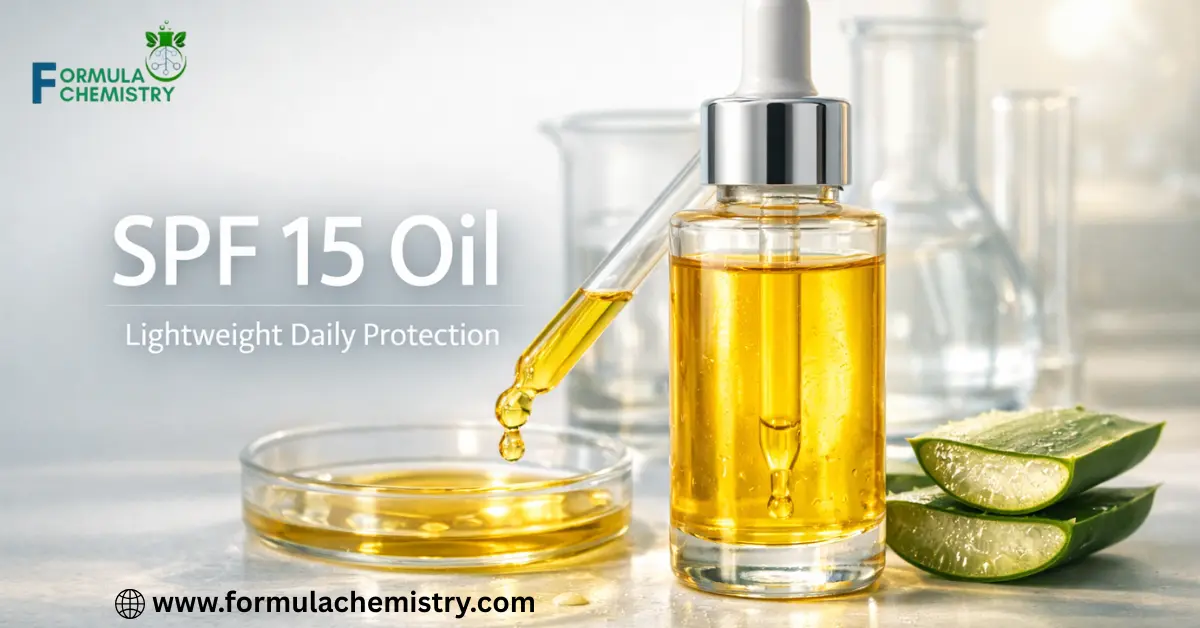
For those who crave the nourishing feel of an oil but need sun protection without the heaviness of a high-SPF cream, an SPF 15 Oil is the perfect solution. It offers a moderate level of defense suitable for daily, incidental exposure while delivering a luxurious, satin finish.
Understanding the chemical formulae of sun protection oils helps you appreciate how they work differently from lotions. By combining oil-soluble UV filters with lightweight esters, these products protect the skin’s lipid barrier while shielding it from moderate UV radiation.
This guide examines the science behind lightweight SPF oils. We will decode how they function, who they are best for, and how to integrate them into your Formula Chemistry skincare routine for a healthy, glowing complexion.
What Defines an SPF 15 Oil?
An SPF 15 oil is an anhydrous (water-free) formulation designed to protect the skin from UV rays while providing intense moisturization.
The Physics of SPF 15
An SPF 15 rating means the product blocks approximately 93% of UVB rays.
While SPF 30 blocks 97% and SPF 50 blocks 98%, SPF 15 is often sufficient for short periods of sun exposure, such as a commute or a lunch break. It provides a baseline of protection without the heavier texture often required to suspend higher concentrations of filters.
Anhydrous Benefits
Because it contains no water, an SPF oil is naturally water-resistant.
The oil forms a hydrophobic film on the skin’s surface. This film locks in existing moisture and repels sweat, making it surprisingly durable for light activity compared to water-based lotions that can wash away easily.
The Chemistry Formula of Transparency
One of the biggest advantages of sunscreen oils is their clarity; they leave absolutely no white cast on any skin tone.
Soluble Organic Filters
To preserve clarity, formulators use chemical (organic) UV filters like Octinoxate, Homosalate, or Avobenzone.
These molecules are lipophilic (oil-loving). Their chemical formula allows them to dissolve completely into the carrier oils. Unlike mineral powders (Zinc/Titanium) that sit on top and reflect light, soluble filters absorb UV energy and convert it to heat, remaining invisible to the eye.
Film-Forming Polymers
To ensure the protection is uniform, film-forming agents are added to the oil.
These invisible polymers create a structured network that holds the UV filters in an even layer. Without them, the oil would spread too thin or pool in creases, creating spaces in your sun protection.
Carrier Oils: The Vehicle of Hydration
The “feel” of an SPF oil is determined by the mixture of plant oils and synthetic esters used as the base.
Dry Oils vs. Wet Oils
A “dry oil” absorbs instantly. This is achieved using esters like Isopropyl Myristate or Coco-Caprylate.
These ingredients have a low molecular weight and low viscosity. They penetrate the top layers of the skin rapidly, delivering the UV filters without leaving a greasy residue. This makes the formula chemistry suitable even for those who typically dislike body oils.
Nourishing Plant Lipids
To provide long-term hydration, formulators add oils rich in fatty acids like Argan or Almond Oil.
These oils mimic the skin’s natural oils. They reinforce the lipid barrier, preventing Transepidermal Water Loss (TEWL) caused by sun and wind exposure.
Who Should Use SPF 15 Oil?
This product is not a universal solution; it serves a specific lifestyle and skin type.
The Urban Commuter
If your sun exposure is limited to walking to the car or office, SPF 15 is an excellent daily shield.
It protects against the accumulated harm of incidental UV exposure without the sticky feel of “beach day” sunscreens. It encourages compliance because it feels like a beauty treatment rather than a chore.
Darker Skin Tones
Those with melanin-rich skin have some natural protection against burning (UVB) but still need protection against aging (UVA).
SPF 15 provides this necessary boost. Crucially, the oil formula chemistry guarantees zero white cast, avoiding the ashy look common with mineral sunscreens.
Formula Chemistry DIY: Customizing Your Glow
While you should never attempt to make sunscreen from scratch at home due to the complexity of testing, you can safely customize a store-bought SPF oil.
Adding Shimmer
You can turn a standard SPF 15 oil into a sparkling body bronzer.
- Method: Add a pinch of cosmetic-grade Mica (gold or bronze) to the bottle.
- Safety: Shake well before every use. The mica is inert and will not react with the chemical formula of the UV filters, adding a cosmetic benefit to your daily protection.
Antioxidant Boosting
Add a few drops of Vitamin E oil or Rosehip Seed Oil to your bottle.
These oils are high in antioxidants. They help stabilize the carrier oils against oxidation (rancidity) and provide extra free-radical scavenging power on the skin.
Application Plan for Peak Efficacy
The liquidity of oil often leads to under-application; proper technique is vital to achieve the labeled SPF 15 protection.
The “Sheen” Test
To get the full SPF value, you need to apply 2mg/cm².
Since you can’t weigh it, look for the visual cue: a uniform, visible sheen. If your skin looks matte or dry in patches, you haven’t applied enough. The gloss is your assurance that the protective formula chemistry film is intact.
Timing Matters
Apply the oil 15 minutes before going outside.
Although it feels like it absorbs instantly, the UV filters need time to settle into a stable layer. Rushing out the door immediately can result in the oil rubbing off on clothes before it has set.
Limitations of SPF 15 Oil
It is important to know when not to rely on this product to avoid skin damage.
Not for Peak Sun
Do not use SPF 15 for a day at the beach or hiking at noon.
The protection level is too low for intense, prolonged radiation. In those scenarios, you need SPF 30 or 50. Relying on SPF 15 during peak UV index hours will likely result in sunburn and cellular damage.
Acne-Prone Skin
Unless labeled “non-comedogenic,” oils may block pores.
Avoid using heavy SPF oils on the face or chest if you are prone to breakouts. Stick to using these luxurious formulas on the arms and legs, where the skin is drier and less reactive.
| Ingredient | Function | Weight % | Amount (ml/g) |
|---|
⚠ Professional Lab Verification Required
- Anhydrous Formula: This is a fully water-free anhydrous oil-based sunscreen formula. All percentages are fixed and must total exactly 100% by weight.
- SPF Value: SPF 15 claim requires mandatory in-vivo or in-vitro testing by an accredited laboratory per ISO 24444 and ISO 24443. No formula on paper can guarantee a specific SPF value without certified testing.
- UV Filter Solubility: All chemical UV filters must be fully dissolved and compatible in the oil phase. Verify solubility and compatibility at lab scale before production.
- Preservation Efficacy: Preservative performance must be validated through Challenge Testing (PET) as per ISO 11930 before any commercial or consumer use of this formulation.
- Stability Testing: This formula requires accelerated stability testing at 4°C, 25°C, and 40°C over a minimum of 12 weeks to confirm physical, chemical, and microbiological stability before market release.
Conclusion
SPF 15 Oil delivers a refined, lightweight approach to daily sun protection, perfect for those who value texture and skin conditioning.
By comprehending the science of oil-soluble filters and anhydrous stability, you can enjoy the benefits of sun defense without sacrificing luxury.
Whether you use it for your morning commute or an evening walk, this chemical formula guarantees your skin continues to be hydrated, glowing, and protected from the silent damage of daily UV exposure.
FAQ’s about SPF 15 Oil: Lightweight Daily Protection
Is SPF 15 enough to prevent tanning?
SPF 15 blocks 93% of UVB rays, which means 7% still reach your skin. Over time, this contact can stimulate melanin production and lead to a tan. If your goal is to prevent all color change, you should opt for a higher SPF and physical protection such as clothing.
Can I use SPF oil on my face?
Only if your skin is very dry or the product is specifically formulated for the face (non-comedogenic). Body oils often contain heavier lipids like Coconut Oil that can cause acne on the face. Always patch test before applying a body product to facial skin.
Does sunscreen oil expire?
Yes. Oils can go rancid (oxidize), and chemical UV filters may deteriorate over time. Check the expiration date on the bottle. If the oil smells like old crayons or stale nuts, the formula chemistry has degraded, and it should be discarded.
Will it stain my clothes?
Oils can leave grease marks on fabrics. Additionally, some chemical filters, like Avobenzone, can react with iron in water to cause orange stains. Allow the oil to absorb fully (10-15 minutes) before getting dressed to minimize transfer.
Can I layer SPF 15 oil over lotion?
Yes. In fact, layering oil over a water-based lotion is an excellent way to seal in moisture. Apply your body lotion first, let it absorb, and then seal it with the SPF 15 oil to improve hydration and sun protection.
Is SPF oil reef-safe?
It depends on the filters. Many clear oils use Octinoxate or Oxybenzone, which are harmful to coral reefs. If you plan to swim in the ocean, look for oils labeled “Reef Safe” that use biodegradable esters and reef-friendly filters, or simply wear them when not entering the water.
Does “water-resistant” mean waterproof?
No sunscreen is “waterproof.” “Water-resistant” means the SPF rating holds up for 40 or 80 minutes while being in water or perspiring. You must reapply immediately after towel drying, as the friction removes the oil film.
Why does my skin feel hot with oil?
Oils can trap body heat, and chemical filters convert UV rays into heat as part of their protection mechanism. If you are sensitive to heat (e.g., Rosacea), a mineral lotion might be a more comfortable choice than a chemical-based oil.