

Introduction
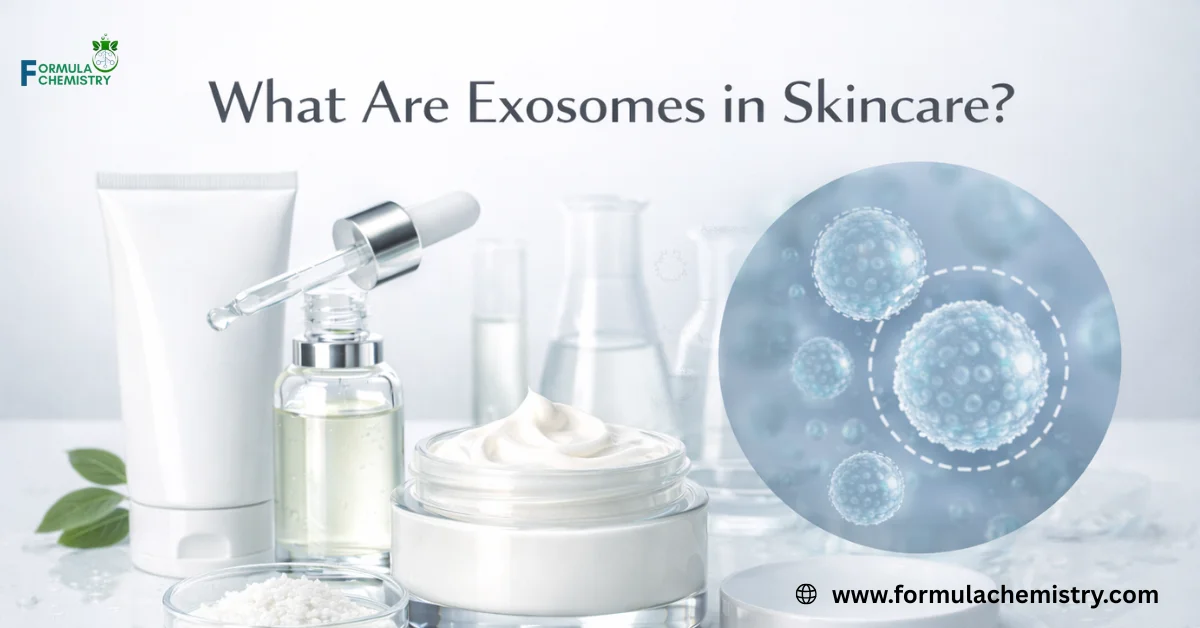
Exosomes represent the next frontier in regenerative aesthetics, moving beyond simple hydration to cellular-level communication.
While traditional skincare focuses on topical barrier repair, exosome technology applies extracellular vesicles to signal skin cells to behave more efficiently.
At FormulaChemistry, we focus on understanding the biochemical mechanisms behind these vesicles to ensure formulators and consumers approach this high-tech ingredient with scientific clarity.
Quick Facts
- What it is: Nano-sized extracellular vesicles (30–150 nm) that facilitate intercellular communication by transporting proteins, lipids, and genetic material.
- Primary Function: Acts as a “messenger” system to trigger collagen production, wound healing, and anti-inflammatory responses.
- Who it is for: Individuals targeting advanced photoaging, skin laxity, or post-procedural recovery.
- How to use: Primarily used in professional clinical settings via microneedling or laser delivery; topical consumer versions are emerging.
- Usage Range: Typically 0.5% to 5% in high-end serum formulations, depending on the source concentration.
- Compatibility: Highly compatible with hyaluronic acid and growth factors; use caution when mixing with high-percentage exfoliating acids.
- Common Mistake: Confusing exosomes with stem cells; exosomes are the cell-free byproduct, not the living cells themselves.
- Safety Note: Always ensure the source (bovine, plant, or human adipose-derived) is ethically sourced and medical-grade to avoid immunogenic reactions.
The Science of Cellular Signaling
Exosomes are essentially microscopic “envelopes” secreted by cells. They contain a cargo of bioactive molecules, including mRNA, miRNA, and cytokines.
Unlike standard active ingredients that the skin must metabolize, exosomes provide a direct signal to fibroblasts to increase the synthesis of structural proteins.
What Are the Benefits of Exosomes for Skin Health?
Exosomes are appreciated for their ability to bypass the standard limitations of the skin barrier due to their nanoscale.
Their primary benefit lies in “bio-hacking” the skin’s natural repair cycle. By delivering concentrated regenerative signals, they are able to significantly reduce the downtime associated with invasive dermatological treatments.
Targeted Skin Regeneration and Repair
The deepest impact of exosome therapy is seen in the treatment of atrophic scarring and deep wrinkles.
Because they carry precise genetic instructions, they can effectively “re-program” aged or damaged cells to function like younger ones. This leads to a measurable increase in elastin and collagen density over time.
- Enhanced Wound Healing: Accelerates the closure of the skin barrier after micro-trauma.
- Reduces Inflammation: Modulates the immune response to soothe chronic redness.
- Pigmentation Control: Can signal melanocytes to normalize pigment production.
- Common Problems and Fixes:
- Problem: Reduced potency due to heat sensitivity. Fix: Store exosome-based products in a cool, dark environment or refrigerator if specified by the manufacturer.
- Problem: Poor penetration through intact skin. Fix: Use immediately following a chemical peel or microneedling session to ensure the vesicles reach the dermis.
- Problem: Ingredient instability in water-based formulas. Fix: Look for lyophilized (freeze-dried) exosomes that are reconstituted at the time of use.
Synergy with Professional Procedures
In clinical environments, exosomes are frequently paired with fractional CO2 lasers or radiofrequency microneedling.
The heat or physical trauma from these devices creates channels, allowing the exosomes to flood the tissue. This cooperation results in faster re-epithelialization and a substantial decrease in post-treatment erythema.
How Are Exosomes Sourced and Formulated?
The efficacy of an exosome product is entirely dependent on its origin and the stabilization method used during manufacturing.
FormulaChemistry emphasizes that not all exosomes are created equal; the “cargo” inside the vesicle varies based on the parent cell. Sources include human mesenchymal stem cells (MSCs), plant-derived “exosome-like” vesicles (ELVs), and even bovine sources.
Human vs. Plant-Derived Exosomes
Human-derived exosomes, specifically from umbilical cord or adipose tissue stem cells, are generally regarded as the gold standard for skin rejuvenation because their signaling molecules are most compatible with human biology.
However, plant-derived exosomes (often from citrus, grapes, or ginger) are gaining popularity in the “clean beauty” sector for their antioxidant-rich cargo and lower regulatory obstacles.
| Feature | Human MSC Exosomes | Plant-Derived ELVs |
| Primary Benefit | Deep tissue regeneration | Antioxidant & Barrier |
| Bio-compatibility | Highest | Moderate |
| Usage Range | 1% – 5% | 2% – 10% |
| Price Point | Premium/Clinical | Accessible/Consumer |
| Stability | Fragile; requires cold chain | More robust |
Formulation Challenges and Stability
Integrating exosomes into a stable cosmetic vehicle is a complex task for any chemist. These vesicles are delicate and can be ruptured by harsh surfactants or extreme pH shifts.
Formula Chemistry recognizes that sustaining the structural integrity of the lipid bilayer of the exosome is essential for the product to remain bioactive upon application.
- pH Notes: Most exosome preparations are most stable at a physiological pH of 6.0 to 7.5.
- Preservation: Since many exosome products are water-based, a strong, non-disruptive preservation system is required to prevent microbial growth without degrading the vesicles.
- Temperature Control: Many professional-grade exosomes must be stored at 4°C or lower until used.
Safety Considerations and Application Protocols
While exosomes offer exciting potential, they are a high-potency biological ingredient. FormulaChemistry provides practical formulation education and safety-forward guidance to help navigate these advanced technologies.
Users and formulators must focus on the purity of the isolate to ensure no unwanted cellular debris is present in the final product.
Who Should Avoid Exosome Therapy?
Although typically well-tolerated because they are cell-free, certain individuals should exercise caution.
Who should avoid:
Those with active skin infections, undiagnosed skin lesions, or a history of skin malignancies in the treatment area should consult a medical professional before use. Additionally, individuals with known sensitivities to the source material (e.g., bovine proteins) must vet the origin of the ingredient.
- Key Warnings: Never use non-sterile topical exosomes on open surgical wounds without medical supervision.
- Irritation Cautions: While exosomes themselves are soothing, they are often paired with delivery-enhancing acids; monitor for excessive peeling or stinging.
- Patch Testing: Always perform a patch test on the inner forearm for 48 hours to rule out immunogenic sensitivity.
Correct Application for Maximum Efficacy
For consumer-grade exosome serums, application should occur on clean, slightly damp skin. Because the vesicles are so small, they should be applied as the first layer before heavier creams or oils.
This makes certain that the cellular signals are not blocked by occlusive obstacles such as petrolatum or thick waxes.
The editorial team at FormulaChemistry maintains that while exosomes are revolutionary, they are part of a holistic regimen. They work best when the skin is already supported by basic sun protection and a healthy moisture barrier.
FAQs about What Are Exosomes in Skincare?
Are exosomes better than retinol?
They serve different purposes; retinol accelerates cell turnover via irritation/renewal, while exosomes signal repair and collagen synthesis without the “retinization” inflammatory period.
Can I use exosomes every day?
Yes, most consumer-grade topical exosome serums are designed for daily use, although professional treatments are usually spaced 4–6 weeks apart.
Are exosomes considered “vegan”?
It depends on the source. Human and bovine-derived exosomes are not vegan; however, plant-derived exosome-like vesicles are an animal-free alternative.
Do exosomes need to be refrigerated?
Clinical-grade vials often require refrigeration. Some consumer serums are stabilized for room temperature, but keeping them cool generally extends the shelf life of the bio-actives.
How long does it take to see results?
Initial hydration and redness reduction can be seen in days, but structural changes like wrinkle reduction typically take 8–12 weeks with consistent use.
Are there side effects to exosome skincare?
Side effects are rare but can include mild redness or itching if the product contains other active “boosters” like AHAs or high-dose vitamin C.
Can exosomes be used under the eyes?
Yes, they are excellent for the thin skin in the periorbital area as they help thicken the dermis and reduce the appearance of fine lines and hollows.
Is exosome skincare safe during pregnancy?
While exosomes themselves are generally safe, many formulas contain other ingredients that may not be. Always check with a physician regarding biological topicals during pregnancy.