
Introduction
The skin around the eyes is the first to reveal signs of aging, fatigue, and stress due to its delicate anatomical structure. A super Multi-corrective serum promises to lift, smooth, and brighten, but true results depend on the molecular efficiency of the ingredients.
We believe that through analyzing the formula chemistry of these high-performance serums, you can distinguish between marketing hype and genuine biological repair. It is about delivery systems that penetrate without irritation.
This guide examines the science behind eye-opening serums, breaking down the ingredients that physically tighten and biologically repair the periorbital area for a wide-awake look.
What Causes the Eye Area to Age Faster?
Understanding the biological deficiencies of the eye contour explains why specialized treatments are necessary.
Anatomy of the Periorbital Skin
The skin here is 40% thinner than the rest of the face. It lacks the sebaceous glands found elsewhere, leading to a chronic deficit in the lipid barrier.
This lack of natural oils weakens the structural integrity. Without a robust chemical formula of lipids protecting it, the skin loses elasticity rapidly, leading to the formation of crow’s feet and crepiness.
The Impact of Micro-Movements
You blink approximately 28,000 times a day.
This constant mechanical stress breaks down collagen fibers. A multi-corrective serum must utilize Formula Chemistry skincare principles to reinforce the matrix against this daily wear and tear.
The Chemistry Formula of a “Super” Serum
A serum differs from a cream in its molecular weight and delivery mechanism, designed for deep penetration.
High Concentrations of Solubles
Serums are water- or silicone-based vehicles that deliver high concentrations of water-soluble actives, such as peptides and glycosaminoglycans.
The formula chemistry is engineered to be lightweight. This prevents the product from migrating into the eyes or causing milia (small cysts), which can occur with heavy, occlusive creams.
Optical Diffusers
“Eye-opening” claims commonly depend on immediate physical chemistry.
Ingredients like minerals (mica, titanium dioxide) are added to reflect light. By manipulating the angle of reflection, these particles blur shadows instantly, giving the illusion of a smoother surface while the actives work long-term.
Key Ingredients for Lifting and Firming
To physically open the eye area, ingredients must stimulate structural proteins or provide a tightening film.
Rhamnose and Sugar Chemistry
Rhamnose is a naturally derived plant sugar clinically proven to boost the activity of the papillary dermis (the upper layer of skin).
Its chemical formula signals fibroblasts to ramp up collagen and elastin production. This biological indicator results in thicker, firmer skin that resists sagging.
Sodium Hyaluronate
This is the salt form of Hyaluronic Acid. It has a smaller molecular size, enabling better penetration.
It acts as a moisture magnet. By holding 1000 times its weight in water within the skin’s matrix, it physically plumps the hollows under the eyes, reducing the appearance of fatigue.
Correcting Dark Circles via Formula Chemistry
Dark circles are a result of vascular leakage or hyperpigmentation; a super serum must address both.
Vitamin C (L-Ascorbic Acid)
Vitamin C is vital for strengthening blood vessel walls to prevent leakage (the blue/purple tone).
Simultaneously, it inhibits tyrosinase, the enzyme responsible for brown pigmentation. Stability is key here; look for a serum with a stabilized chemistry formula or an airtight container to avoid oxidation.
Haloxyl and Peptides
Haloxyl is a peptide complex specifically designed to eliminate the blood pigments responsible for dark circles.
It works by enzymatic degradation of the accumulated hemoglobin. In Formula Chemistry skincare, this focused method clears the “bruised” look from under the eyes.
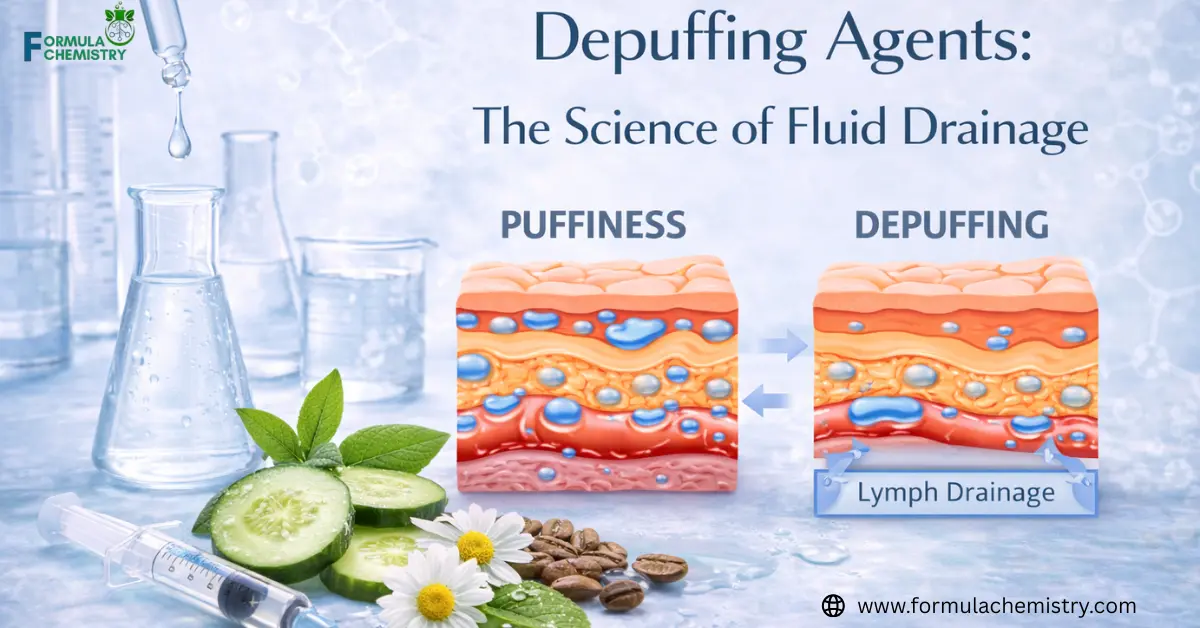
Depuffing Agents: The Science of Fluid Drainage
Puffiness is often caused by fluid retention and poor lymphatic drainage during sleep.
Caffeine’s Vasoconstrictive Properties
Caffeine is an alkaloid that penetrates the skin barrier easily.
It works by constricting the capillaries. This reduction in blood flow assists in clearing excess fluid and toxins, creating a tighter, more contoured appearance immediately after application.
Botanical Anti-Inflammatories
Ingredients like Escin (from Horse Chestnut) or Arnica are used to strengthen vein walls.
They improve microcirculation. By improving the flow of blood and lymph, they prevent the stagnation of fluid that leads to morning bags.
Smoothing Texture with Gentle Exfoliation
Smooth skin reflects light better; gentle renewal is required to remove rough, dry patches without irritation.
LHA (Capryloyl Salicylic Acid)
LHA is a derivative of Salicylic Acid, but with a lipophilic chain.
Its unique chemical formula allows for cell-by-cell exfoliation. It is much gentler than traditional acids and has a pH close to the skin’s natural acidity, making it safe for the delicate eye area.
Pro-Xylane
This is a sugar-protein hybrid derived from beech wood.
It stimulates the production of glycosaminoglycans (GAGs) in the extracellular matrix. This effectively thickens the skin, smoothing out fine lines and wrinkles from within.
Formula Chemistry DIY: Custom Eye Serum Blend
You can create a potent, preservative-free eye serum at home using simple, high-efficacy ingredients.
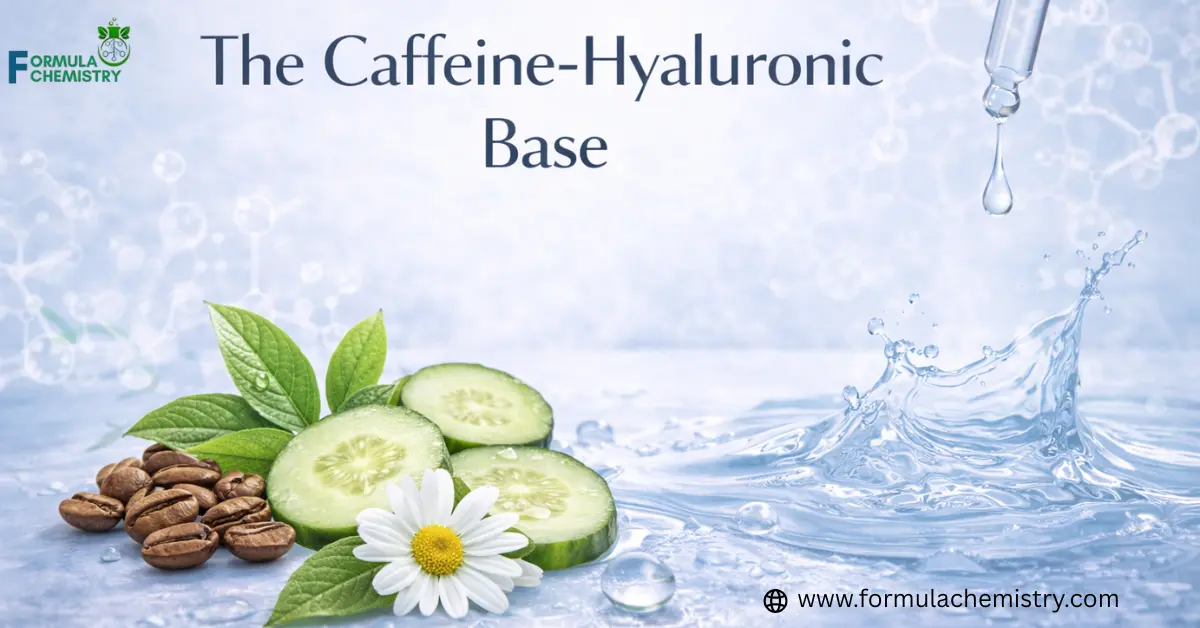
The Caffeine-Hyaluronic Base
This simple blend targets puffiness and hydration simultaneously.
- Ingredients: 1% Caffeine powder, 0.5% High Molecular Weight Hyaluronic Acid, Distilled Water.
- Method: Dissolve caffeine in water, then sprinkle HA on top. Let it hydrate into a gel.
- Science: The caffeine tightens while the HA plumps, a classic Formula Chemistry DIY victory.
Coffee Bean Oil Infusion
For a lipid-based serum, infuse carrier oils.
- Method: Infuse coffee beans in Sweet Almond Oil for 2 weeks.
- Application: Use as a night treatment.
- Benefit: The oil provides fatty acids to repair the barrier, while the caffeine extract works on circulation.
Application Techniques for Maximum Efficacy
How you apply the product changes how the formula chemistry interacts with the dermal layers.
The Ring Finger Rule
The ring finger applies the least amount of pressure.
Tapping the serum into the skin (tapotement) aids lymphatic drainage. Never drag or pull the skin, as this creates mechanical stress that breaks collagen fibers.
The Orbital Bone Boundary
Do not apply serum directly to the lash line unless specified.
Apply to the orbital bone (the hard bone surrounding the eye). The product will naturally migrate inward. Applying too close can cause the product to seep into the eye, causing irritation and puffiness.
Safety and pH Considerations
The eye has a pH of roughly 7.0-7.3 (neutral), while skin is acidic (4.5-5.5).
Ocular Compatibility
Formulators must balance the pH carefully.
An eye serum should be formulated to be compatible with the skin but not so acidic that it stings the eyes if migration occurs. This fine equilibrium is a hallmark of superior Formula Chemistry skincare.
Fragrance-Free Necessity
Fragrance is the number one cause of contact dermatitis.
For the eye area, essential oils and synthetic fragrances should be avoided. They are unstable substances that can cause watering and swelling, counteracting the depuffing goals.
Integrating the Serum into Your Routine
To see “super multi-corrective” results, consistency and layering order are of utmost importance.
Layering Order
Apply your eye serum after cleansing and toning, but before your face serum and moisturizer.
Because it is lightweight, it needs direct contact with the skin. Applying it over a thick moisturizer would block the chemical formula from penetrating.
Day vs. Night Use
Most corrective serums can be used twice daily.
However, if your serum contains Retinol or light-reflecting minerals, check the label. Retinol is best for night repair, while optical diffusers are best for morning brightness.
Conclusion
A super multi-corrective eye-opening serum is not magic; it is a work of art in formula chemistry.
By combining structural repair agents like Rhamnose with vascular correctors such as Vitamin C and Caffeine, these products tackle the root causes of tired eyes.
Whether you invest in clinical formulations or explore Formula Chemistry DIY, treating the eye area with specific, science-backed ingredients is the only way to smooth, lift, and restore a youthful gaze.
FAQ’s about Super Multi-Corrective Eye Opening Serum
What is the best age to start using an eye serum?
Prevention is better than a cure. Starting in your mid-20s is ideal because collagen production begins to decline. Using a hydrating and antioxidant-rich serum early on can delay the formation of static wrinkles and keep the skin elastic.
Can I use my facial serum around my eyes?
It depends on the ingredients. Many facial serums are too potent (high acid or retinol percentage) or too heavy for the thin eye skin, resulting in irritation or milia. A dedicated eye serum has a chemistry formula adjusted for ocular safety and thinner tissue.
What are milia, and how do serums cause them?
Milia are small, white keratin-filled cysts that appear under the skin. They are often caused by using heavy, occlusive creams that trap dead skin cells. Switching to a lightweight, water-based serum instead of a heavy cream can help prevent them.
Does caffeine permanently remove eye bags?
No, the effects of caffeine are temporary. It constricts blood vessels and dehydrates fat cells for a few hours, creating a tighter look. For permanent removal of structural eye bags (herniated fat pads), surgery is usually required, but skincare can manage the fluid retention aspect.
How long does it take to see results?
Instant smoothing can be seen within minutes due to hydration and film-formers. However, true biological repair—such as collagen stimulation or fading dark circles—requires consistent use for at least 4 to 12 weeks to correspond to the skin’s natural renewal cycle.
Is it safe to put Vitamin C under the eyes?
Yes, Vitamin C is excellent for dark circles. However, you should look for a stable, less irritating derivative like Magnesium Ascorbyl Phosphate or a lower concentration of L-Ascorbic Acid to avoid stinging the sensitive skin.
Why does my eye serum sting?
Stinging can indicate a compromised skin barrier or a reaction to an ingredient like preservatives or fragrance. It can also happen if the pH of the product is too low (acidic). If stinging persists, discontinue use and switch to a bland barrier repair cream.
Can peptides really lift the eyelid?
Peptides like Argireline can relax muscle tension, smoothing expression lines. Other peptides stimulate collagen, which firms the skin. While they are unable to replicate a surgical blepharoplasty, they can markedly improve skin elasticity and reduce the appearance of drooping over time.