
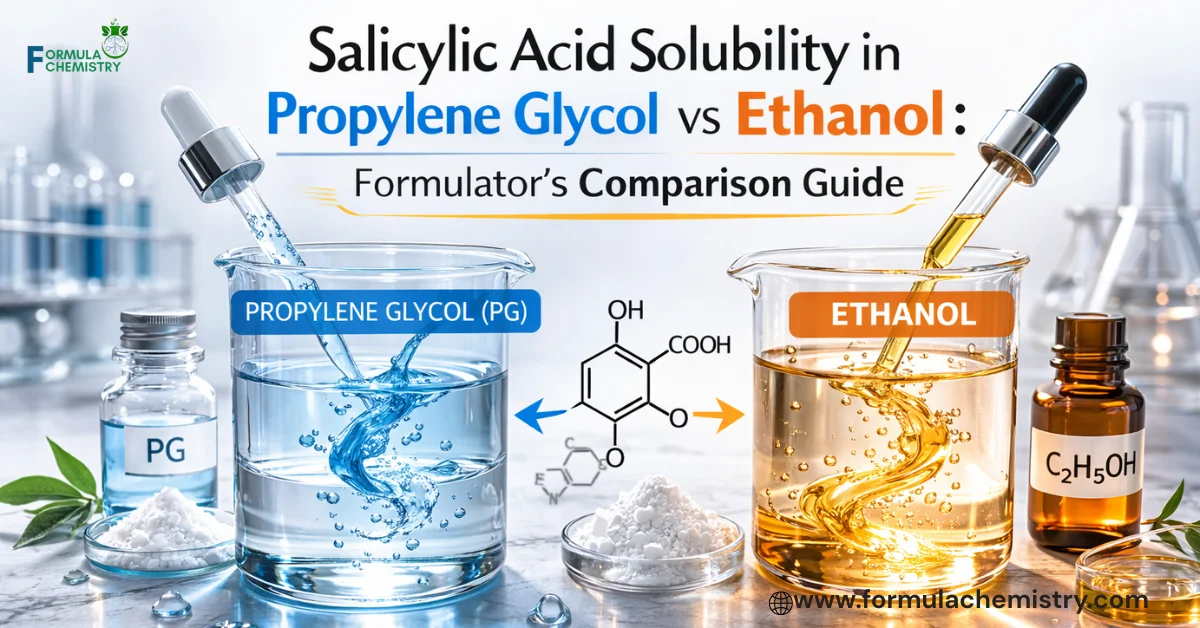
When working with salicylic acid in aqueous cosmetic formulas, the single most important decision after pH is which cosolvent to use.
Salicylic acid solubility in propylene glycol and salicylic acid solubility in ethanol are both significantly higher than in water alone. Still, the two solvents behave differently in a formula, carry different sensory profiles, and fit different product formats.
Comprehending this distinction is foundational to building stable, effective BHA toners, serums, and cleansers.
Ingredient Overview
Subject: Salicylic Acid Co-Solvent Selection
INCI Names in focus: Salicylic Acid / Propylene Glycol / Alcohol Denat. (Ethanol)
Category: Active (BHA) : Solubilization focus
Related chemical class: Weak aromatic acid with lipophilic character (pKa 2.97)
Salicylic acid (2-hydroxybenzoic acid) has a water solubility of only ~0.2% at room temperature, which makes it practically impossible to dissolve at cosmetic usage rates (0.5–2%) in pure water without a co-solvent.
Both propylene glycol and ethanol serve as solubilizes in a co-solvent system for BHA, but they do so through different mechanisms and with meaningfully different formulation outcomes. At formula chemistry, this entry compares them directly so you can make the right choice for your specific product format.
Function in Cosmetic Formulation
Before comparing solvents, it helps to understand what a co-solvent is actually doing here.
- Primary role of the co-solvent: To overcome salicylic acid’s low water solubility by providing a compatible liquid environment that holds the molecule in solution before and after incorporation into the aqueous phase
- Secondary role: To act as a humectant (propylene glycol) or astringent/antimicrobial support (ethanol) in the finished formula.
- Why this matters for stability: If the co-solvent ratio is insufficient, salicylic acid will crystallize out of solution notably under cold storage or temperature cycling rendering the formula both ineffective and aesthetically unacceptable.
The goal is to keep salicylic acid fully dissolved throughout the product’s shelf life at every temperature it may encounter during distribution and consumer use.
Solubility Comparison: Propylene Glycol vs Ethanol
This is the core of this entry. Both solvents dissolve salicylic acid far more effectively than water, but their solubility capacities differ substantially.
| Solvent | Approximate Salicylic Acid Solubility | Notes |
| Water (20°C) | ~0.2% (2 g/L) | Baseline reference |
| Propylene Glycol (pure) | ~10–15% | Varies slightly by temperature |
| Ethanol 96% (pure) | ~25–30% | Highly efficient solubilizer |
| Ethanol 70% (aqueous) | ~10–15% | Reduced by water content |
| Butylene Glycol (pure) | ~8–12% | Comparable to propylene glycol |
Key takeaway: Ethanol is the more powerful solubilizer on a gram-per-gram basis. Propylene glycol is less harsh, provides humectant properties, and is suitable for alcohol-free formulation systems.
Solubility & Phase Information
Salicylic Acid Solubility in Propylene Glycol
Propylene glycol (PG) dissolves salicylic acid at approximately 10–15% concentration in pure PG. In practice, this means:
- To dissolve 2g of salicylic acid (for a 2% formula in 100g total), you need approximately 13–20g of propylene glycol as the primary solubilizer, this is a significant portion of your formula.
- PG is added to the water phase in standard emulsions and water-based formulas.
- The BHA slurry method works well here: dissolve salicylic acid in warm PG (40–50°C) first, then stir it into the aqueous phase.
- PG also contributes humectancy, meaning it pulls double duty in the formula.
Crystallization risk: Moderate. In formulas with lower PG content or poor homogenization, crystallization can occur at refrigeration temperatures (4–8°C). Freeze-thaw cycling is the critical stress test.
Salicylic Acid Solubility in Ethanol
Salicylic acid solubility in alcohol (ethanol specifically) is substantially higher, approximately 25–30% in high-percentage ethanol (96%). This makes ethanol the preferred solubilizer in:
- Alcohol-based toners and astringents
- Formulas where fast evaporation and a dry skin feel are desirable
- Products where a very clean, low-viscosity texture is required
Practical example: In a toner containing 20% ethanol, salicylic acid at 2% is comfortably within the solubility capacity of the ethanol fraction — making dissolution reliable with minimal processing effort.
Crystallization risk: Low in high-ethanol formulas. Risk increases as the ethanol percentage decreases (below ~15% in the total formula) or when the formula is exposed to very low temperatures.
Which Phase to Add the Co-Solvent
| Scenario | Recommended Approach |
| Ethanol-based toner | Dissolve SA directly in ethanol fraction, then combine with aqueous phase |
| Alcohol-free serum/toner | Pre-dissolve SA in PG (warm), add to water phase with stirring |
| Gel serum (carbomer/gum-based) | Pre-dissolve SA in PG, add before gelling agent neutralization |
| Emulsion/cream | Pre-dissolve SA in PG, incorporate into water phase before emulsification |
pH Range & Stability
Regardless of which co-solvent you choose, pH management is equally critical.
- Optimal pH for salicylic acid efficacy: 3.0–4.0
- pKa of salicylic acid: 2.97: Below this, the unionized (active, skin-penetrating) form dominates
- Neither propylene glycol nor ethanol substantially alters the pKa of salicylic acid in the final formula, but both can influence the system’s buffering behavior.
Stability considerations by solvent:
- Propylene glycol systems: Very stable. PG is chemically inert with salicylic acid at cosmetic pH ranges. A shelf life of up to 24 months is routinely achievable with proper preservation.
- Ethanol systems: Also stable, but ethanol evaporation from improperly sealed packaging can shift the co-solvent balance over time, which may trigger crystallization in older products. Packaging selection (tight-seal, opaque, non-porous) matters more in ethanol-heavy formulas.
- Both systems should be stored away from heat and direct light to protect the overall formula.
- Avoiding alkaline conditions in either system sodium hydroxide or other bases will convert salicylic acid to sodium salicylate, eliminating exfoliant activity.
Compatibility & Incompatibilities
Compatible with:
- Glycerin: works alongside PG; both are compatible humectants in the water phase.
- Butylene glycol: Can be used as a partial or full PG substitute with similar solubilization capacity.
- Hyaluronic acid: Compatible in the aqueous phase at the correct pH
- Panthenol: Stable alongside salicylic acid in both PG and ethanol-based systems
- Niacinamide: Technically compatible, but the low pH required for salicylic acid activity may reduce niacinamide performance; formulate carefully.
- Carbomer / Acrylates thickeners: Compatible in PG-based systems; add salicylic acid solution before neutralization to avoid pH conflicts
- Surfactants (compatibility with surfactants): Anionic and nonionic surfactants are generally compatible; cationic surfactants at low pH may cause compatibility difficulties always bench-test.
Avoid Combining with:
- Alkaline actives or buffers: Destroy salicylic acid’s active form regardless of the co-solvent used
- High-HLB emulsifiers at incompatible pH: Values can destabilize the emulsion when combined with salicylic acid’s low-pH requirement.
- Oxidizing agents: Can degrade both salicylic acid and ethanol-based systems.
- Hard water (high mineral content) in the aqueous phase calcium and magnesium ions can interfere with solubility in marginal formulations; use deionized water.
Formulation Tips (Pro Notes)
The Pre-Dissolve (BHA Slurry) Method
The most reliable way to incorporate salicylic acid into any formula regardless of which co-solvent you choose is the pre-dissolve method:
- Weigh out your salicylic acid.
- Add it to your co-solvent (PG or ethanol) at a ratio that keeps SA well within its solubility limit.
- Warm gently to 40–50°C and stir until fully dissolved (the solution should be completely clear)
- Allow to cool slightly, then incorporate into your aqueous phase while stirring continuously.
This creates a stable BHA slurry that disperses evenly into the water phase without the risk of crystallization.
Solvent polarity comparison why it matters:
Ethanol has a polarity index of approximately 5.2; propylene glycol is approximately 6.1 (closer to water at 9.0).
Salicylic acid, being a moderately lipophilic aromatic acid, dissolves more readily in lower-polarity environments, which explains why ethanol (lower polarity than PG) is the stronger solubilizer.
Understanding solvent polarity helps you predict solubilization behavior when blending solvents.
Blended co-solvent approach:
You do not need to choose exclusively between PG and ethanol. Many effective formulas use both:
- Ethanol for efficient initial dissolution
- Propylene glycol for humectancy and to reduce the alcohol content to skin-tolerable levels
- Example: 10% ethanol + 8% PG in a 2% salicylic acid toner provides excellent solubilization, stability, and a balanced skin feel
Common formulation mistakes:
- Using an insufficient co-solvent volume and relying solely on heat, salicylic acid will re-crystallize on cooling.
- Adding salicylic acid dry to a pre-made formula it will not dissolve properly without specific pre-dissolution
- Using denatured alcohol with incompatible denaturants some denaturants can interact with low-pH formulas or affect fragrance compatibility; consistently verify your alcohol grade.
- Not performing freeze-thaw stability testing is the key test for crystallization risk and should always be done before launch.
Processing temperature:
Keep processing temperature at or below 50°C. Higher temperatures are unnecessary and may stress heat-sensitive co-ingredients. Salicylic acid itself is thermally stable at these temperatures.
Benefits in Cosmetic Products (Non-Medical)
From a formulation outcome perspective, your co-solvent influences not just just dissolution but the end-user experience:
Propylene glycol co-solvent systems:
- Alcohol-free is suitable for fragrance-free and alcohol-free product claims
- Humectant contributions help counterbalance the drying effect of low-pH exfoliant formulas.
- Better tolerated by dry or sensitized skin types
- CAdds to a slightly more viscous, skin-coating texture
Ethanol co-solvent systems:
- Oily skin users prefer a fast-evaporating, lightweight skin feel.
- Provides astringency that supports soil-control positioning
- Supports antimicrobial activity in the formula (preservative booster at >15%)
- Cleaner, more fluid texture ideal for pad-soaked toners and mist formats
Both approaches help support smoother-looking skin, clearer pores, and a more even-textured skin surface — the end benefits driven by the salicylic acid active itself.
Substitutes / Alternatives
If neither propylene glycol nor ethanol is appropriate for your formulation:
- Butylene Glycol: Very close solubilization capacity to propylene glycol (~8–12%), with a lighter skin feel and slightly better consumer perception; direct functional substitute for PG in most BHA systems.
- Pentylene Glycol: Multifunctional humectant-solubilizer with additional antimicrobial properties; lower solubilization capacity than PG but contributes preservation boosting; good choice for minimal-ingredient formulas.
- Dipropylene Glycol (DPG): Lower polarity than PG, slightly better solubilization of lipophilic actives, often used in fragrance and toner formats
- Caprylyl Glycol: At low usage levels, contributes to solubilization and preservative boosting; typically used alongside another primary solubilizer rather than as a standalone
- Dimethyl Isosorbide (DMI) :Powerful penetration-enhancing solubilizer; dissolves salicylic acid efficiently and may enhance dermal delivery; use at 2–5%, not as a primary bulk solvent.
Safety & Regulatory Notes
Propylene Glycol:
- Considered safe at cosmetic usage levels (up to ~30% in rinse-off, lower in leave-on for sensitive applications)
- Rare cases of contact sensitivity exist relevant for very high-concentration PG formulas.
- No significant regulatory restrictions in major markets at cosmetic usage rates
Ethanol:
- Alcohol Denat. is regulated in the EU; check the permitted denaturants list for your market
- At high concentrations (>30% in leave-on), it may increase skin dryness and barrier disruption. Consider this against the skin-sensitizing potential of the low-pH formula.
- Not suitable for products positioned for dry, eczema-prone, or sensitive skin at high levels
- Flammability considerations apply during manufacturing, storage, and handling per standard safety guidelines.
Salicylic acid general reminders:
- A patch test is always recommended for end consumers.
- Avoid the eye area and broken skin.
- Not recommended in leave-on formulas during pregnancy at higher concentrations
- Always constantly verify maximum use levels for your target market (EU, US, ASEAN requirements differ)
FAQ’s about Salicylic Acid Solubility in Propylene Glycol vs Ethanol: Formulator’s Comparison Guide
Which is better for dissolving salicylic acid: propylene glycol or ethanol?
Ethanol is more efficient on a gram-per-gram basis, dissolving up to 25–30% salicylic acid in high-purity form compared to 10–15% in propylene glycol. However, “better” depends on your formula: ethanol is ideal for lightweight, alcohol-based toners; propylene glycol is preferred for alcohol-free systems that also require humectancy.
Can I use both propylene glycol and ethanol in the same formula?
Yes, and many professional formulas do exactly this. Combining both solvents gives you efficient dissolution from the ethanol fraction, while the propylene glycol contributes humectancy and reduces overall alcohol content. This blended co-solvent approach is a reliable way to maintain effective skin feel and stability.
What is the crystallization risk if I use propylene glycol alone?
Moderate. If your PG content is insufficient relative to the salicylic acid load, or if the product is stored at refrigeration temperatures (4°C), crystal reformation can occur. Always perform freeze-thaw stability testing (3–5 cycles of freezing at –10°C and warming to 25°C) before finalizing your formula.
Does the co-solvent affect salicylic acid’s pH or pKa?
No, neither propylene glycol nor ethanol meaningfully shifts the pKa of salicylic acid (2.97). Both solvents are pH-neutral in practical terms. You still need to adjust and verify your formula pH independently using a calibrated pH meter. Target pH 3.0–4.0 for maximum active efficacy.
Is salicylic acid soluble in alcohol-free formulas at 2%?
Using the right approach. Pre-dissolving in warm propylene glycol (or butylene glycol) to a sufficient concentration, then carefully incorporating into the aqueous phase, yields stable 2% salicylic acid formulas without ethanol. Butylene glycol can also be used as an alternative or in combination with PG.
How does solvent polarity affect salicylic acid solubility?
Salicylic acid is a moderately lipophilic molecule. Lower-polarity solvents (like ethanol, polarity index ~5.2) dissolve it more readily than higher-polarity solvents (like propylene glycol at ~6.1, or water at ~9.0). This is why ethanol outperforms PG as a solubilizer and why water alone cannot dissolve salicylic acid at cosmetic usage rates without co-solvent support.
Final Summary
Quick reference for formulators:
- Primary role of co-solvent: Enable stable dissolution of salicylic acid at 0.5–2% in aqueous cosmetic formulas
- Ethanol: Higher solubilization capacity (~25–30% pure), fast-evaporating, lightweight, preferred for alcohol-based toners and sprays
- Propylene glycol: Moderate solubilization (~10–15% pure), humectant function, alcohol-free compatible, preferred for gel serums and alcohol-free toners
- Best practice: Pre-dissolve salicylic acid in your co-solvent (BHA slurry method) before adding to the aqueous phase
- Optimal formula pH: 3.0–4.0 regardless of co-solvent choice
- Crystallization risk: Low in ethanol-heavy systems, moderate in PG-only systems always freeze-thaw test
- Blended approach: Using both ethanol and PG in the same formula is a valid and effective strategy
Choosing between salicylic acid solubility in propylene glycol vs ethanol is not a matter of one being universally superior, it is a formulation choice determined by your product format, target skin type, and desired sensory profile. Master the pre-dissolve method, respect the solubility limits of each solvent, and always validate stability before launch.