
If you’ve ever stood in a skincare aisle staring at two different acne face washes and had no idea which to pick, you are not alone.
Salicylic acid vs benzoyl peroxide is one of the most common dilemmas for anyone dealing with acne, and the answer is not as simple as “one is better than the other.”
Each ingredient works through a completely different mechanism, targets a different type of acne, and suits a different skin type. This guide breaks it down clearly so you can make the right call for your skin.
Quick Direct Answer
Salicylic acid is a chemical exfoliant (BHA) that unclogs pores by dissolving dead skin cells and sebum, best suited for blackheads, whiteheads, and comedonal acne.
Benzoyl peroxide is an antibacterial agent that kills acne-causing bacteria (C. acnes) and reduces inflammatory breakouts, such as pustules and cysts.
Neither is universally better. The right choice depends entirely on your acne type, skin sensitivity, and formulation goals.
Why This Comparison Matters in Cosmetic Formulation
From a formula Chemistry‘s perspective, salicylic acid and benzoyl peroxide are two of the most well-researched over-the-counter acne actives in existence.
Still, they are chemically and functionally worlds apart. Understanding how each one works at the ingredient level helps you choose the right product, avoid misuse, and understand why certain combinations cause problems.
This is especially important for:
- DIY formulators building acne-targeted cleansers
- Small skincare brands deciding which active to feature in a face wash
- Beginners endeavoring to decode ingredient labels on commercial products.
How Each Ingredient Works, The Chemistry
Salicylic Acid (BHA)
Salicylic acid is a beta-hydroxy acid derived originally from willow bark. It is oil-soluble, a key property that sets it apart from AHAs. Because it dissolves in oil, it can penetrate the sebum-filled follicle lining and exfoliate from within.
- Acts as a keratolytic, breaking the bonds between dead skin cells.
- Works at pH 3.0–4.0 for maximum efficacy (though milder at higher pH)
- Concentration range in face washes: 0.5%–2%
- Targets: comedones (blackheads, whiteheads), clogged pores, oily skin texture
- Anti-inflammatory properties may help calm mild acne redness.
Benzoyl Peroxide (BPO)
Benzoyl peroxide is an organic peroxide that releases free radical oxygen when it contacts the skin. This oxygen creates an environment where anaerobic bacteria, specifically Cutibacterium acnes, cannot survive.
- Acts as an antibacterial and mild keratolytic
- Works across a wider pH range (more forgiving to formulate)
- Concentration range in face washes: 2.5%–10% (higher is not always better)
- Targets: inflammatory acne papules, pustules, nodules, cysts
- Also reduces excess sebum production to a degree.
Key Differences at a Glance
| Feature | Salicylic Acid | Benzoyl Peroxide |
| Mechanism | Chemical exfoliation | Antibacterial (kills C. acnes) |
| Best acne type | Comedonal (blackheads, whiteheads) | Inflammatory (pustules, cysts) |
| Skin penetration | Into the pore (oil-soluble) | Surface and follicle |
| Irritation risk | Moderate (barrier stripping) | Moderate–High (oxidative dryness) |
| Bleaching effect | None | Yes — bleaches fabric and hair |
| Sensitivity risk | Lower | Higher |
| Beginner-friendly | More so | Requires more caution |
| Antibiotic resistance concern | None | None (unlike topical antibiotics) |
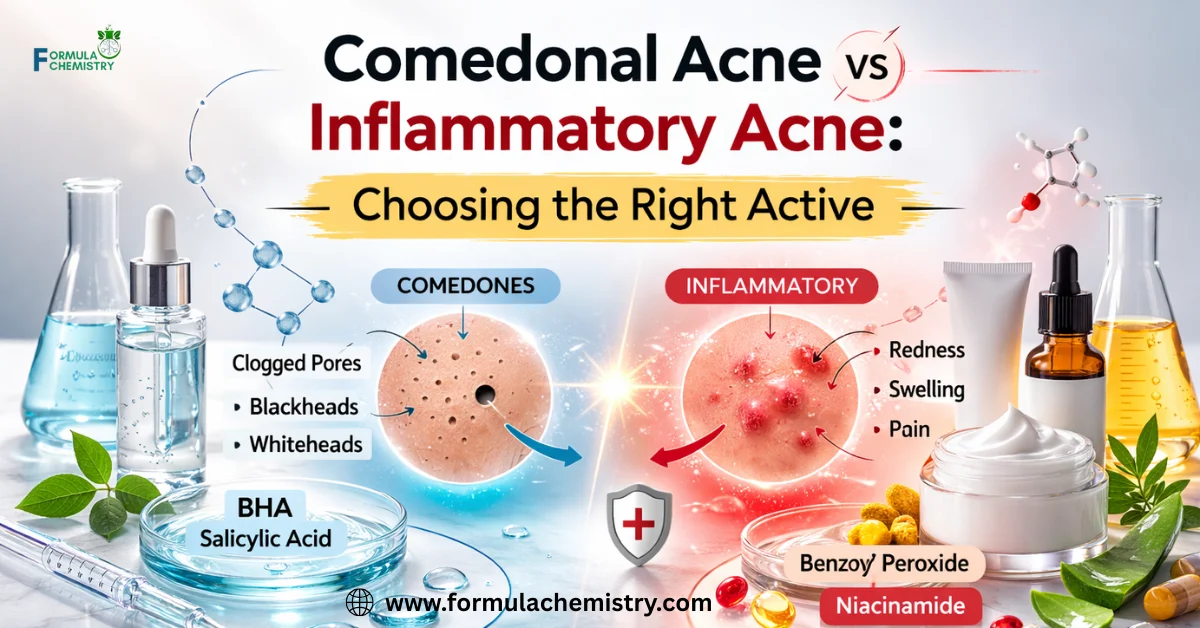
Comedonal Acne vs Inflammatory Acne: Choosing the Right Active
This is the single most important factor in deciding between these two ingredients.
Comedonal acne
It includes non-inflamed lesions, open comedones (blackheads), and closed comedones (whiteheads). The problem here is a blockage: excess sebum and dead skin cells clogging the follicle.
Salicylic acid directly handles this by dissolving the blockage from inside the pore. Benzoyl peroxide offers limited benefit here because the issue is not bacterial.
Inflammatory acne
It includes red, raised lesions, papules, pustules, and deeper nodules or cysts. The driving factor is bacterial proliferation, triggering an immune response.
Benzoyl peroxide excels here. It kills the bacteria responsible and, unlike topical antibiotics, does not contribute to antibiotic resistance.
Mixed acne (both comedonal and inflammatory present at the same time) is where the comparison gets more subtle and where using both strategically may make the most sense.
Technical Formulation Considerations
pH and Stability
- Salicylic acid requires a low-pH environment (ideally 3.0–4.5) to remain in its active, non-ionized form. Above pH 5.0, efficacy drops considerably. Formulators must balance this against skin compatibility.
- Benzoyl peroxide is less pH-sensitive but is chemically unstable and prone to degradation. It can bleach color cosmetics, stain fabrics, and is incompatible with many other actives.
Solubility and Phase Properties
- Salicylic acid is slightly water-soluble and well-soluble in ethanol, propylene glycol, and certain esters. Most face wash formulas use these solvents to dissolve properly.
- Benzoyl peroxide is practically insoluble in water and typically formulated as a micronized suspension or in polyethylene glycol-based systems in wash-off formats.
Short-Contact Therapy in Wash-Off Formats
A very common question is: does a face wash with these actives actually work if it’s rinsed off in 30–60 seconds?
The answer is yes with caveats. Research supports the concept of short-contact therapy, particularly with benzoyl peroxide.
Studies show meaningful absorption and bacterial reduction even from brief wash-off contact. Salicylic acid similarly demonstrates measurable pore penetration in rinse-off formats, though leave-on products deliver more sustained exposure.
For face washes specifically, the key is to let the lather sit on the skin for 60–90 seconds before rinsing, rather than lathering and rinsing immediately.
Sensitivity and Irritation Comparison
- Salicylic acid face wash tends to cause dryness, barrier disruption, and over-exfoliation with overuse, especially at 2% used daily.
- Benzoyl peroxide face washes can cause oxidative dryness, peeling, and redness, often more acutely irritating, especially at concentrations above 5%.
- At equivalent concentrations, benzoyl peroxide generally poses a higher short-term irritation risk for sensitive or dry skin types.
Common Mistakes and Troubleshooting
- Choosing based on concentration, not acne type: Using a 10% benzoyl peroxide wash for blackheads will not unclog pores; it will just irritate your skin. Match the active to the lesion type first.
- Using both actives simultaneously in the same step: Applying a salicylic acid wash and a benzoyl peroxide wash back-to-back in the same routine dramatically increases irritation and barrier damage risk.
- Expecting overnight results from BPO: Benzoyl peroxide reduces bacterial load progressively. Most users see meaningful improvement at 4–8 weeks of regular use.
- Not accounting for BPO’s bleaching effect: Benzoyl peroxide will bleach colored towels, pillowcases, and clothing. Using white linens is a practical necessity, not a suggestion.
- Starting at 10% BPO when 2.5% is just as effective: Research regularly shows that 2.5% benzoyl peroxide is nearly as effective as 5% and 10% for acne reduction, with significantly less irritation.
- Using either active on a damaged or sunburned skin barrier: Both actives should be paused when the skin barrier is already compromised.
- Skipping SPF: Both salicylic acid and benzoyl peroxide increase photosensitivity. Daytime use without broad-spectrum SPF30+ is a significant mistake.
- Patch testing is neither necessary nor sufficient: Benzoyl peroxide, in particular, has a non-trivial rate of contact sensitization. Always patch test for 24–48 hours before full-face use.
Can You Use Both Together? Routine Layering Guide
Yes, but not at the same time or without care. Used strategically, these two actives complement each other well because they target different parts of the acne cycle.
Option 1: Split by AM/PM:
- AM: Benzoyl peroxide face wash (targets bacteria before the day’s sebum production builds)
- PM: Salicylic acid face wash (exfoliates and unclogs during overnight skin renewal)
- This is a common approach in clinical acne regimens and is typically well tolerated after a slow build-up period.
Option 2: Split by day:
- Alternate days, SA one day, BPO the next
- Better for sensitive skin or beginners who cannot tolerate the daily use of either
Option 3: Use one active as a leave-on, one as a wash:
- BPO as a spot treatment or leave-on gel (targeted)
- SA as a face wash (whole face exfoliation and pore care)
- Lowest irritation risk of the combined approaches
What to avoid: Using both as leave-on products in the same step of the routine, or layering both washes in the same cleansing session.
Who Should Use Which
Choose Salicylic Acid Face Wash if:
- Your acne is primarily blackheads, whiteheads, or clogged pores.
- You have oily or combination skin.
- You are a beginner to active ingredients.
- You have mild-to-moderate acne without many inflamed lesions.
- You tend toward sensitivity or dryness.
Choose Benzoyl Peroxide Face Wash if:
- Your acne primarily consists of red, inflamed papules and pustules.
- You have moderate-to-severe inflammatory acne.
- You have tried SA and found it insufficient.
- You are not prone to extreme sensitivity.
- You are aware of and can manage the bleaching risk.
Consider Both (strategically) if:
- You have mixed acne, both comedonal and inflammatory lesions.
- You are an intermediate user who is comfortable managing active ingredients.
- You are building a more targeted, multi-step acne routine.
FAQ’s about Salicylic Acid vs Benzoyl Peroxide Face Wash for Acne, Which One Should You Use?
Which is better, salicylic acid or benzoyl peroxide for acne?
Neither is universally better. Salicylic acid is better for blackheads and clogged pores. Benzoyl peroxide is better for inflamed, bacterial-driven acne, like pustules and cysts. Identifying your acne type first is the most important step before choosing.
Can I use a salicylic acid face wash and a benzoyl peroxide face wash on the same day?
Yes, but not at the same time. The safest approach is to use one in the morning and the other at night, or to alternate days. Using both back-to-back in the same cleansing session significantly increases the risk of irritation.
Does benzoyl peroxide face wash work if you rinse it off quickly?
Research supports that short-contact therapy, even a rinse-off product, can meaningfully reduce bacterial load. For best results, allow the lather to remain on the skin for 60–90 seconds before rinsing, rather than washing it off immediately.
Is salicylic acid or benzoyl peroxide better for sensitive skin?
Salicylic acid at 0.5%–1% is generally better tolerated by sensitive skin types. Benzoyl peroxide, especially at concentrations above 2.5%, tends to cause more acute irritation. If you have sensitive skin, start with a low-concentration salicylic acid formula before considering BPO.
Can benzoyl peroxide and salicylic acid be formulated together in one product?
Technically, yes, but it is formulation-challenging. BPO is an oxidizing agent that can degrade other actives, and the low pH required for salicylic acid efficacy can affect BPO stability. Most commercial products keep them in separate formulas for this reason. Formulators should test stability thoroughly before launching a combined product.
Conclusion
Both salicylic acid and benzoyl peroxide are genuinely powerful, well-researched acne actives; the key is choosing the right one for the right problem.
- Salicylic acid face wash, pore exfoliation, blackhead removal, comedonal acne control.
- Benzoyl peroxide face wash, bacterial kill, inflammatory acne reduction, pustule and cyst management.
- Acne type determines the winner, not marketing, not concentration.
- Both can be used together when approached correctly, split by time of day or alternating days.
- Beginners should start with salicylic acid; intermediate users can layer strategically.
- Always patch tests, always use SPF, and always give actives 6–8 weeks before judging results.