
Introduction
Hydrolyzed Keratin is a key ingredient in modern hair repair technology. As hair is mainly composed of keratin protein (approximately 90%), this ingredient acts as a direct building block for restoring integrity to damaged strands.
In cosmetic formulation, it is revered for its ability to penetrate the hair shaft and adhere to the cuticle, supplying both internal strength and external shine. Unlike whole proteins, which are too large to penetrate the hair shaft, Hydrolyzed Keratin has been broken down into smaller peptide fragments.
This enzymatic processing makes it highly substantive to hair, particularly hair that has been compromised by chemical bleaching, heat styling, or environmental stress. Formula Chemistry provides practical formulation education and safety-forward guidance to help you deal with the complexities of protein chemistry in personal care.
Quick Facts
- INCI Name: Hydrolyzed Keratin
- Origin: Animal-derived (typically sheep’s wool or feathers); synthetic/plant mimics exist but are labeled differently (e.g., Hydrolyzed Wheat Protein).
- Function: Hair conditioning, strengthening, film-forming, humectant.
- Typical Usage Rate: 0.5% – 5.0% (up to 10% in intensive treatments).
- Solubility: Water-soluble; insoluble in oil.
- Optimal pH Range: Stable between pH 4.0 and 6.0.
- Appearance: Amber to dark brown liquid with a characteristic (sometimes strong) odor.
- Best For: Chemically treated, porous, or mechanically damaged hair.
- Safety Note: Always preserve water-based formulas containing proteins, as they are a primary food source for bacteria.
What Is Hydrolyzed Keratin and How Does It Work?
Hydrolyzed Keratin is not a single molecule but a complex mixture of polypeptides and amino acids produced through hydrolysis. Hydrolysis is a chemical reaction where water is used to break down the peptide bonds that hold the long protein chains together.
The “magic” of this ingredient consists of its twofold mechanism of action. Because it contains high levels of cysteine—an amino acid rich in sulfur—it can form disulfide bridges with the hair’s natural keratin. This cross-linking capability effectively reinforces the hair’s structural matrix, temporarily reversing the loss of elasticity caused by aging or damage.
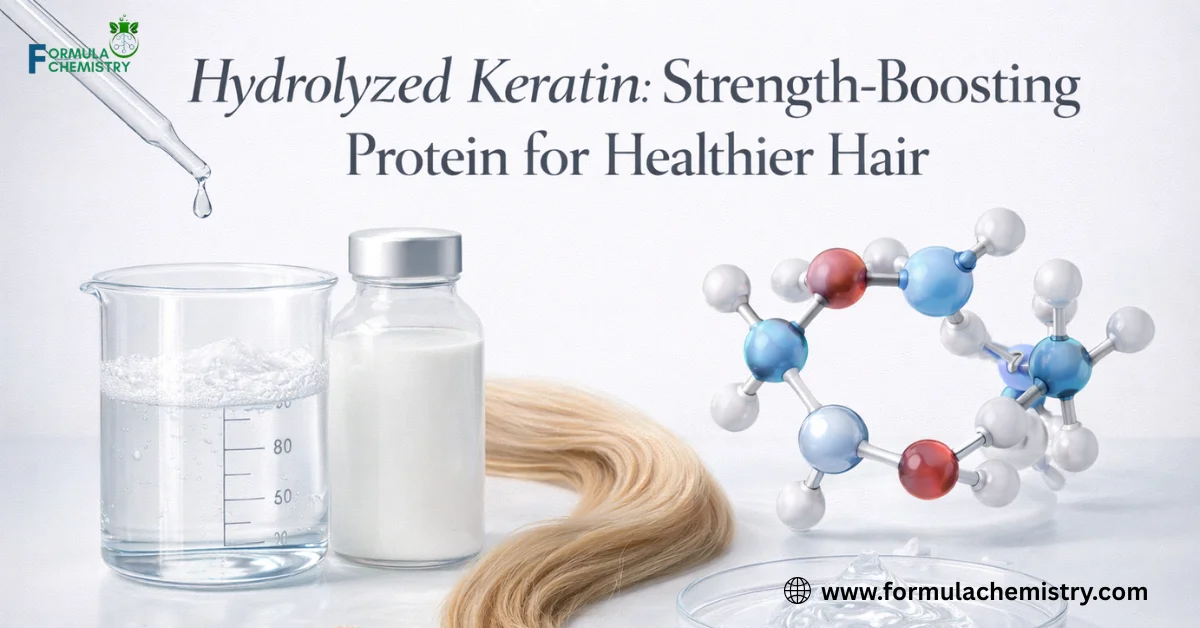
Hydrolyzed Keratin: Strength-Boosting Protein for Healthier Hair
In formulation, size matters. The efficacy of Hydrolyzed Keratin is dictated by its molecular weight, typically measured in Daltons (Da). Lower molecular weight peptides (<1000 Da) are small enough to penetrate through the cuticle layers and reach the cortex, where they provide deep hydration and tensile strength.
Conversely, higher molecular fractions (>2000 Da) are too large to penetrate deeply. Instead, they deposit on the cuticle surface, forming a protective, sacrificial shield. This film smooths the hair surface, reflects light (adding shine), and locks in moisture. A well-rounded Hydrolyzed Keratin ingredient often contains a mix of these weights to yield comprehensive benefits.
Substantivity to Damaged Hair
“Substantivity” refers to an ingredient’s ability to stick to the hair and resist rinsing off. Hydrolyzed Keratin is highly substantive because it is amphoteric but often carries a cationic (positive) charge in acidic formulation environments. Damaged hair carries a strong negative charge due to the oxidation of cysteine to cysteic acid.
This electrostatic attraction makes certain that the protein adheres specifically to the areas that need it most. Healthy, virgin hair has a lower negative charge and absorbs less protein, preventing unnecessary buildup. This “smart” targeting makes Hydrolyzed Keratin one of the most efficient repair agents available to cosmetic chemists.
Formulating with Hydrolyzed Keratin in Hair Care
When incorporating Hydrolyzed Keratin into a formula, it is almost exclusively added to the water phase or the cool-down phase. Because proteins can denature (lose their structure) or darken when exposed to high heat for prolonged periods, it is best practice to add them below 40°C whenever possible.
It is fully water-soluble and integrates easily into shampoos, conditioners, serums, and aqueous sprays. However, it is insoluble in oil. To use it in an anhydrous product like a hair oil, you would need a specialized oil-soluble derivative (often reacted with fatty acids), or you must formulate an emulsion to house the water-soluble protein.
Usage Rates and Synergy
The typical usage rate for maintenance products (daily shampoos/conditioners) is 0.2% to 1.0%. For intensive repair masks or “protein treatments,” formulators may increase this to 2.0% to 5.0%. Exceeding these levels may cause stiffness, as the protein film becomes too rigid on the hair shaft.
Hydrolyzed Keratin works synergistically with moisturizing agents. A protein-heavy formula without emollients can make hair feel dry or “straw-like.” To counteract this, always pair keratin with humectants like Glycerin or Propanediol, and cationic conditioning agents like Behentrimonium Chloride or Polyquaternium-10.
Stability and Preservation
Proteins are notoriously difficult to preserve. They provide an excellent nitrogen source for microbial growth. When using Hydrolyzed Keratin, a strong, broad-spectrum preservative system is mandatory.
Weak preservative systems (like plain potassium sorbate) often fail in protein-rich environments. Additionally, Hydrolyzed Keratin can impact the aesthetics of a formulation. It is typically amber-colored, which can tint clear gels yellow or turn white lotions off-white/beige.
It also has a distinct “meaty” or “bouillon-like” odor. Formulators have to account for this by using higher fragrance loads or selecting compatible scents (like vanilla, amber, or citrus) that mask the base odor effectively.
Troubleshooting and Safety in Protein Formulations
While highly effective, Hydrolyzed Keratin does not lack its formulation challenges. Issues usually arise from pH incompatibility, precipitation, or sensory negatives. The isoelectric point of keratin is roughly between pH 4.5 and 5.5; formulating significantly outside this range can sometimes affect solubility or stability, although hydrolyzed versions are generally more forgiving.
One key safety and performance consideration is “Protein Overload.” This occurs when a consumer uses high-protein products exclusively, leading to hair that snaps easily. As a formulator, it is your responsibility to balance your protein claims with adequate moisturizing instructions or ingredients.
Common Problems and Fixes
- Problem: The finished product smells like wet dog or soup.
- Fix: The protein concentration is likely high. Lower the usage rate or use a fragrance with strong middle and base notes to cover the amine odor.
- Problem: The shampoo has turned cloudy or has sediment at the bottom.
- Fix: Incompatibility with anionic surfactants or salt. Hydrolyzed proteins can interact with salt (sodium chloride), causing haze. Try reducing salt or adding a solubilizer.
- Problem: The conditioner turned brown over time.
- Fix: Oxidation of the protein or interaction with fragrance aldehydes (Maillard reaction). Add a chelating agent (like Disodium EDTA) and an antioxidant (like Vitamin E) to stabilize color.
- Problem: Hair seems stiff or crunchy after use.
- Fix: “Protein overload.” Increase the ratio of emollients (oils/esters) and humectants. Reduce the % of Hydrolyzed Keratin.
Who Should Avoid Hydrolyzed Keratin?
While generally safe, individuals with low-porosity, coarse, or very dry hair should use keratin-based products sparingly. In these hair types, the protein can accumulate on the cuticle surface instead of penetrating, leading to rigidity and breakage.
Furthermore, because Hydrolyzed Keratin is animal-derived, it is not suitable for vegan formulations. Formulators seeking vegan claims should opt for Hydrolyzed Wheat, Soy, or Corn Protein, or specialized fermented plant peptides that mimic the amino acid profile of keratin. Always clearly label the source to preserve transparency with your audience.
FAQ’s about Hydrolyzed Keratin: Strength-Boosting Protein for Healthier Hair
Is Hydrolyzed Keratin vegan?
No, standard Hydrolyzed Keratin is derived from sheep’s wool, horns, or feathers. Vegan alternatives exist, such as Hydrolyzed Wheat Protein or Hydrolyzed Soy Protein, which can mimic the strengthening effects but are not identical in amino acid profile.
Does Hydrolyzed Keratin contain formaldehyde?
No. Hydrolyzed Keratin is a protein ingredient used in conditioners and shampoos. It should not be confused with “Keratin Treatments” or “Brazilian Blowouts” performed in salons, which act as chemical straighteners and often release formaldehyde vapors.
Can Hydrolyzed Keratin straighten hair?
No. Used as a cosmetic ingredient, it cannot alter the curl pattern or permanently straighten hair. It smooths the cuticle and reduces frizz, which may make hair appear sleeker, but it does not break the disulfide bonds required for permanent straightening.
What is the difference between Keratin and Hydrolyzed Keratin?
“Keratin” usually refers to the native, insoluble protein found in the body. It is too large to penetrate hair. “Hydrolyzed Keratin” has been broken down chemically into smaller fragments, making it water-soluble and able to penetrate the hair shaft for repair.
How often should I use products with Hydrolyzed Keratin?
This depends on hair damage levels. Severely damaged hair may benefit from daily use of a conditioner. However, for healthy hair, using it once a week is usually sufficient to prevent “protein overload,” which can make hair brittle.
Is Hydrolyzed Keratin safe for sensitive skin?
Yes, it is generally considered safe and non-irritating for skin. However, people with specific wool allergies should be cautious. Always perform a patch test when trying a new raw material or finished product.
Can I add Hydrolyzed Keratin to my existing shampoo?
Yes, you can add it to a finished base. Because it is water-soluble, it mixes easily. Add about 1-2 ml per 100 ml of shampoo (approx. 1-2%). Shake well. Be aware that this may thin out the product slightly or alter the preservative balance.
Does Hydrolyzed Keratin expire?
Yes. Like all proteins, it has a shelf life (typically 12–24 months). It must be stored in a cool, dark place. If the liquid develops a foul, sour smell or visible mold, it has spoiled and must be discarded immediately.