
Introduction
Guar Gum is a powerhouse natural ingredient derived from the endosperm of the guar bean (Cyamopsis tetragonoloba). In the world of cosmetic formulation, it is revered as a cost-effective, high-performance rheology modifier.
It functions as a natural thickener that not only increases viscosity but additionally improves the sensory profile of lotions, creams, and cleansers. Unlike synthetic polymers that can feel plastic-like, Guar Gum offers a smooth, slippery texture often described as “silky.”
It is a non-ionic polysaccharide, meaning it is compatible with a vast array of surfactants and actives. This versatility renders it a mainstay for formulators seeking to create stable, natural, and hydrating products.
Quick Facts
- INCI Name: Cyamopsis Tetragonoloba (Guar) Gum
- Function: Rheology modifier, thickener, emulsion stabilizer, texture enhancer.
- Typical Usage Rate: 0.1% – 1.5% (higher rates can result in a stringy or “snotty” texture).
- Solubility: Water-soluble; requires high-shear mixing or a slurry method to hydrate fully.
- pH Stability: Stable across a wide range, generally pH 4.0 – 10.0.
- Charge: Non-ionic (standard Guar Gum) or Cationic (Guar Hydroxypropyltrimonium Chloride).
- Compatibility: Compatible with anionic, cationic, and non-ionic surfactants.
- Synergy: Often paired with Xanthan Gum to boost viscosity and reduce stringiness.
- Safety Note: Always preserve water-based formulas; Guar Gum is a food source for bacteria.
What Makes Guar Gum a Skincare Staple?
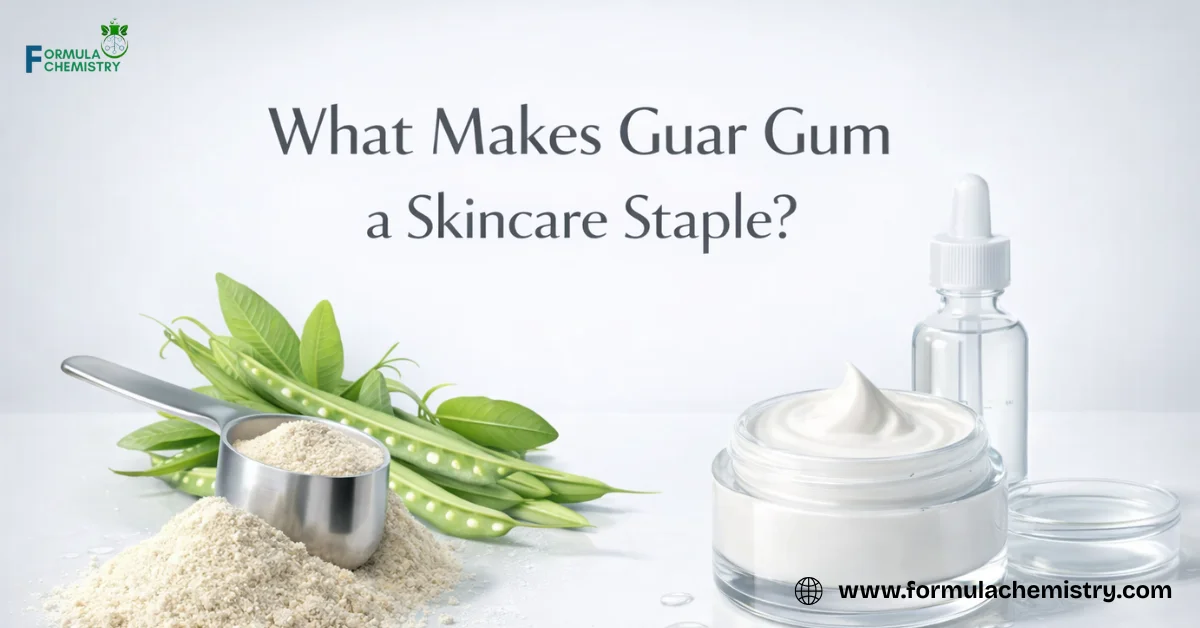
Guar Gum is structurally composed of galactomannans, which are high-molecular-weight polysaccharides. These long chains of sugars have an incredible capacity to bind and hold water. This property allows Guar Gum to act as a humectant, drawing moisture to the skin and keeping it hydrated long after application.
When dispersed in water, these polymer chains uncoil and overlap, creating a mesh-like network that traps water molecules. This physical mechanism is what builds viscosity in your toners and serums. Because it is derived from a legume, it offers a “green” alternative to carbomers and acrylates, appealing to the clean beauty market.
The Difference Between Standard and Cationic Guar
It is critical for formulators to distinguish between standard Guar Gum and Guar Hydroxypropyltrimonium Chloride (Cationic Guar). Standard Guar Gum is non-ionic and used primarily for thickening and stabilizing emulsions like lotions and creams. It provides a body and improves the spreadability of the product.
Cationic Guar, on the other hand, has been chemically modified to carry a positive charge. This makes it “substantive” to skin and hair, meaning it adheres to negatively negatively charged surfaces.
Sensory Benefits and Texture Enhancement
One of the main reasons formulators choose Guar Gum over Xanthan Gum is the texture. Xanthan Gum can sometimes leave a tacky or sticky residue on the skin, especially at higher concentrations. Guar Gum, conversely, feels slipperier and smoother, often reducing the “drag” of heavy creams.
This lubricity makes it a perfect option for shaving gels and intimate washes where slip is essential. In low-viscosity formulations like facial mists, a tiny amount (0.1% – 0.2%) adds a luxurious “cushion” to the water, making the product feel more premium than plain water without clogging the sprayer.
Unlock natural hydration with Sodium Alginate: Sea-Derived Secret for Hydration & Stability.
Formulating with Guar Gum: Best Practices
The biggest challenge with Guar Gum is its hydration profile. It is a “cold water soluble” gum, which seems convenient, but it means it swells instantly upon contact with water.
If you dump the powder directly into your water phase, the outer particles will hydrate immediately, forming a gel seal around dry powder clumps, creating “fish eyes.” To avoid this, experienced formulators use the slurry method.
This involves dispersing the gum in a non-solvent humectant like Glycerin, Propanediol, or a carrier oil before adding water. This separates the gum particles, allowing water to reach each one simultaneously when introduced, resulting in a smooth, lump-free gel.
Optimizing pH and Processing
While Guar Gum is stable over a wide pH range, its hydration rate is pH-dependent. It hydrates faster in acidic conditions and slower in alkaline ones.
Some grades of “easy-mix” Guar are surface-treated to delay hydration until the pH is lowered, permitting easier dispersion in neutral water. Once hydrated, Guar Gum can tolerate heat, rendering it suitable for the heated water phase of emulsions.
However, prolonged exposure to high shear or extreme heat (above 80°C) can degrade the polymer chains, leading to a permanent loss of viscosity. Add it early in the water phase and mix gently once fully hydrated.
Synergies with Other Rheology Modifiers
Guar Gum is rarely used alone in sophisticated formulations because it can exhibit “pseudoplastic” flow meaning it thins under stress but can be stringy when poured.
To counteract this stringiness, it is often paired with Xanthan Gum. The combination of Guar and Xanthan exhibits a synergistic effect, where the final viscosity is higher than the sum of the two individual parts.
A ratio of 80:20 (Xanthan: Guar) or 50:50 creates a stable, non-stringy gel with a pleasant texture. This blend is especially effective for suspending particles like exfoliant beads or micas in body washes.
Diagnosing Common Formulation Issues
Although it has benefits, Guar Gum can be tricky for beginners. The most frequent complaint is texture specifically, a slimy or “snotty” feel. This is almost always due to overdosing on the ingredient. Because it is so potent, less is often more.
Another common issue is microbial contamination. Natural polysaccharides are excellent food sources for bacteria and mold. If you are making a simple aqueous gel with Guar Gum, a strong preservative system is mandatory. Weak preservation will lead to liquefaction of the product as bacteria consume the gum matrix.
Common Problems and Fixes
- Problem: The gel has visible white lumps (“fish eyes”).
- Fix: You did not create a slurry. Disperse the gum in Glycerin (3 parts glycerin to 1 part gum) before adding water.
- Problem: The lotion feels stringy and slimy.
- Fix: Reduce the usage rate to 0.5% or less. Combine with a small amount of Xanthan Gum to cut the stringiness.
- Problem: The product separated or became watery after a few weeks.
- Fix: Check your preservative efficacy. Bacterial growth breaks down the gum. Alternatively, the pH may have drifted outside the stable range.
- Problem: The gum won’t hydrate fully; the solution is gritty.
- Fix: Ensure you are using high-shear mixing initially. Allow the batch to rest for 20-30 minutes to ensure full polymer uncoiling.
Guar Gum vs. Xanthan Gum: A Comparison
Choosing between these two natural giants depends on your specific goals. Use the table below to decide which is right for your formulation.
Table: Guar Gum vs. Xanthan Gum
| Feature | Guar Gum | Xanthan Gum |
| Source | Guar Bean (Legume) | Bacterial Fermentation |
| Texture | Smooth, slippery, can be stringy | Short flow, can be tacky |
| Clarity | Slightly hazy / translucent | Clear to hazy (grade dependent) |
| Hydration | Difficult (clump prone) | Easier (still needs care) |
| pH Stability | Moderate (pH 4-10) | Excellent (pH 2-12) |
| Best For | Conditioners, slippery gels, body wash | Serums, suspending particles, acids |
FAQ’s about Guar Gum: Natural Solution for Smooth & Hydrated Skin
Is Guar Gum safe for sensitive skin?
Yes, Guar Gum is generally considered safe and mild for all skin types, including sensitive skin. It is a large molecule that does not penetrate the skin barrier, reducing the chance of irritation. However, always patch test, as legume allergies can theoretically cross-react.
Is Guar Gum comedogenic?
No, Guar Gum is non-comedogenic. It does not clog pores or contribute to acne breakouts. Its main role is to thicken the water phase of a product, so it does not interact with the skin’s oil production or follicle structure.
Can I use Guar Gum in hair products?
Absolutely. In fact, Cationic Guar is a standard ingredient in shampoos and conditioners. Standard Guar Gum is also used in styling gels to provide hold and viscosity without flaking. It helps to smooth the hair cuticle and reduce static.
Is Guar Gum vegan and gluten-free?
Yes, Guar Gum is 100% plant-based and vegan. It is naturally gluten-free as it is derived from the guar bean, not wheat or grains. However, always check your specific supplier’s documentation to ensure no cross-contamination occurred during manufacturing.
Does Guar Gum need to be heated?
No, Guar Gum is cold-water soluble. You do not need to heat the water to hydrate it, although warm water can speed up the process. It can be added to the heated phase of emulsions, but avoid boiling it for extended periods to avoid deterioration.
How much Guar Gum should I use in a lotion?
For a standard lotion, a usage rate of 0.2% to 0.5% is usually sufficient to stabilize the emulsion and improve texture. Going above 1.0% is rarely necessary for emulsions and can result in an unpleasant, slimy texture.
Can Guar Gum replace emulsifying wax?
No. Guar Gum is a thickener and a stabilizer, but it is not an emulsifier. It cannot bind oil and water together on its own. You still need an emulsifier (like Polawax or Olivem 1000) to create a cream; the gum just stops it from separating.
Why did my Guar Gum gel turn into water?
This is typically a sign of microbial contamination. Bacteria produce enzymes that “eat” the polysaccharide chains, destroying the viscosity. Ensure you are using a broad-spectrum preservative for example Liquid Germall Plus or Phenoxyethanol/EHG within the correct pH range.