

Introduction
Most body butter failures happen before a single butter hits the beaker. The finished product is either too hard, too greasy, too soft at room temperature, or it separates into an oily mess within weeks.
The problem is almost never the ingredients it is the emollient ratio, the processing temperature, and the absence of a structured formulation approach.
A well-built body butter recipe is an exercise in anhydrous chemistry, and when you understand what each butter and oil contributes to the final texture and performance, you stop guessing and start formulating with precision.
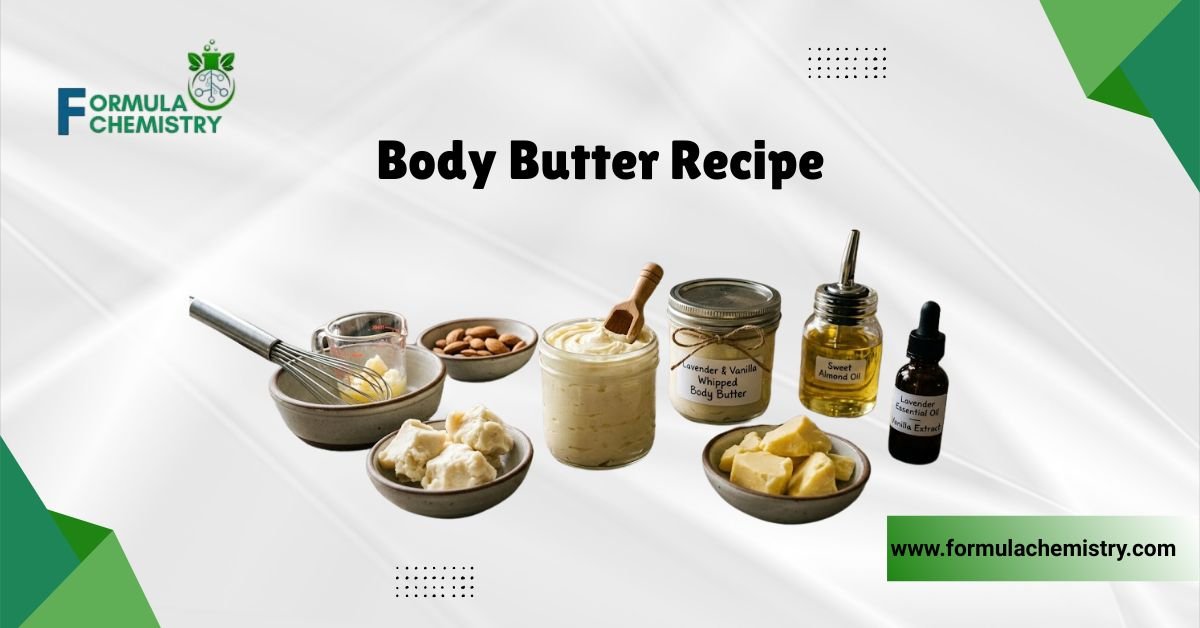
This article gives you a complete, bench-ready formula using shea, mango, and cocoa butter with the full ingredient breakdown, step-by-step method, and technical notes you need to make it work first time.
Formula Chemistry has built this guide for formulators who want to understand the science behind what they are making, not just follow a list of ingredients.
Why This Body Butter Recipe Works The Anhydrous Formula Science
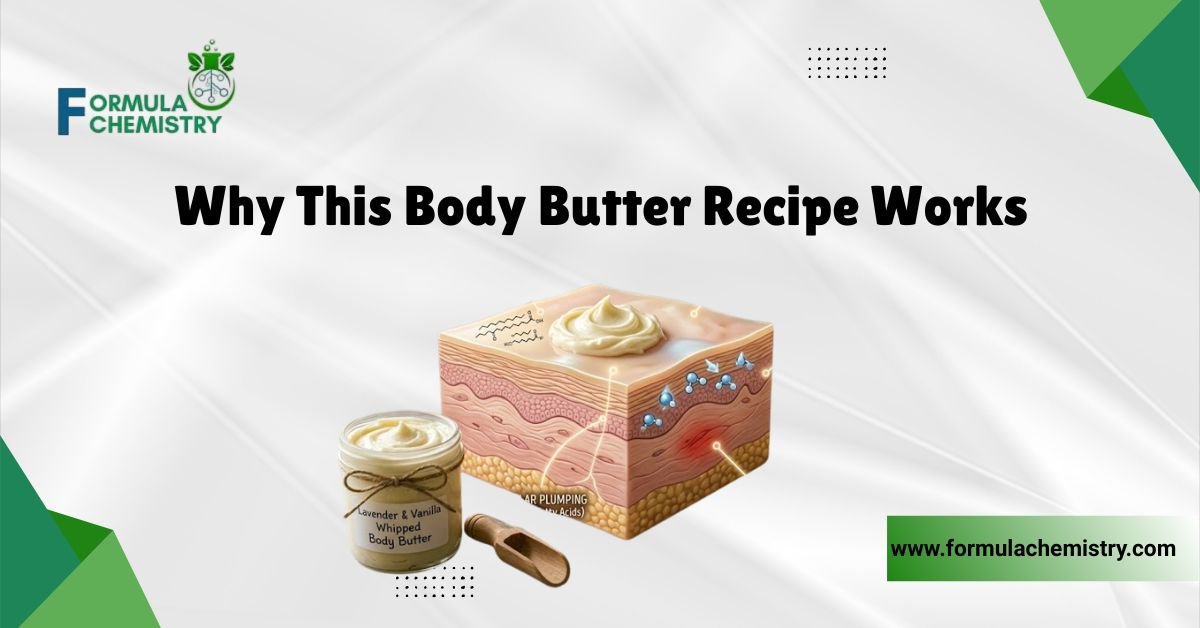
Anhydrous formulas are often described as simple, and in some ways they are. There is no emulsification to manage, no water activity to control, no pH to adjust.
What anhydrous formulation demands instead is a precise understanding of lipid chemistry specifically, how solid fats, semi-solid butters, and liquid oils interact to produce a finished texture that melts cleanly on skin without leaving a heavy residue.
The mistake most formulators make is over-relying on cocoa butter. Cocoa butter has a melting point of approximately 34–38°C, which sits just above skin temperature.
Used at high percentages it produces a body butter that feels hard in the jar, melts unevenly on application, and sits on the skin rather than absorbing.
Shea butter, with a melting point of 32–38°C and a higher unsaponifiable content, blends more readily and provides the skin-conditioning feel that cocoa butter alone cannot deliver.
Mango butter bridges the two. Its melting point of 34–38°C and its high stearic and oleic acid content make it a structuring butter that also contributes emolliency.
Together, the three butters create a stable semi-solid base that responds predictably to temperature, application pressure, and skin contact.
The liquid oil fraction in this formula, a combination of jojoba and squalane, controls the final skin feel and prevents the formula from feeling waxy after absorption.
The wax component, candelilla wax at low percentage, adds structural rigidity without the heaviness of a higher butter load.
Body Butter Ingredients Breakdown by Phase
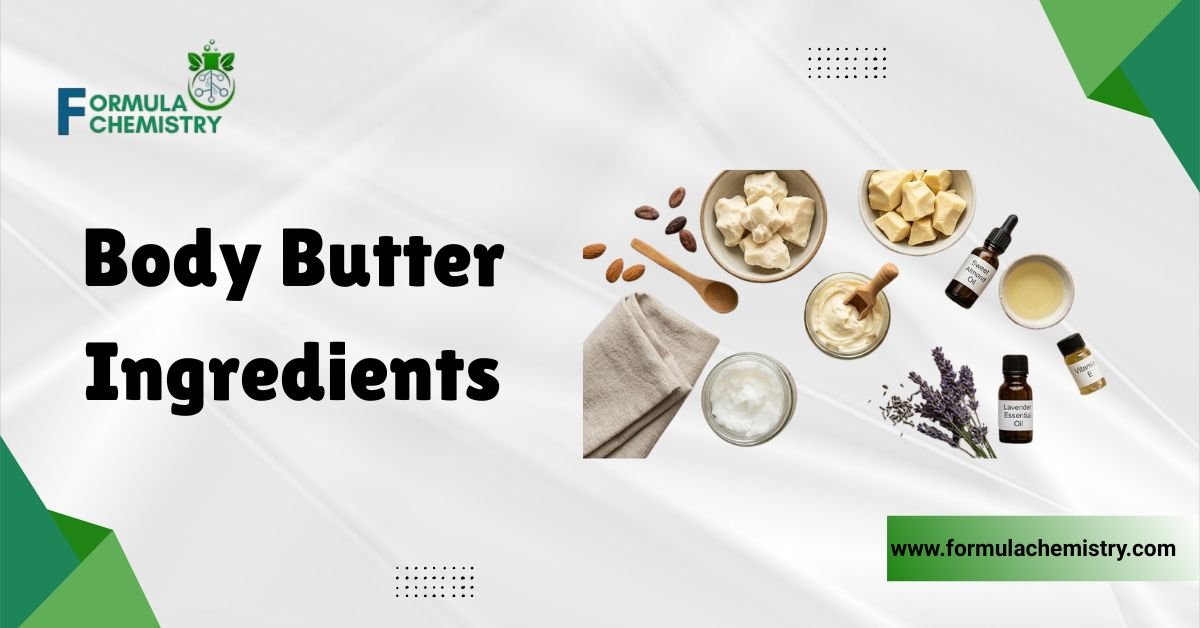
Every ingredient in this formula was chosen for a specific chemical reason. Understanding those reasons means you can substitute intelligently when a raw material is unavailable, rather than reaching for the nearest alternative and hoping the texture holds.
Oil Phase Butters and Structuring Fats
Butyrospermum Parkii (Shea) Butter is the primary emollient base of this formula. Its high unsaponifiable fraction typically 5–11%, unusually high for a plant fat contributes to the characteristic skin feel that makes sh
ea butter one of the most used ingredients in body care formulation.
It melts just below skin temperature and absorbs without the waxy drag that harder butters produce.
Mangifera Indica (Mango) Seed Butter provides structural integrity to the formula while contributing oleic and stearic acid fractions that condition the skin.
It is chosen over alternatives such as kokum butter because it produces a slightly softer set, which balances the rigidity cocoa butter brings to the formula.
Theobroma Cacao (Cocoa) Seed Butter is the hardest of the three butters and the primary structural component. It sets the baseline rigidity of the finished product.
The percentage is deliberately kept lower than shea to prevent the formula from becoming too firm or developing a grainy texture on cooling.
Oil Phase Liquid Emollients
Simmondsia Chinensis (Jojoba) Seed Oil is technically a liquid wax ester, not a triglyceride oil, which makes it exceptionally stable against oxidative rancidity.
It contributes a dry, non-greasy skin feel that offsets the richness of the butter base and extends the oxidative shelf life of the formula overall.
Squalane is a saturated hydrocarbon emollient derived from sugarcane or olive sources. It is colourless, odourless, and completely stable.
It spreads easily on skin, leaves no residue, and serves as the lightweight finishing element that prevents the formula from feeling heavy after the butters have melted in.
Oil Phase Structure and Stability
Candelilla Wax (Euphorbia Cerifera Cera) is a vegan wax with a melting point of 67–79°C. At 1–2% in an anhydrous formula it adds structural rigidity and raises the formula’s overall melting point, improving heat stability during shipping and storage.
It is chosen over beeswax for its vegan status and its harder, more brittle character which at low concentrations translates to a cleaner break on application.
Cool Down Phase Antioxidant and Fragrance System
Tocopherol (Vitamin E) at 0.5–1% functions as a chain-breaking antioxidant that interrupts lipid oxidation before rancidity develops.
It is not a preservative in the traditional sense; it does not prevent microbial growth but in an anhydrous formula where microbial risk is low, oxidative rancidity is the primary stability threat and tocopherol addresses it directly.
Fragrance or Essential Oil Blend is added at cool-down to prevent volatile aromatic compounds from evaporating during processing.
Usage level follows IFRA guidelines for rinse-off and leave-on body products. For essential oil blends, stay within dermal limits for each individual component.
Complete Body Butter Formula
| Phase | INCI Name | Common Name | % Weight |
| Oil Phase | Butyrospermum Parkii Butter | Shea Butter | 40.00 |
| Oil Phase | Mangifera Indica Seed Butter | Mango Butter | 20.00 |
| Oil Phase | Theobroma Cacao Seed Butter | Cocoa Butter | 15.00 |
| Oil Phase | Simmondsia Chinensis Seed Oil | Jojoba Oil | 12.00 |
| Oil Phase | Squalane | Squalane | 8.50 |
| Oil Phase | Euphorbia Cerifera Cera | Candelilla Wax | 1.50 |
| Cool Down | Tocopherol | Vitamin E | 0.50 |
| Cool Down | Fragrance / Essential Oil Blend | Fragrance | 1.00 |
| Cool Down | Rosmarinus Officinalis Leaf Extract | Rosemary CO₂ Extract | 0.50 |
| Total | 100.00 |
Batch size note: Multiply each percentage by your target batch weight in grams. For a 100g batch, percentages are equivalent to grams directly.
Step-by-Step Body Butter Method
- Sanitise all equipment beakers, spatulas, thermometer, and filling containers — with 70% isopropyl alcohol. Allow to air dry fully before use.
- Weigh all oil phase ingredients shea butter, mango butter, cocoa butter, candelilla wax, jojoba oil, and squalane into a heat-safe borosilicate glass or stainless steel beaker.
- Place the oil phase beaker into a water bath or on a hot plate set to low-medium heat. Melt all ingredients gently, stirring occasionally. Do not exceed 75°C.
- Once all butters and wax are fully melted and the mixture is clear and uniform, confirm temperature with a calibrated thermometer. Remove from heat when the batch reads 70–75°C.
- Allow the melted oil phase to cool at room temperature, stirring every few minutes to encourage even cooling. Do not refrigerate at this stage rapid chilling causes graininess and uneven crystal formation.
- When the temperature drops to 40–45°C and the mixture begins to turn opaque at the edges, add the cool-down phase: tocopherol, rosemary CO₂ extract, and fragrance or essential oil blend. Stir thoroughly to incorporate.
- Continue stirring as the formula cools. If a whipped texture is desired, begin hand or stand mixer whipping when the batch reaches 30–35°C and has begun to thicken but is not yet fully set.
- For a solid set body butter, pour into jars at approximately 40–42°C before the formula becomes too viscous to pour cleanly.
- Leave filled jars uncovered at room temperature until completely set typically 2–4 hours depending on ambient temperature. Cap only when fully cool to prevent condensation forming inside the lid.
- Label with full INCI list, batch number, date of manufacture, and use-by date based on your stability and oxidative shelf life assessment.
Technical Formulation Notes for This Body Butter Recipe
Anhydrous Formula Preservation and Antioxidant System
This formula contains no water and therefore presents no meaningful risk of bacterial or fungal growth. Traditional broad-spectrum preservatives phenoxyethanol, sodium benzoate, parabens are designed for aqueous environments and serve no preservative function in an anhydrous base.
The stability threat in this formula is oxidative rancidity the chemical degradation of unsaturated fatty acids triggered by oxygen, light, heat, and trace metal ions. Tocopherol at 0.5% addresses this as a primary antioxidant.
Rosemary CO₂ extract at 0.5% provides a secondary antioxidant contribution through its carnosic acid content and extends the effective oxidative shelf life of the formula.
Store finished product away from direct light and heat. Dark glass or aluminium jars outperform clear plastic packaging for oxidative stability.
Body Butter Consistency and pH Considerations
This is an anhydrous formula, so pH is not applicable. Consistency is governed entirely by the butter-to-liquid-oil ratio and the wax percentage. Increasing cocoa butter or candelilla wax produces a firmer set.
Increasing jojoba or squalane produces a softer, more fluid result. The formula as written is designed to be firm at 20°C and melt cleanly on skin contact at 32–34°C.
Substitutions and Alternatives for This Body Butter Formula
Shea butter can be partially substituted with kokum butter for a harder set or cupuacu butter for a softer, more emollient result to adjust cocoa butter percentage in response.
Jojoba oil can be replaced with meadowfoam seed oil at a 1:1 ratio for comparable oxidative stability. Squalane can be replaced with hemisqualane for a lighter, faster-absorbing dry-touch finish.
Candelilla wax can be replaced with carnauba wax at approximately half the percentage — carnauba is significantly harder and a 1:1 substitution will over-firm the formula. Beeswax is also suitable at 1.5–2% for non-vegan formulas.
Body Butter Scale-Up Notes
At larger batch sizes, heat distribution becomes uneven and cooling time extends significantly. Stir more frequently during cool-down at scale to prevent the outer edges of the batch setting before the centre has reached pour temperature.
For batches above 5kg, jacketed vessels with controlled cooling are recommended. Whipped variants become more difficult above 2kg without commercial mixing equipment.
Common Body Butter Formulation Mistakes and How to Fix Them
- Melting butters at too high a temperature: Excessive heat above 80°C degrades tocopherol and volatile antioxidants before they are even added. Melt at the lowest temperature required to fully liquefy all solids, confirmed by thermometer.
- Adding fragrance too early in the cool-down: Adding fragrance above 45°C causes volatile aromatic compounds to evaporate, producing a weaker scent in the finished product. Always add fragrance at 40–45°C or below.
- Cooling the formula too quickly: Placing the melted batch in a refrigerator or cold water bath causes beta-polymorphism in cocoa butter, producing a grainy, sandy texture that cannot be reversed without remelting. Cool at room temperature only.
- Over-whipping the formula: Incorporating too much air produces a light, fluffy texture initially but causes the product to collapse and weep oil over time. Whip until the texture is just thick and creamy, then stop.
- Using an incorrect antioxidant percentage: Tocopherol above 1% can become pro-oxidant under certain conditions, accelerating rancidity rather than preventing it. Stay within the 0.5–1% range confirmed by stability data.
- Skipping oxidative stability testing: Visual inspection does not detect early-stage rancidity. Conduct an accelerated oxidative stability test induction period testing or rancimat before finalising your formula for commercial use.
Body Butter Formula Variations and Customisation
- For a lighter summer texture: Reduce cocoa butter to 10% and increase squalane to 12%. This lowers the overall melting point and produces a formula that absorbs more quickly in warm weather.
- For a whipped body butter: Increase jojoba oil to 15% and reduce candelilla wax to 1%. Cool to 30–35°C and whip until the texture reaches a mousse-like consistency. Fill immediately into wide-mouth jars.
- For a fragrance-free sensitive skin version: Omit the fragrance component entirely and increase squalane by 1% to maintain the total at 100%. Rosemary CO₂ extract can also be replaced with additional tocopherol if any botanical sensitivity is a concern.
- For active ingredient addition: Bakuchiol at 0.5–1% can be added at cool-down as a retinol alternative suitable for anhydrous bases. Fat-soluble vitamins such as retinyl palmitate can be included at 0.1–0.5% with the cool-down phase.
- For a tinted body butter: Cosmetic-grade iron oxides or ultramarines dispersed in a small amount of jojoba oil can be incorporated at the cool-down stage. Disperse pigments thoroughly before addition to prevent streaking in the finished product.
Suitability Guide for This Body Butter Recipe
This formula is best suited to dry, very dry, and mature skin types that benefit from a rich occlusive emollient layer. It is suitable for body use on arms, legs, elbows, knees, and feet.
It is not recommended as a facial moisturiser for oily or acne-prone skin types due to the high comedogenic potential of cocoa butter at this percentage.
It is appropriate for all hair types as a targeted treatment for dry ends or scalp, used in small amounts. Beginners can make this formula successfully on their first attempt the anhydrous process removes the complexity of emulsification and pH adjustment, making it an excellent entry point into structured cosmetic formulation.
Always conduct a 48-hour patch test with any new formula before wider use.
| Ingredient | Function | Weight % | Amount (ml/g) |
|---|
FAQ’s about body butter recipe
What is the best butter ratio for body butter?
A starting ratio of 40% shea, 20% mango, and 15% cocoa gives a balanced texture that is firm in the jar but melts cleanly on skin contact. Adjust cocoa butter percentage to control firmness. Higher cocoa content produces a harder set; lower produces a softer, creamier result.
Does body butter need a preservative?
Anhydrous body butter contains no water, so bacterial and fungal growth is not a meaningful risk. What it does need is an antioxidant system tocopherol at 0.5–1% and rosemary CO₂ extract at 0.5% to prevent oxidative rancidity of the lipid phase over time.
Why does my body butter turn grainy?
Graininess is caused by rapid temperature fluctuation during cooling, which triggers unstable crystal formation in cocoa and shea butter. Always cool at room temperature and never refrigerate a freshly made batch. If graininess develops, remelt gently and re-cool slowly.
Can I use coconut oil instead of shea butter?
Coconut oil can replace part of the liquid oil fraction but not the shea butter base. Shea contributes a skin feel, emolliency, and structural character that coconut oil at equivalent percentages does not replicate.
Substituting shea directly with coconut oil at 40% produces a formula that is too fluid at room temperature
How long does homemade body butter last?
An anhydrous body butter with a proper antioxidant system typically has a shelf life of 12 months when stored away from heat and direct light.
The limiting factor is oxidative rancidity of the unsaturated oils, not microbial contamination. Rancidity presents as an off, crayon-like smell.
Can I add essential oils to this body butter recipe?
Yes, at cool-down when the batch temperature is below 45°C. Follow IFRA guidelines for maximum dermal use levels on leave-on body products.
Citrus essential oils require particular attention as many are phototoxic at certain concentrations when applied to skin exposed to sunlight.
Why is my body butter too soft after setting?
A body butter that is too soft has either too high a liquid oil fraction or too low a wax and hard butter content. Increase candelilla wax by 0.5% increments or raise the cocoa butter percentage by 3–5% and retest.
Ambient temperature also affects perceived firmness assess at a consistent room temperature of 20–22°C.
What oil gives body butter the best skin feel?
Squalane consistently delivers the cleanest after-feel in anhydrous butter formulas it is lightweight, non-greasy, and absorbs without residue.
Jojoba contributes a slightly drier finish. For a more luxurious skin feel, a blend of both at equal ratios, as used in this formula, produces the most balanced result.
Formulator’s Summary for body butter
- Anhydrous body butter requires an antioxidant system rather than a traditional preservative tocopherol and rosemary CO₂ extract address oxidative rancidity, which is the primary stability risk in lipid-only formulas
- The three-butter base of shea, mango, and cocoa creates a structured, stable semi-solid that melts cleanly at skin temperature when percentages are correctly balanced
- Candelilla wax at 1.5% raises the formula’s heat stability and sets the structural baseline without adding waxy drag to the skin feel
- Cooling rate is the single most controllable variable in body butter consistency always cool at room temperature and never refrigerate a freshly poured batch
- Liquid oil selection determines after-feel: squalane for a dry, clean finish, jojoba for a slightly richer dry-touch result, and a blend of both for the most balanced performance
- Oxidative stability testing before commercial launch is not optional visual and olfactory assessment does not detect early-stage rancidity reliably
Run an accelerated stability test at 40°C for four weeks on your first batch before scaling it is the fastest way to confirm your antioxidant system is performing as intended and your formula is ready for wider production.