
Introduction
Creating a custom skin resurfacing cleanser anti aging allows you to combine the purifying properties of a face wash with the rejuvenating benefits of chemical exfoliation. Unlike harsh physical scrubs, which can cause micro-tears, a well-formulated anti-aging cleanser uses acids to dissolve the “glue” holding dead skin cells together. This reveals a fresher, smoother complexion and prepares the skin to better absorb serums and moisturizers.
At Formula Chemistry, we focus on practical formulation education and safety-forward guidance. This guide focuses on creating a stable, effective wash-off product using Alpha Hydroxy Acids (AHAs). We will explore the necessary ingredients, pH requirements, and preservation tactics to ensure your creation is safe for use.
Quick Facts
- What it is: A water-based gel cleanser containing chemical exfoliants (AHAs/BHAs).
- Who it’s for: Mature skin, sun-damaged skin, or textures prone to dullness.
- Key Actives: Glycolic Acid, Lactic Acid, or Salicylic Acid.
- Typical Usage Range: 2% to 5% active acid concentration for wash-off products.
- pH Requirements: Must be formulated between pH 3.5 and 4.0 for efficacy without excessive irritation.
- Preservation: Mandatory. Water-based formulas grow bacteria rapidly without a broad-spectrum preservative.
- Safety Note: Acids increase sun sensitivity. Always apply SPF 30+ during the day when using resurfacing products.
- Common Mistake: Using surfactants that are unstable at low pH, leading to separation or hydrolysis.
- Compatibility: Avoid using simultaneously with retinol or high-strength Vitamin C to prevent barrier damage.
What Makes a Cleanser “Resurfacing”?
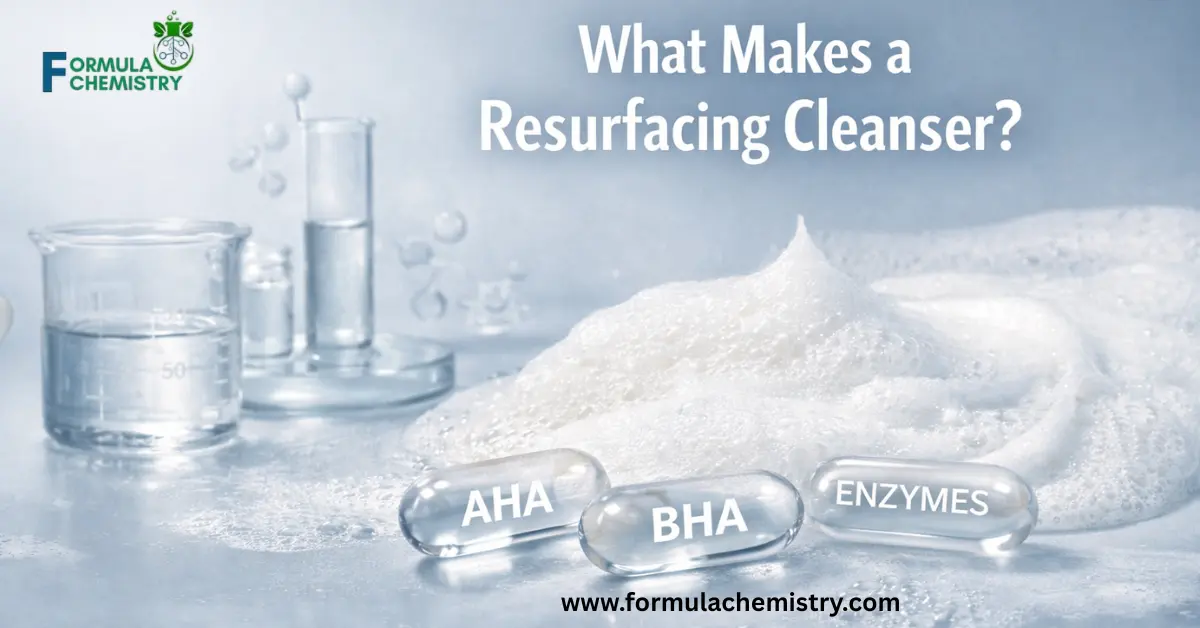
The Role of Chemical Exfoliants
A resurfacing cleanser differs from a standard face wash because it contains active keratolytic agents. These are ingredients that break down the outer layer of the skin. For anti-aging purposes, Alpha Hydroxy Acids (AHAs) are the gold standard. Glycolic Acid (derived from sugar cane) has a small molecular size, allowing it to penetrate quickly for immediate radiance. Lactic Acid (derived from milk) is larger and more hydrating, rendering it ideal for dry or mature skin types.
When formulated into a cleanser, these acids have limited contact time with the skin—usually 60 seconds or less. This reduces the chance of irritation compared to leave-on toners, making this format excellent for beginners. To be effective, the free acid value must be available, which dictates the strict pH requirements of the final product.
Choosing the Right Surfactants
Not all foaming agents can handle the acidic environment required for a resurfacing cleanser. Many traditional soaps are alkaline (pH 9-10) and will neutralize the acids, rendering them useless. Furthermore, some surfactants hydrolyze (break down) in acidic conditions, causing the formula to turn into a watery mess.
For a strong anti-aging cleanser, opt for non-ionic or amphoteric surfactants. Decyl Glucoside and Coco Glucoside are excellent non-ionic choices that remain stable at a low pH. Cocamidopropyl Betaine is a mild amphoteric surfactant that boosts foam and reduces the irritation potential of the acids. Avoid Sodium Lauryl Sulfate (SLS) in acid cleansers, as the combination can be too stripping for aging skin barriers.
Keep your skin fresh and balanced with Purifying Gel Cleanser, Deeply Calm and Balance Your Skin.
Formulating Your Anti-Aging Cleanser
Step-by-Step Recipe Guide
This recipe creates a 100g batch of a gentle, gel-textured Lactic Acid cleanser. We use Lactic Acid here for its humectant properties, which support skin hydration while exfoliating.
The Formula (Percentages = Grams for 100g batch):
- Phase A (Water Phase)
- Distilled Water: 68.5%
- Glycerin: 3.0% (Humectant)
- Xanthan Gum (Soft/Clear Grade): 1.0% (Thickener/Stabilizer)
- Phase B (Surfactant Phase)
- Decyl Glucoside: 15.0% (Primary mild surfactant)
- Cocamidopropyl Betaine: 8.0% (Secondary foam booster)
- Phase C (Active & Preservative)
- Lactic Acid (88% solution): 3.5% (Exfoliant)
- Liquid Germall Plus: 0.5% (Broad-spectrum preservative)
- Fragrance/Essential Oil (Optional): 0.5% (Solubilizer may be needed)
Instructions:
- Prepare Phase A: Weigh the Glycerin and Xanthan Gum into a beaker. Slurry them together to prevent clumps. Add the Distilled Water and mix vigorously until the gum is fully hydrated and a gel forms.
- Add Phase B: Slowly stir in the Decyl Glucoside and Cocamidopropyl Betaine. Stir gently to avoid creating excessive foam.
- Check pH: Measure the pH. It will likely be around 5.5–6.0 initially.
- Add Phase C: Add the Lactic Acid. Stir well.
- Final pH Adjustment: Measure the pH again. You are aiming for pH 3.6 to 3.8. If it is too low, use a 10% Sodium Hydroxide solution to raise it. If too high, add tiny amounts of Citric Acid.
- Preserve: Add the preservative once the temperature is below 40°C (104°F) and the pH is correct.
pH Adjusting and Preservation
The most critical step in the formulation remains the pH adjustment. If the pH is above 4.5, the acid loses its exfoliating ability and simply becomes a moisturizer. If the pH is below 3.5, it may cause stinging, redness, or chemical burns, especially near the eyes. Always use a calibrated digital pH meter rather than paper strips for acid formulations.
Preservation cannot be negotiated. This formula contains a high percentage of water and “bug food” (sugar-based surfactants). Liquid Germall Plus (Propylene Glycol, Diazolidinyl Urea, Iodopropynyl Butylcarbamate) is a strong choice for DIY beginners because it is effective across a wide pH range. Alternatively, Sodium Benzoate and Potassium Sorbate can be used, but they are strictly pH-dependent and lose efficacy above pH 5.0 (which is fine for this specific acidic formula).
Common Problems and Customizations
Troubleshooting Stability Issues
Formulating with acids often leads to viscosity issues. Many DIYers find that their cleanser turns water-thin after adding the acid. This happens because electrolytes (salts) and low pH are able to disrupt the micellar structure of surfactants that rely on salt thickening.
To prevent this, we rely on Xanthan Gum in the recipe above. The gum provides physical viscosity that is largely unaffected by the pH shift. If you prefer a clear gel without gum, you would need specialized liquid thickeners like PEG-150 Distearate or specific acrylate crossovers, which are more advanced. If your product separates over time, ensure your Xanthan Gum is fully hydrated before adding surfactants.
| Problem | Potential Cause | Suggested Fix |
| Product is too thin | Acid disrupted surfactant thickening. | Increase Xanthan Gum to 1.2% or use Hydroxyethylcellulose. |
| Product is cloudy | Incompatible essential oils or cold temperatures. | Use a solubilizer (like Polysorbate 20) for oils; warm gently. |
| Skin stinging | pH is too low or acid % too high. | Adjust pH to 3.8–4.0; reduce acid concentration. |
| Separation | Surfactant incompatibility with acid. | Switch to Glucoside surfactants (non-ionic). |
Adjusting for Sensitive Skin
If the standard recipe feels too active for sensitive or rosacea-prone skin, customization is easy. You can swap the Lactic Acid for Mandelic Acid. Mandelic Acid has a greater molecular weight, meaning it penetrates the skin more slowly and more evenly, lessening irritation risk.
Alternatively, you can lower the active surfactant matter (ASM) to create a gentler wash. Reduce the Decyl Glucoside to 10% and increase the water content. Adding soothing agents is also beneficial. Ingredients like Allantoin (0.5%), Panthenol (Vitamin B5), or Aloe Vera Juice (replacing some water) can help buffer the skin against the exfoliation process. Always patch test new variations on the inner arm before facial application.
| Ingredient | Function | Weight % | Amount (ml/g) |
|---|
⚠ Professional Lab Verification Required
- Water Percentage (q.s.): Distilled water is listed as a starting estimate. In a real laboratory batch, water is added q.s. (quantity sufficient) after all other ingredients are accurately weighed to bring the total to exactly 100%.
- pH Adjustment: Sodium hydroxide and citric acid percentages are formulation starting points only. Every real batch must be verified and corrected using a calibrated pH meter to hit the target pH range precisely.
- Preservation Efficacy: Preservative performance must be validated through Challenge Testing (PET) as per ISO 11930 before any commercial or consumer use of this formulation.
- Stability Testing: This formula requires accelerated stability testing at 4°C, 25°C, and 40°C over a minimum of 12 weeks to confirm physical, chemical, and microbiological stability before market release.
FAQ’s about Skin Resurfacing Cleanser Anti-Aging Cleanser Recipe
Can I use this cleanser every day?
It depends on your skin tolerance. Most dermatologists recommend using resurfacing cleansers 2 to 3 times per week initially. If your skin is resilient, you may work up to daily use, but watch for signs of over-exfoliation like tightness or shiny, “plastic” looking skin.
Do I really need a preservative if I use distilled water?
Yes, absolutely. Bacteria, mold, and yeast thrive in water. Distilled water is clean only the moment you open the bottle. Once you mix ingredients and expose the product to air and tools, contamination begins. A broad-spectrum preservative is required for safety.
Can I mix Glycolic Acid and Salicylic Acid in one cleanser?
Yes, this is common for acne-prone anti-aging formulas. However, it increases the irritation potential. A common blend is 2% Glycolic Acid (for surface exfoliation) and 0.5% Salicylic Acid (for deep pore cleaning). Ensure the pH remains between 3.5 and 4.0.
What happens if the pH is too high?
If the pH rises above 4.5 or 5.0, the “free acid” converts to its salt form (e.g., Sodium Lactate instead of Lactic Acid). It will still be a great moisturizing cleanser, but it will no longer exfoliate or provide resurfacing benefits.
Will this cleanser remove makeup effectively?
Acid cleansers are generally not designed as makeup removers. They are best used as a second cleanse. Remove makeup with an oil or balm first, then use the resurfacing cleanser to treat the skin and remove residue.
Is this safe to use during pregnancy?
Lactic Acid and Glycolic Acid are generally considered safe in low concentrations during pregnancy. However, Salicylic Acid (BHA) is often restricted or limited by doctors. Always consult your obstetrician before adding new active skincare products during pregnancy.
Can I add Vitamin C to this recipe?
It is not recommended for beginners. Vitamin C (L-Ascorbic Acid) is highly unstable and oxidizes quickly in water-based cleansers. It is better to use a separate Vitamin C serum after cleansing.
How long will this homemade cleanser last?
If prepared in a sanitized environment with fresh ingredients and the correct percentage of preservative, this cleanser should last 3 to 6 months. If you notice any changes in color, smell, or texture, discard it immediately.