
Introduction
The delicate skin surrounding the reversal eyes is significantly thinner than the rest of the face, making it the first area to show signs of chronological aging and environmental stress.
A Reversal Eye Complex Cream is a specialized cosmetic formulation designed to address the trifecta of periorbital concerns: dark circles, fine lines (crow’s feet), and puffiness.
Unlike standard facial moisturizers, these treatments are engineered with specific viscosity and molecular weights to ensure penetration without causing milia or irritation to the ocular mucosa.
Formulating an effective brightening eye treatment necessitates a thorough comprehension of active synergy. By combining retinoids, peptides, and antioxidants, formulators can create a product that encourages cellular turnover while strengthening the skin barrier.
At Formula Chemistry, we provide practical formulation education and safety-forward guidance to help you manage the challenges of high-performance skincare.
Quick Facts
- What it is: A targeted emulsion designed to brighten, firm, and hydrate the periorbital region.
- Who it’s for: Individuals experiencing hyperpigmentation, loss of elasticity, or fatigue-related eye bags.
- How to use: Apply a pea-sized amount to the orbital bone using the ring finger, tapping gently from the inner to outer corner.
- Typical Usage Range: Actives generally range from 0.5% to 5%, depending on the specific potency of the extract or derivative.
- pH Note: Aim for a final pH of 5.5 to 6.0 to maintain compatibility with the eye’s natural tear film and prevent stinging.
- Compatibility: Avoid mixing high-strength L-Ascorbic Acid with Retinol in the same phase to prevent instability.
- Common Mistakes: Applying too close to the lash line or using heavy occlusives that can migrate into the eye.
- Safety Note: Always perform a patch test on the inner arm before facial application, especially when using active lighteners.
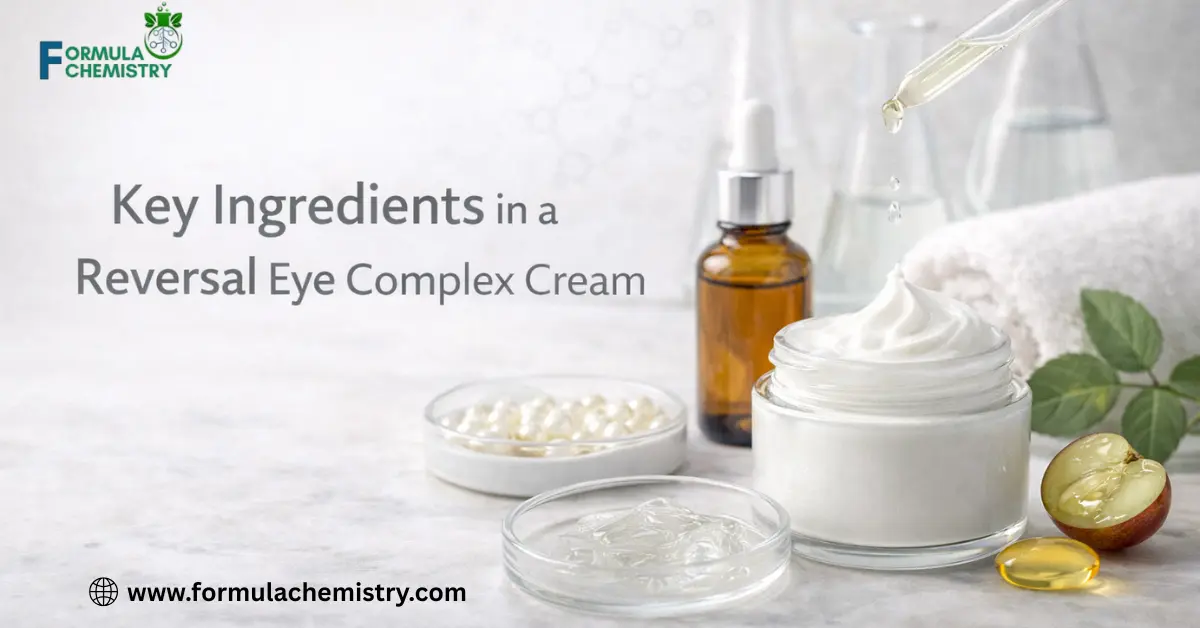
What are the Key Ingredients in a Reversal Eye Complex Cream?
The efficacy of a brightening eye treatment depends entirely on its “active load.” Because the eye area lacks sebaceous glands, the formula must provide lipids without being comedogenic.
The “reversal” aspect of the complex typically refers to the use of Vitamin A derivatives or bio-retinols that stimulate collagen synthesis to fill in hollow areas and smooth texture.
To combat the blue or purple undertones of dark circles, formulators often turn to Vitamin K or Palmitoyl Tetrapeptide-7.
These ingredients work by improving microcirculation and reducing the leakage of hemoglobin into the dermis. Furthermore, Caffeine is a staple for its vasoconstrictive properties, which temporarily reduce the appearance of fluid-filled bags.
The Role of Peptides and Retinoids
Peptides act as cellular messengers. In an eye complex, Argireline (Acetyl Hexapeptide-8) is frequently used at a 3% to 10% usage rate to mimic the effects of topical neurotoxins, relaxing the muscle contractions that lead to expression lines.
When paired with a stabilized Encapsulated Retinol, the formula provides long-term structural repair. Encapsulation is critical in eye treatments to ensure a slow release, minimizing the “retinoid flush” or peeling common in sensitive skin.
Brightening Agents and Antioxidants
Brightening is achieved through tyrosinase inhibitors and skin-brightening agents like Niacinamide (Vitamin B3) and Tetrahexyldecyl Ascorbate. Niacinamide, typically used at 2% to 5%, strengthens the ceramide barrier while fading yellow sallow tone.
For immediate visual correction, many complex creams include Mica or Titanium Dioxide to reflect light, providing an instant “awake” appearance while the biological actives work over time.

Formulating for Stability and Safety
Creating a Reversal Eye Complex Cream entails more than just mixing actives; it requires a stable emulsion system. Since eye creams often contain both oil-soluble vitamins (like Vitamin E) and water-soluble extracts (like Green Tea), a high-quality emulsifier is mandatory.
Using a Liquid Crystal Emulsifier can improve the delivery of actives by mimicking the skin’s natural lipid structure.
Safety is critical in periorbital formulation. Because the product is used near the eyes, the choice of preservatives must be made carefully.
Avoid high concentrations of Phenoxyethanol if possible, as it can be irritating to some users; instead, consider a combination of Caprylyl Glycol and Ethylhexylglycerin to ensure broad-spectrum protection without the sting.
Usage Rates and Compatibility Table
The following table outlines the recommended concentrations for common ingredients found in a professional-grade eye treatment.
| Ingredient Type | Common Example | Usage Range | Primary Function |
| Humectant | Hyaluronic Acid (Low MW) | 0.1% – 2.0% | Deep Hydration |
| Active | Caffeine (Anhydrous) | 0.5% – 1.0% | De-puffing |
| Vitamin | Niacinamide | 2.0% – 5.0% | Brightening |
| Peptide | Matrixyl 3000 | 3.0% – 8.0% | Collagen Support |
| Emollient | Squalane (Olive derived) | 2.0% – 10.0% | Barrier Repair |
| Preservative | Broad Spectrum Blend | 0.5% – 1.0% | Microbial Safety |
pH Optimization and Preservation
A Reversal Eye Complex Cream must be formulated at a pH of 5.0 to 6.0. If the pH is too acidic (below 4.5), the user will experience significant burning.
If it is too alkaline, the skin barrier may be compromised. Additionally, any formula containing water must be strictly preserved.
Contamination in an eye product can lead to serious ocular infections. Always use a calibrated pH meter and perform stability testing at various temperatures.
Common Problems and Fixes in Eye Cream Formulation
Even experienced formulators meet issues when creating highly active eye treatments. One common problem is pilling, where the product rolls off the skin in small flakes.
This is often caused by an excess of high-molecular-weight polymers or Hyaluronic Acid used at too high a percentage. Reducing these film-formers or switching to a cross-polymer version can solve the issue.
Another frequent complaint is milia small white bumps caused by trapped keratin. This occurs when the cream is too heavy or occlusive for the thin eye skin. To fix this, swap heavy waxes like Beeswax for lighter esters or Squalane to ensure the formula is “breathable” while still supplying necessary lipids.
Managing Irritation and Sensitivity
If users report redness, the culprit is often the Retinol concentration or the Fragrance. For the eye area, it is highly recommended to formulate fragrance-free products and avoid essential oils like peppermint or citrus.
If using Retinol, ensure the usage rate is between 0.01% and 0.05% for the eye area, which is significantly lower than standard face serums. [Internal link: understanding retinol percentages for sensitive skin → (insert appropriate FormulaChemistry URL)].
Addressing Stability and Separation
Active-heavy creams can sometimes undergo phase separation. This is particularly true if you are using high levels of electrolytes or botanical extracts. To prevent this, include a stabilizer like Xanthan Gum or Magnesium Aluminum Silicate at 0.2% to 0.5%.
These “thickeners” create a networked structure in the water phase that keeps the oil droplets suspended, ensuring a shelf-stable brightening eye treatment.
Best Practices for Application and Results
To get the most out of a Reversal Eye Complex Cream, the application technique is as important as the formula itself.
Because the skin here is so fragile, “rubbing” the product in can actually contribute to the formation of fine lines. Instead, users should utilize a “stippling” or “tapping” motion. This both prevents stretching the skin and also encourages lymphatic drainage, helping to move stagnant fluid that causes morning puffiness.
Consistency is the final key to success. Brightening actives like Vitamin C or Alpha Arbutin require 4 to 8 weeks of daily use to show a visible reduction in melanin production. Similarly, collagen-stimulating peptides require time to rebuild the dermal matrix.
Who Should Avoid Specific Actives?
While these creams are generally beneficial, certain populations should exercise caution:
- Pregnant/Nursing Women: Should generally avoid Retinoids and consult a physician regarding Salicylic Acid or certain chemical lighteners.
- Highly Reactive Skin: Individuals with eczema or rosacea should avoid high-strength L-Ascorbic Acid (Vitamin C) in the eye area.
- Post-Procedure: Do not apply active treatments immediately after chemical peels or microneedling around the eyes until the skin has fully re-epithelialized.
Storage and Shelf Life
A professional Reversal Eye Complex Cream should be stored in airless pumps or opaque tubes. Many of the best brightening ingredients, such as Retinol and Vitamin C, are highly sensitive to light and oxygen.
Exposure will lead to oxidation, turning the cream yellow or brown and rendering the actives ineffective. Remind users to keep the product in a cool, dark place and to discard it if the odor or color changes significantly.
FAQs about Reversal Eye Complex Cream Brightening Eye Treatment
Can I use this cream on my eyelids?
No, most treatments are designed for the orbital bone only. Applying the product to the eyelids can lead to it migrating into the eye, causing severe irritation or blurred vision.
How long does it take to see results for dark circles?
Visible brightening typically takes 4 to 6 weeks of regular morning and evening application, as this is consistent with the natural skin cell turnover cycle.
Is a reversal eye complex safe for sensitive skin?
Yes, provided it is fragrance-free and uses encapsulated or low-percentage actives. Always perform a patch test on a small area of the neck or inner arm first.
Can I layer this with my regular face moisturizer?
Yes. Apply the eye cream first to clean skin to ensure maximum absorption of the actives, then follow with your facial moisturizer, avoiding the immediate eye area.
Why does my eye cream sting when I apply it?
Stinging is often a sign of a disrupted skin barrier or a product pH that is too low. Discontinue use for a few days and reintroduce it slowly.
Does this product help with genetic dark circles?
While it can improve skin texture and brightness, topical creams cannot change genetics or deep-set bone structure (tear troughs).
Should I use this treatment in the morning or at night?
For best results, use it twice daily. If it contains Retinol, ensure you apply a broad-spectrum sunscreen during the day to protect the sensitized skin.
Can this cream cause milia?
Heavy, occlusive formulas can contribute to milia. This specific complex is formulated with non-comedogenic oils like Squalane to minimize that risk.