
Introduction
Scalp wellness is the basic pillar of hair longevity. A scalp-purifying shampoo is not simply a cleansing agent; it is a functional formulation designed to de-clog follicles, regulate sebum, and remove the stubborn biofilm created by styling polymers and environmental pollutants.
When the scalp environment is compromised by buildup, it can lead to micro-inflammation, which weakens the hair anchor and leads to thinning or dullness.
Through integrating specific surfactant systems and keratolytic agents, these shampoos restore the scalp to its optimal physiological state.
Formula Chemistry provides practical formulation education and safety-forward guidance to help you understand the science behind your self-care.
Transitions from standard cleansing to purification require a balance of detergency and barrier protection to ensure the hair stays resilient rather than stripped.
Quick Facts
- What it is: A specialized cleanser targeting sebum oxidation, product accumulation, and dead skin cells.
- Who it’s for: Individuals with oily scalps, heavy product users, or those experiencing dull, weighed-down hair.
- How to use: Massage into a wet scalp for 1–2 minutes to allow actives to penetrate before rinsing.
- Typical Usage Range: Use once weekly or bi-weekly, depending on scalp sensitivity and oil production.
- pH Range: Formulated at pH 4.5–5.5 to maintain the scalp’s acid mantle and keep hair cuticles flat.
- Compatibility: Works well with lightweight, silicone-free conditioners applied only to the mid-lengths and ends.
- Common Mistake: Applying the purifying formula to the dry ends of the hair, which can cause excessive dryness.
- Safety Note: Always perform a patch test on the inner arm to rule out sensitivity to high-concentrate surfactants or botanical extracts.
Discover the most effective solutions in Hair Loss Remedies 2026: What Really Works?
What defines a high-performance scalp-purifying shampoo?
A true purifying formula differs from a daily shampoo in its surfactant load and the inclusion of active exfoliants.
While standard shampoos use mild cleansers like Cocamidopropyl Betaine to remove surface dirt, a purifying version often utilizes Anionic surfactants such as Sodium C14-16 Olefin Sulfonate or Sodium Lauroyl Sarcosinate.
These provide the “lift” necessary to break down waxy sebum plugs that can lead to follicular occlusion.
Beyond cleansing, these formulas commonly incorporate Salicylic Acid (BHA) at concentrations of 0.5%–2.0%. Because BHA is oil-soluble, it can travel into the pore to dissolve debris.
This process is necessary for forming an environment where “stronger, healthier hair” can actually emerge. Without this deep cleaning, hair growth can be stunted by malassezia overgrowth or oxidative stress at the root.
The chemistry of sebum removal
The primary goal is the emulsification of non-polar lipids. Formulators must select surfactants that have a high Hydrophilic-Lipophilic Balance (HLB) to effectively grab onto oils and wash them away.
However, to prevent the hair from feeling “straw-like,” the inclusion of Polyquaternium-10 or other cationic polymers is vital. These provide a thin protective film that reduces friction during the washing process, guaranteeing the mechanical action of scrubbing doesn’t damage the hair cuticle.
Protecting the acid mantle and barrier
The scalp’s natural pH is slightly acidic. If a shampoo is too alkaline (above pH 7.0), the hair shaft swells, and the scalp becomes prone to bacterial infection and moisture loss.
A high-quality purifying shampoo is buffered with Citric Acid or Lactic Acid to keep the pH between 4.5 and 5.5.
This acidity makes certain that while the “trash” is removed, the scalp’s defensive barrier remains intact, preventing the “rebound oiliness” often seen with harsh, high-pH soaps.
Keep your hair strong and polished using Nourishing Hair Wax, Strengthen & Protect with Botanical Care.
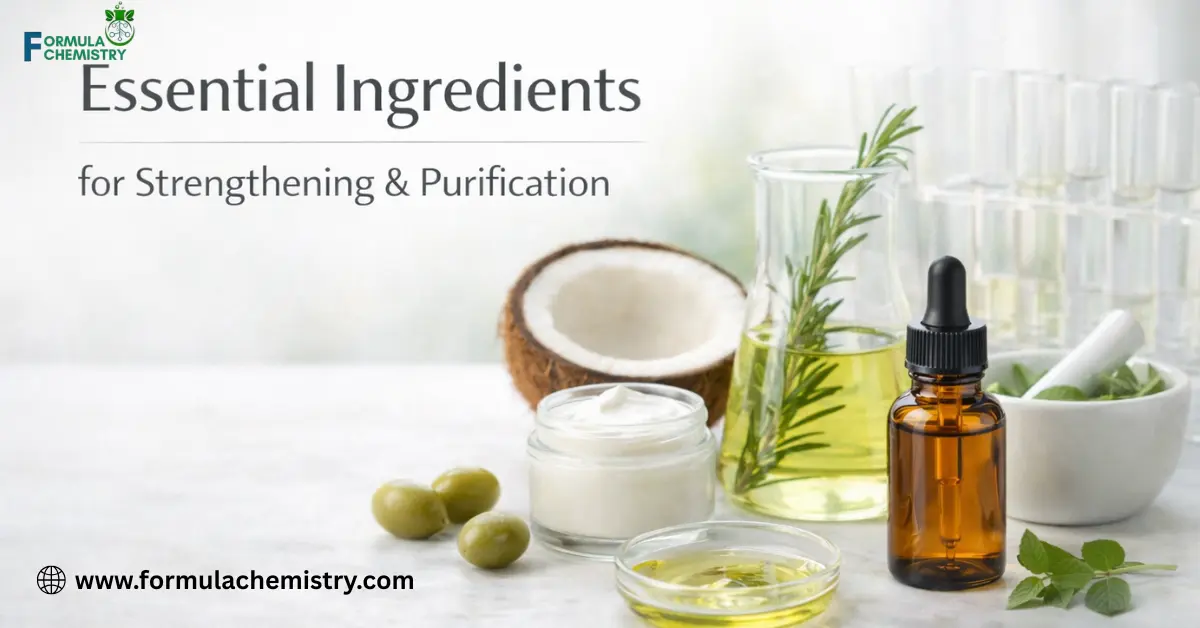
Essential ingredients for strengthening and purification
To achieve “stronger” hair, the formula must do more than just clean; it must reinforce the hair structure.
Hydrolyzed proteins (wheat, silk, or quinoa) are frequently added at 1.0%–3.0% to temporarily fill gaps in the damaged cuticle.
While the shampoo is a rinse-off product, these micro-proteins can provide a protective coating that survives the rinse, increasing the tensile strength of the hair fiber.
Chelating agents like Disodium EDTA or Sodium Phytate are also critical, especially for those in hard water areas.
These ingredients “grab” minerals like calcium and magnesium that otherwise deposit on the hair, making it brittle and prone to breakage. By removing these metallic ions, the purifying shampoo leaves the hair feeling significantly lighter and more responsive to subsequent treatments.
| Ingredient Category | Examples | Purpose | Usage Range |
| Primary Surfactant | Sodium Lauryl Methyl Isethionate | Deep cleansing/Foam | 10% – 15% |
| Chemical Exfoliant | Salicylic Acid | Pore de-clogging | 0.5% – 2.0% |
| Chelating Agent | Tetrasodium Glutamate Diacetate | Mineral removal | 0.1% – 0.5% |
| Humectant | Panthenol (Pro-Vitamin B5) | Moisture retention | 0.5% – 1.0% |
| Scalp Soother | Bisabolol / Allantoin | Reduce irritation | 0.1% – 0.2% |
Strengthening agents and film formers
For hair to be “healthier,” the internal disulfide bonds must be protected. Ingredients like Panthenol act as a humectant that penetrates the hair shaft to improve elasticity.
Additionally, Niacinamide is often included in professional scalp formulas to improve the skin’s barrier function and possibly increase blood flow to the follicle, supporting the biological processes of hair growth.
Botanical extracts and essential oils
Although often marketed for scent, extracts like Tea Tree Oil, Peppermint, and Rosemary fulfill functional roles. Tea Tree provides antimicrobial properties, which are helpful for those prone to dandruff.
Peppermint provides a cooling feeling that can soothe itchy scalps, though it should be used sparingly (below 1.0%) to avoid potential contact dermatitis or sensitization.
Common problems and how to fix them
When switching to a scalp-purifying shampoo, users often encounter specific issues related to the transition from “product-heavy” hair to “clean” hair. One common complaint is increased tangling. Because the shampoo is removing the heavy silicones that usually provide “slip,” the hair may feel different during the wash.
The fix is to ensure the use of a pH-balanced rinse or a lightweight conditioner specifically on the ends to restore manageability without re-clogging the scalp.
Another issue is scalp dryness or flaking shortly after use. This usually occurs if the product is used too frequently or if the preservative system (such as Phenoxyethanol or Methylisothiazolinone) causes a mild reaction.
If dryness occurs, reduce usage to once every ten days and ensure you are not using water that is too hot, which further strips the sebaceous lipids.
Identifying “Rebound Oiliness”
If your scalp feels greasier the day after using a purifying shampoo, you may be over-stripping. This triggers the sebaceous glands to overcompensate.
To fix this, look for a “Gentle Purifying” formula that includes soothing agents such as Aloe Vera or Colloidal Oatmeal to signal to the skin that it is protected, preventing the emergency oil production.
Managing color fade
Purifying shampoos can be aggressive on color-treated hair. The high detergency can lift the cuticle and allow pigment molecules to escape.
To reduce this, look for “sulfate-free” purifying options and always follow up with a UV-protectant or an acidic sealer to close the cuticle immediately after the deep clean.
Formulation and safety issues for home and lab
Any water-based shampoo must be adequately preserved to prevent the growth of mold, yeast, and bacteria.
In a purifying formula, where the user may be leaving the bottle in a damp shower for weeks, the preservative system (like Ethylhexylglycerin combined with Phenoxyethanol) is mandatory. Contaminated products can lead to scalp infections, which directly counteract the goal of “healthier hair.”
Furthermore, if you are incorporating alpha-hydroxy acids (AHAs) like Glycolic Acid into your routine, remember that these increase photosensitivity.
While the scalp is often covered by hair, thinning areas or parts are at risk of sunburn. Always rinse thoroughly and consider the cumulative effect of using multiple “active” hair products simultaneously to avoid chemical sensitization.
Who should avoid purifying shampoos?
Those with extremely dry, brittle hair or ailments such as psoriasis and eczema should consult a professional before using high-surfactant purifying formulas.
In these cases, the skin barrier is already compromised, and intense purification can lead to fissures or increased inflammation. If you have recently had a chemical perm or keratin treatment, avoid purifying shampoos for at least two weeks, as they can strip the treatment from the hair.
| Ingredient | Function | Weight % | Amount (ml/g) |
|---|
⚠ Professional Lab Verification Required
- Water Percentage (q.s.): Distilled water is listed as a starting estimate. In a real laboratory batch, water is added q.s. (quantity sufficient) after all other ingredients are accurately weighed to bring the total to exactly 100%.
- pH Adjustment: Citric acid percentage is a formulation starting point only. Every real batch must be verified and corrected using a calibrated pH meter to hit the target pH range precisely. Shampoo pH must stay between 4.5-5.5 to maintain hair cuticle integrity and scalp health.
- Viscosity Building: Sodium Chloride is the primary viscosity builder for this surfactant system. Final salt concentration must be tested and adjusted at lab scale to achieve target viscosity without destabilizing the foam profile.
- Preservation Efficacy: Preservative performance must be validated through Challenge Testing (PET) as per ISO 11930 before any commercial or consumer use of this formulation.
- Stability Testing: This formula requires accelerated stability testing at 4°C, 25°C, and 40°C over a minimum of 12 weeks to confirm physical, chemical, and microbiological stability before market release.
The importance of the patch test
Regardless of the brand or price point, a patch test is a key safety step. Apply a small amount of the diluted shampoo to the inside of your elbow and wait 24 hours. If redness, itching, or burning occurs, the surfactant concentration or a specific fragrance/essential oil may be too high for your skin type.
Boost your hair and skin’s resilience with Hydrolyzed Wheat Protein: Strength for Hair & Skin.
FAQs about Shampoo: Scalp-purifying Shampoo For Stronger, Healthier Hair
How often should I use a scalp-purifying shampoo?
For most hair types, once a week is sufficient. If you use heavy styling products or have a very oily scalp, you may increase this to twice weekly. Overuse can lead to barrier disruption and dry hair.
Can I use a purifying shampoo on color-treated hair?
Yes, but with caution. Frequent use can cause color leaching. Use a formula labeled “color-safe” and limit use to once every 10–14 days to maintain vibrancy while still cleaning the scalp.
Is a purifying shampoo the same as a clarifying shampoo?
They are very similar. “Clarifying” usually focuses on the hair strand (removing minerals and silicones), while “Purifying” often includes actives for scalp wellness (like BHAs or antimicrobials).
Will this help with hair growth?
Indirectly, yes. By removing follicular debris and reducing inflammation, you create an optimal environment for the follicle to function, which supports the growth of stronger, healthier hair.
Does it help with dandruff?
If your dandruff is caused by oily buildup or mild fungal activity, a purifying shampoo with Zinc Pyrithione or Salicylic Acid can be very effective at managing flakes.
Should I double-wash with a purifying shampoo?
Usually, no. One thorough wash where the product is massaged into the scalp for 60–90 seconds is enough. Double-washing with a high-strength formula may be too stripping.
Can I skip conditioner after using this?
No. Purifying shampoos open the hair cuticle to clean. You must use a conditioner or a low-pH rinse to seal the cuticle back down, stopping moisture loss and tangles.
Why does my scalp tingle when using it?
Tingling is usually caused by menthol or peppermint oil. While refreshing, if the tingle turns into a burning sensation, rinse immediately, as this indicates irritation or an allergic reaction.