
Introduction
Removing long-wear makeup and waterproof sunscreen regularly feels like a battle that leaves your skin red and sore from scrubbing. Traditional soaps simply cannot break down these stubborn, oil-based substances effectively without damaging the skin barrier.
The solution lies in a PreCleanser Cleansing Oil, the first step of the celebrated double-cleansing method. This product melts away lipophilic debris effortlessly, turning a chore into a luxurious ritual.
By applying the principles of formula chemistry, we can create or choose a cleansing oil that purifies deep within the pores while leaving the skin’s moisture barrier intact and resilient.
What Is a PreCleanser Cleansing Oil?
A PreCleanser is an anhydrous (water-free) formula designed specifically to solubilize oil-based impurities on the skin’s surface before you wash with a traditional cleanser.
The First Step of Double Cleansing
In the hierarchy of skincare, this product is the heavy lifter.
It is applied to dry skin where it binds to sebum, silicone-based makeup, and SPF. Unlike a water-based face wash, a PreCleanser does not rely on foaming agents but on the solvency power of lipids.
Emulsification Technology
The defining characteristic of a modern PreCleanser is its ability to rinse off with water.
It contains a specialized surfactant known as an emulsifier. When water touches the oil, this chemical formula transforms the clear liquid into a milky white emulsion, lifting the dissolved dirt away from the skin without leaving a greasy residue.
The Chemistry Formula of “Like Dissolves Like”
To understand why oil cleansers are superior for deep purification, we must look at the fundamental rules of solubility.
Polarity and Solubility
Water is a polar molecule; oil is non-polar. They do not mix naturally.
Most makeup and skin oils are non-polar. According to the principle “like dissolves like,” you need a non-polar solvent (oil) to dissolve non-polar dirt. A water-based cleanser often just pushes these oils around the face rather than dissolving them.
Protecting the Acid Mantle
Harsh detergents strip the skin by chemically attacking the proteins in the stratum corneum.
An oil cleanser works via solvation, not denaturation. This means the formula chemistry removes the “bad” oils (oxidized sebum and makeup) while conditioning the “good” oils (intercellular lipids), sustaining the integrity of the acid mantle.
Key Ingredients in Formula Chemistry Skincare
A high-performance PreCleanser relies on a specific balance of carrier oils and emulsifying agents to function correctly.
Carrier Oils (The Solvent)
These make up the bulk of the formula (80-90%).
They act as the vehicle that softens the skin and dissolves debris. Typical selections include Sunflower Oil, Rice Bran Oil, and Caprylic/Capric Triglyceride (fractionated coconut oil) because they are lightweight and resistant to oxidation.
The Emulsifier (The Rinser)
This ingredient connects the gap between the oil on your face and the water in your tap.
Common emulsifiers in Formula Chemistry skincare include Polysorbate 80, PEG-40 Sorbitan Peroleate, or Cromollient SCE. Without this ingredient, you are just putting kitchen oil on your face, which requires a hot cloth and friction to remove.
Vitamin E (The Preservative)
Since oils can go rancid, antioxidants are important.
Tocopherol (Vitamin E) is added to protect the unsaturated fatty acids in the carrier oils from breaking down. This ensures the chemical formula remains stable and beneficial for the skin over months of use.
Why Regular Kitchen Oil Is Not a Pre-Cleanser
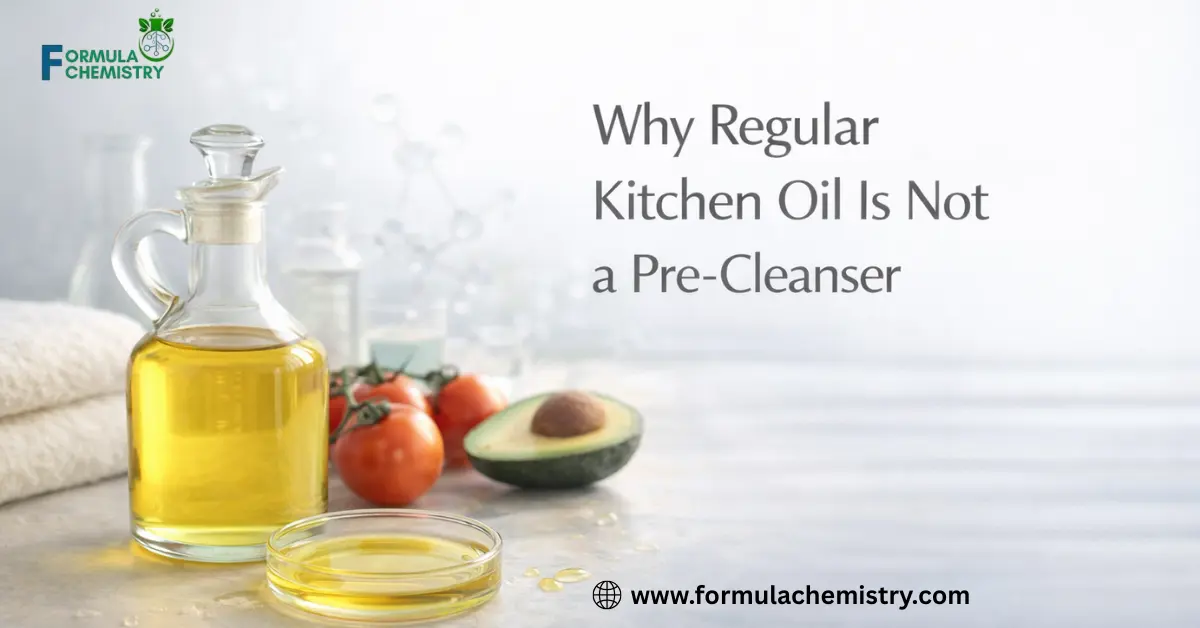
Many home hobbyists try to use plain Coconut or Olive oil, but this often leads to congestion and displeasure.
The Lack of Rinsability
Plain oil is hydrophobic; it repels water.
When you try to wash plain oil off your face, it forms a barrier. You end up having to scrub with a washcloth to remove it. The friction defeats the purpose of a gentle cleanse and can force dirt deeper into the pores.
Comedogenic Risks
Many kitchen oils are heavy and comedogenic (pore-clogging).
A formulated PreCleanser uses refined, cosmetic-grade oils selected for their low molecular weight. In formula chemistry, we specifically choose lipids that provide “slip” without suffocating the follicle.
Formula Chemistry DIY: The Ultimate Cleansing Oil
Creating your own PreCleanser is one of the easiest and most fulfilling projects for a budding cosmetic chemist.
The 90/10 Rule
A standard, effective ratio for a rinse-off oil is 90% Carrier Oil to 10% Emulsifier.
This provides enough oil to dissolve makeup and enough surfactant to rinse clean. You can adjust this ratio slightly depending on how dry or oily your skin feels.
The Recipe
- Base Oil: 60% Sunflower Oil (High linoleic acid, good for all skin types).
- Texturizer: 29% Caprylic/Capric Triglyceride (Lightweight, non-greasy feel).
- Emulsifier: 10% Cromollient SCE or Polysorbate 80.
- Antioxidant: 1% Vitamin E Oil.
- Method: Simply weigh all ingredients into a bottle and shake. The chemistry formula is instantly stable and ready to use.
Customizing Oils for Your Skin Type
The beauty of Formula Chemistry DIY is the capacity to tailor the lipid profile to match your specific biological needs.
For Oily and Acne-Prone Skin
You need oils high in Linoleic Acid.
This fatty acid helps fluidize sebum, avoiding blockages. Hemp Seed Oil, Grapeseed Oil, and Safflower Oil are excellent choices. They feel “dry” on the skin and help balance the composition of your natural oils.
For Dry and Mature Skin
You need oils high in Oleic Acid.
These oils are richer and heavier. Avocado Oil, Apricot Kernel Oil, and Olive Oil provide deep nourishment. They linger slightly longer on the surface during the massage, softening rough patches and conditioning dry flakes.
The Mechanics of Deep Pore Decongestion
Using a PreCleanser is not only about makeup removal; it is a therapeutic technique for clearing “plugs” from the pores.
The Oil Massage
Massaging the oil into the skin warms the product and the sebum in your pores.
Heat reduces the viscosity of the waxy plugs (blackheads). The “like dissolves like” action of the formula chemistry softens the hardened edges of the plug, allowing it to dislodge gently without extraction tools.
Grit Removal
With consistent oil cleansing, you may feel small, grainy granules beneath your fingers.
These “grits” are dislodged keratin and sebum plugs coming out of the follicle. This is the ultimate sign that your PreCleanser is functioning effectively as a deep purification treatment.
Benefits Beyond Cleaning: Lipid Barrier Support
While the primary goal is removal, the secondary benefit of a PreCleanser is the deposition of conditioning agents.
Preventing TEWL
Transepidermal Water Loss accelerates when the skin is stripped.
Even though the oil rinses off, a trace amount of emollient remains. This micro-layer acts as a temporary seal, stopping water from evaporating from the skin surface while you prepare for your second cleanse.
Softening the Stratum Corneum
Oil softens keratin.
A rigid, dry stratum corneum is prone to cracking and irritation. By saturating this layer with lipids during the cleanse, the PreCleanser retains the flexibility and softness of the skin, essential for a healthy Formula Chemistry skincare glow.
Preservation and Safety in Anhydrous Formulas
Because there is no water in a cleansing oil, bacterial growth is less of a risk, but other stability issues arise.
Water Contamination
The biggest risk to a PreCleanser is introducing water into the bottle.
If water gets in, bacteria can grow. Always use a pump dispenser to prevent shower water from entering the container. In Formula Chemistry DIY, making sure your packaging is completely dry before filling is a key safety step.
Oxidation Management
Vegetable oils oxidize over time, leading to a rancid smell and free radical generation.
Store your oil in a cool, dark place. Using stable esters like Fractionated Coconut Oil extends the shelf life significantly compared to using unstable oils like Evening Primrose or Hemp, which should be refrigerated.
Troubleshooting Your Cleansing Oil
If your PreCleanser isn’t performing as expected, it usually comes down to application error or formulation imbalance.
Blurry Vision
If your vision gets cloudy after use, the oil is getting into your eyes.
This isn’t dangerous but is annoying. It happens if the oil is too thin (migrates easily) or applied too heavily. Use less product around the orbital bone and keep eyes tightly closed during the rinse.
Breakouts After Use
If you break out, the oil isn’t rinsing off completely.
This means the chemical formula needs more emulsifier In a DIY scenario, increase the emulsifier percentage from 10% to 15%. Alternatively, ensure you are following with a water-based cleanser to remove any residue.
Conclusion
The PreCleanser Cleansing Oil is a foundation of modern skin hygiene, connecting heavy makeup removal and delicate barrier care.
By utilizing the scientific principles of solubility and emulsification, this product offers a deep, purifying cleanse that scrubbing simply cannot duplicate.
Whether you rely on a high-end commercial blend or craft your own Formula Chemistry DIY masterpiece, incorporating this step is the fastest route to softer, clearer, and more balanced skin.
FAQ’s about PreCleanser Cleansing Oil: Deeply Purifying Oil Cleanser
Do I need to use a PreCleanser if I don’t wear makeup?
Yes, absolutely. A PreCleanser is excellent for removing sunscreen, which is designed to stick to the skin and repel water. It also dissolves excess sebum and environmental pollutants (like car exhaust) that are oil-soluble and won’t wash off easily with a standard water-based gel.
Can oil cleansing cause acne?
It shouldn’t, provided you use the right oils and rinse thoroughly. If a product uses highly comedogenic oils (like Coconut Oil or Wheatgerm Oil) and isn’t washed off completely, it may clog pores. However, a properly formulated rinsing oil with high linoleic acid is actually beneficial for clearing acne congestion.
What is the best emulsifier for a DIY cleansing oil?
Polysorbate 80 is the most accessible and effective choice for beginners. It is a non-ionic surfactant that works well with heavy vegetable oils. Cromollient SCE (Di-PPG-2 Myreth-10 Adipate) is a premium option that feels silky and is very gentle on sensitive skin.
How long should I massage the oil into my skin?
Aim for 60 seconds. This gives the chemistry formula enough time to interact with the makeup and sebum, breaking down the structures effectively. Massaging for too long (over 5 minutes) can be irritating, while under 30 seconds may not fully dissolve stubborn mascara.
Can I use baby oil as a pre-cleanser?
Baby oil is mineral oil with fragrance. While mineral oil is non-comedogenic and dissolves makeup well, baby oil lacks an emulsifier. It will not rinse off with water, forcing you to use a hot cloth to remove it, which can damage the skin barrier.
Should I use the oil on wet or dry skin?
Always apply to dry skin. If your skin is wet, the water creates a barrier that prevents the oil from touching the oil-based dirt on your face. The oil needs direct contact with the sebum and makeup to dissolve them according to the laws of formula chemistry.
Does Vitamin E act as a preservative in my oil?
No, Vitamin E is an antioxidant, not a preservative. It prevents the oils from going rancid (oxidizing), but it does not kill bacteria or mold. However, since cleansing oils are anhydrous (water-free), bacterial growth is unlikely unless water is introduced into the bottle.
Why does my cleansing oil turn white when I add water?
This is the “bloom” or emulsification process. The emulsifier in the formula reduces the surface tension between the oil and the water, producing a temporary emulsion (milk). This physical change allows the water to grab the oil and wash it down the drain.